
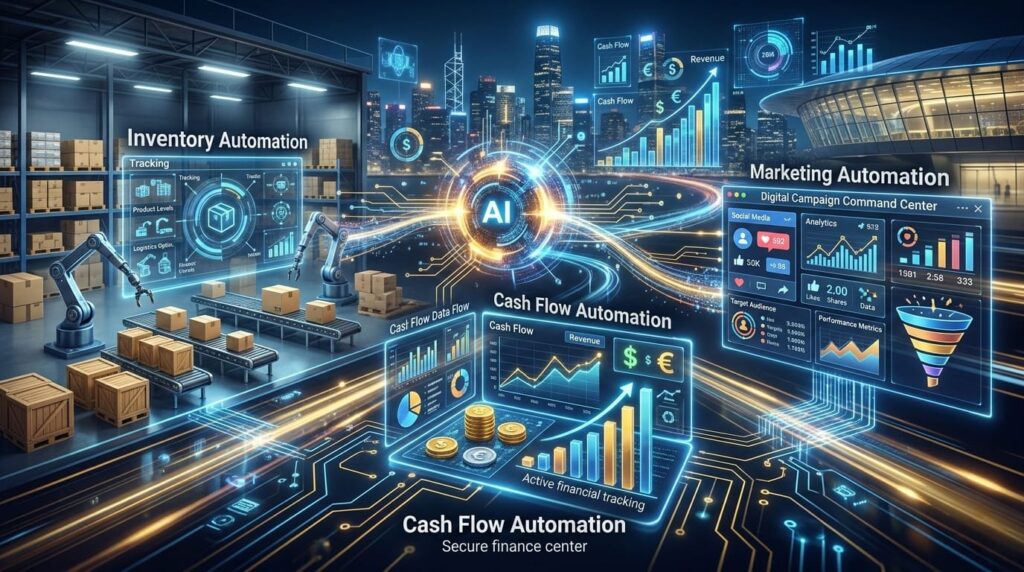
Artificial Intelligence (AI) is no longer just a buzzword. Over the past few years, a specific class of AI tools called “AI agents”: autonomous digital assistants capable of performing tasks and making decisions on your behalf — has shifted from research lab concepts to business realities. Powered by large language models and automation frameworks, these AI agents are rapidly reshaping how companies operate, from inventory control to marketing, customer service, and financial management.
In this article, I’ll explain what AI agents are, how they work, and how a small or medium‑sized e‑commerce entrepreneur can introduce them into daily operations. We’ll explore both paid and free options, practical implementation, common barriers to adoption, and why many businesses haven’t fully embraced these tools yet.
What Exactly Are AI Agents?
At their core, AI agents are autonomous software programs that can interpret goals given in natural language, plan a strategy to achieve those goals, and execute tasks across multiple systems without continuous supervision. They go beyond the typical chatbot. Instead of merely responding to queries, they orchestrate actions using APIs, databases, and business systems to complete real‑world objectives.
Think of an AI agent as a virtual employee who:
- Understands your instructions expressed in natural language.
- Breaks them down into sub‑tasks.
- Interacts with your systems: inventories, CRMs, accounting software, social media platforms, to get things done.
For example, a typical agent can reorder stock when inventory runs low or schedule marketing posts across multiple platforms automatically.
A simple analogy is thinking of an AI agent like J.A.R.V.I.S. in the Iron Man series, not just a source of information, but a digital worker that takes actions to complete objectives. �
How AI Agents Work?
AI agents combine several technologies:
- A language model (the brain) such as those from OpenAI, Anthropic, Meta, or Google, which interprets natural language goals and makes planning decisions.
- Tool integrations, such as APIs for inventory systems, CRM platforms, accounting software, and social media dashboards, that enable agents to perform tasks on your systems.
- Memory and context systems that allow agents to remember past interactions and improve recommendations over time.
- Feedback loops that help the agent refine its outputs and act more accurately.
When a user tells an AI agent what they want to accomplish, the agent analyzes the request, decomposes it into stepwise tasks, interacts with external systems as needed, and proceeds autonomously until the goal is complete.

AI Agents in Action: A Daily Example for an E‑Commerce Business Owner
Let’s bring this to life through a concrete example:
Alex, an online store owner selling electronics and accessories, runs a small e‑commerce business. Alex’s goals include:
- Keeping inventory at optimal levels.
- Managing cash flow.
- Publishing social media posts regularly.
- Engaging with customer inquiries on multiple channels.
Here’s how AI agents can help him.
1. Inventory Management
Traditional inventory management can be tedious: you review stock levels daily, calculate reorder points, contact suppliers, and manually place purchase orders. An AI agent can automate the entire sequence.
How It Works
The AI agent continuously monitors your store’s inventory data through the e‑commerce backend. such as Shopify, WooCommerce, or Magento.
When a specific product falls below threshold levels, the agent forecasts demand based on historical sales patterns, seasonality, and trends. It can generate purchase orders and automatically send them to suppliers at predetermined reorder points. If necessary, it can even renegotiate with suppliers for better prices or delivery terms.
From research published in supply chain modeling, autonomous AI agents that monitor inventory and initiate purchase orders can significantly reduce stockouts, lower holding costs, and improve product mix turnover compared to traditional methods.
Tools You Could Use
Custom agents integrated with your ERP or inventory management system using platforms like Copilot Studio, MetaGPT, or even open‑source agents such as OpenClaw.
There are free and paid AI agent solutions:
- Free options: Development frameworks and open‑source agents like OpenClaw.
- Paid options: Enterprise ERP vendor AI agents like Oracle AI Agents in Fusion Cloud enable inventory forecasting and automation out of the box.
2. Cash Flow and Financial Management
Profitability isn’t just about selling. It’s about cash flow. Small business owners can stress over accounts receivable, payables, forecasting, and budgeting, and AI agents can help here too.
An AI Financial Agent Can Do the foollowing tasks:
- Track transactions across your accounting software, such as QuickBooks or Xero.
- Automatically categorize income and expenses based on business rules.
- Generate real‑time cash flow projections.
- Flag anomalies, such as unexpected expense spikes or late payments.
- Provide decision support such as forecasting future cash flow under different scenarios.
Even for larger organizations, integrated ERP AI agents help accountants by normalizing invoice data, extracting key field values, and checking for compliance issues. These functions are much faster than manual processes.
There are paid tools such as AI agents which are bundled with accounting tools, like Oracle AI Agents, SAP AI solutions. But also Free and low‑cost agents, such as custom workflows built using AI platform APIs with tools like Zapier + GPT integration or Python scripts powered by free GPT‑based LLMs.
3. Social Media and Marketing Automation
In content marketing, publishing posts on Instagram, TikTok, Facebook, and LinkedIn, is crucial but time‑consuming. AI agents can take this burden off your shoulders by:
- Generating high‑quality post drafts based on your brand voice.
- Scheduling posts across multiple networks, at optimal times for engagement.
- Responding to comments or direct messages in real‑time or near real‑time.
- A/B testing different creative or copy automatically.
Example Workflow
Alex tells the agent: “Create five product posts targeting holiday shoppers.” The agent analyzes past engagement data, proposes copy and visuals, and schedules posts. Over the next week, the agent monitors engagement and adjusts post timings based on performance.
Companies like Adobe already rolled out AI agents specifically for online marketing tools, enabling marketers to automate campaign tasks that once required months of manual coordination.
4. Customer Engagement and Support
Customers today expect instant responses. AI agents can:
- Respond instantly to customer chats on your website or messaging channels.
- Classify support tickets, respond with personalized answers, and escalate complex issues to human agents.
- Gather customer feedback and summarize sentiment trends.
Real‑world practitioners share that AI agents can act as support triage systems. Tasks like reading tickets, tagging priority, drafting replies, and freeing human staff to handle exceptions.
There are already native chatbots in e‑commerce platforms, custom GPT agents linked to Zendesk or Intercom, and AI‑powered help desks.
Paid vs. Free AI Agents: What Are Your Options?
OpenClaw is a free autonomous AI agent framework enabling task automation.
AutoGPT and other GitHub‑based agents are open‑source tools which are capable of executing multi‑step goals with customization.
It’s important to stress that free tools often require more setup, technical know‑how, and ongoing maintenance, but they provide maximum control and no licensing fees.
Paid / Commercial tools:
- ERP AI Agents like Oracle and SAP, are enterprise‑grade automation for finance, compliance, supply chain, and planning.
- Marketing and CRM AI agents like Adobe and HubSpot, are fully integrated commercial agents for marketing automation and customer engagement.
The paid options typically offer ease of integration, support, and turnkey solutions, but at a recurring cost.
Why Adoption Isn’t Universal Yet? Challenges and Risks
Despite their promise, many businesses are still hesitant to adopt AI agents fully. Why?
Complexity of Implementation: Free or open‑source options often require technical expertise of developers or systems integrators, which many small businesses lack.
Fear of Errors and “Hallucinations”: AI agents can make mistakes, especially when operating autonomously across systems. Research highlights that autonomous agents may behave unpredictably without strong alignment controls, which can erode trust.
Data Privacy and Security Concerns: Allowing an AI agent access to your financials, customers, and internal systems raises questions about data security, unintended information exposure, and compliance with regulations like GDPR.
Unclear ROI or Internal Resistance: Many organizations still view AI agents as “nice to have” rather than essential. Some executives hesitate to shift from tried‑and‑true human‑centric workflows.
Practical Steps for Adoption: Where to Start?
If you’re an e‑commerce business owner and want to introduce AI agents, here’s a step‑by‑step approach:
- Define Clear, Narrow Goals: Start with one problem. like automating reorder points for inventory, instead of a broad “make everything better” goal.
- Choose the Right Tools: For marketing, commercial agents like Adobe or HubSpot Breeze. For inventory, custom agents integrated with your backend. For support, chatbot agents linked to your CRM.
- Phase the Implementation: Build it in layers. Use first agents that propose actions, but not execute immediately, and Agents that automate low‑risk tasks.
- Monitor, Adjust, and Guardrail: Set confidence thresholds, only let the agent act when its confidence is above a certain level, and keep logs for validation of tasks.
Conclusion: The Future Is Here, But with Caution
AI agents are rapidly shifting from futuristic promises to everyday business tools. An e‑commerce owner can use them to streamline inventory, manage finances, automate marketing, and improve customer engagement, freeing time for strategic decisions.
Both free frameworks and paid enterprise solutions allow AI agents to integrate into daily workflows. But meaningful adoption requires clear goals, careful planning, oversight, and an understanding of limitations.
As research and commercial products evolve, AI agents will likely become an essential part of business operations across industries, not only saving time but enabling new ways of working that were impossible just a few years ago.
The key is to start small, measure impact, and grow into a future where intelligent software partners work side‑by‑side with human teams.