
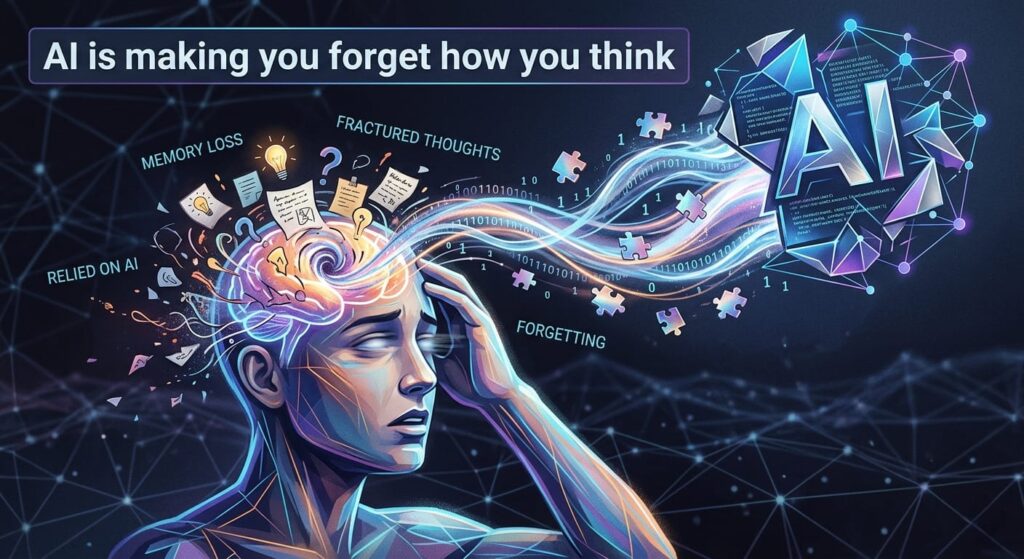
A teenager submits a polished essay in minutes, a student hesitates before writing a single sentence without assistance, a professional drafts emails, reports, and summaries through prompts instead of thought, or even a developer that generates code before fully understanding the problem.
These are no longer exceptions, but are actually habits.
Artificial intelligence has moved rapidly from being a tool we occasionally consult to something that increasingly mediates how we think, write, and express ourselves.
Its advantages are undeniable: speed, accessibility and efficiency. But beneath the surface, a quieter shift is taking place.
We are not just using AI, but rather adapting to it. And the question is no longer whether it changes our behavior, but what it changes in us.
The Disappearing Effort
At the center of human cognition lies a simple truth: thinking is effortful.
Research across Psychological Science and Journal of Experimental Psychology consistently shows that learning and understanding depend on what psychologists call effortful processing: the mental work required to organize ideas, retrieve knowledge, and construct meaning.
This effort is not a barrier, but the mechanism.
When we reduce effort, we don’t just make tasks easier, but change what we retain, how deeply we understand, and how well we can use that knowledge later.
AI, by design, removes this friction. Because instead of struggling to phrase an idea, we request one. And instead of structuring an argument, we generate it. Instead of synthesizing information, we summarize it instantly.
The result is efficient, but efficiency is not the same as understanding.
Cognitive Offloading: A Useful Shortcut Becoming a Default
Psychologists have long studied cognitive offloading: our tendency to rely on external tools to reduce mental effort. Here are some examples to it:
- We use calculators instead of mental math.
- GPS instead of spatial memory.
- Search engines instead of recall.
These shifts are well documented in journals like Trends in Cognitive Sciences and show that when information is easily accessible, we store less of it internally.
Work by Betsy Sparrow and colleagues, published in Science, demonstrated that people are less likely to remember information if they believe it will remain accessible online. Instead, they remember where to find it.
AI extends this pattern beyond memory into reasoning and expression, because we are not only offloading what we know, but beginning to offload how we think.
Writing as Thinking and What Happens When It Disappears
Writing is often treated as a skill, but in reality, it is a cognitive process. Studies in Journal of Educational Psychology show that writing improves comprehension, reasoning, and critical thinking.
The act of translating ideas into language forces structure, clarity, and precision. When that process is bypassed, something is lost.
This does not mean that every use of AI weakens thinking, but when AI consistently replaces the act of drafting, revising, and refining, it reduces opportunities to practice those cognitive skills. Over time, less practice can mean less fluency. Not just in writing, but in thinking itself.
The Illusion of Understanding
One of the more subtle risks is not that people know less, but that they believe they know more than they do. Research in Memory & Cognition describes the illusion of competence: when information is presented clearly and fluently, individuals often overestimate their understanding.
As AI-generated content is designed to be coherent and polished, it feels complete, but fluency can be misleading.
Because a person may read or submit a well-structured argument without being able to reconstruct it independently. We recognize the idea, but cannot generate it.
This gap between recognition and understanding is not new. The AI simply makes it easier to overlook.
Automation Bias: When Confidence Replaces Verification
Another well-established phenomenon is automation bias. It’s the tendency to trust automated systems, sometimes even when they are incorrect.
Research in Human Factors shows that people are more likely to accept machine-generated outputs without sufficient scrutiny, especially when those outputs appear authoritative.
With AI, this risk is amplified by the quality of the language it produces.
There have already been documented cases, particularly in legal contexts, where professionals relied on AI-generated content that included fabricated references. These incidents are not just technical failures, but highlight a human tendency to defer judgment.
The more reliable a system appears, the less we may feel the need to question it.
From Skill to Convenience: The Slow Drift of Deskilling
In professional environments, AI is increasingly embedded in daily workflows: drafting emails, summarizing meetings and generating documents. Although it brings clear gains in productivity, it also introduces a quieter shift: reduced practice.
The concept of deskilling, widely studied in organizational psychology, describes how reliance on automation can lead to a gradual decline in human skills.
This does not mean people become incapable, yet it means they become less practiced, and practice matters.
Skills like writing clearly, analyzing deeply, and articulating arguments are not static. They require use and without it, they can weaken.
Expertise Under Pressure
We need to stress that even highly trained professionals are not immune to these dynamics. Developers using AI-generated code may produce faster results, but risk weaker understanding of underlying logic if they rely too heavily on automation. Legal professionals may draft documents more efficiently, but still need to verify reasoning and sources independently.
In both cases, the issue is not the tool itself, but the balance between use and reliance.
As expertise is built through repeated cognitive engagement, if that engagement decreases, such expertise may become more superficial.
The Brain Adapts: For Better or Worse
Neuroscience offers a useful framework here: the use of dependent plasticity. Research in Nature Reviews Neuroscience shows that neural pathways strengthen with repeated use and weaken when neglected. This is a fundamental principle of how the brain adapts.
If certain types of thinking like structured writing, deep analysis and independent reasoning are practiced less frequently, it is reasonable to expect changes over time.
Although are is no immediate decline, a gradual adaptation is expected. Because the brain optimizes for what it is asked to do.
The Counterpoint: AI as Amplifier
It is important to avoid a one-sided narrative, since there is strong evidence that AI, when used deliberately, can enhance productivity and even support higher-level thinking. Studies in human-computer interaction suggest that offloading routine tasks can free cognitive resources for more complex work.
This is the promise of augmentation, not a replacement, and this distinction is critical.
AI can help generate ideas, but it should not replace evaluating them.
It can assist with structure, but not eliminate the actual understanding. When used as a collaborator, it can elevate thinking, however when used as a substitute, it can diminish practice.
A Subtle but Powerful Behavioral Shift
What makes this moment unique is not just the capability of AI, but the behavior it encourages. For the first time, we receive tools that can produce outputs that may like the result of deep thinking. This creates a powerful shortcut, as it skips the process and keeps the product.
But the process is where cognition develops, and if we consistently bypass it, we risk weakening the very abilities we rely on when the tools are not enough.
Where This Might Lead
If current patterns continue, the long-term effect may not be a loss of intelligence, but a shift in how it is expressed.
People may become highly skilled at directing tools, yet less practiced in independent formulation of ideas.
We may become more efficient in producing outputs, but less comfortable generating them from scratch. To my understanding, this is not inevitable.
The Real Trade-Off
One should understand that every use of AI involves a trade-off.
We may gain speed, but reduce effort and practice.
Although in the short term, the gains are obvious, in the long term, the costs are harder to measure, but potentially more significant.
Conclusion: Between Empowerment and Erosion
I’m not saying that artificial intelligence is inherently diminishing human capability. Because in many contexts, it expands it. But it also changes the conditions under which thinking happens.
If we will consistently allow AI to replace the processes that build understanding, writing, reasoning and analyzing, we are risking a gradual erosion of those skills. And it’s not because the technology forces it, but because we choose convenience over engagement.
And the future of AI is not just about what machines can do, but about what we decide to keep doing ourselves. Because the real risk is not that machines will think for us, but that over time, we may forget how to think without them.