
In the modern era, artificial intelligence (AI) has emerged not just as a transformative commercial technology but as a revolutionary force in military strategy and intelligence operations. From automated analysis of massive data streams to advanced simulations of battlefield scenarios, AI is fundamentally reshaping how nations prepare for, engage in, and understand conflict. As tensions escalate among major powers, notably between the United States, Israel, and Iran, technologies once relegated to research labs are now being deployed on the front lines and behind the scenes of global security.
In this article, we explore how AI is influencing military intelligence, decision-making, and the future conduct of warfare, the associated risks and ethical concerns, and what this means for global stability.
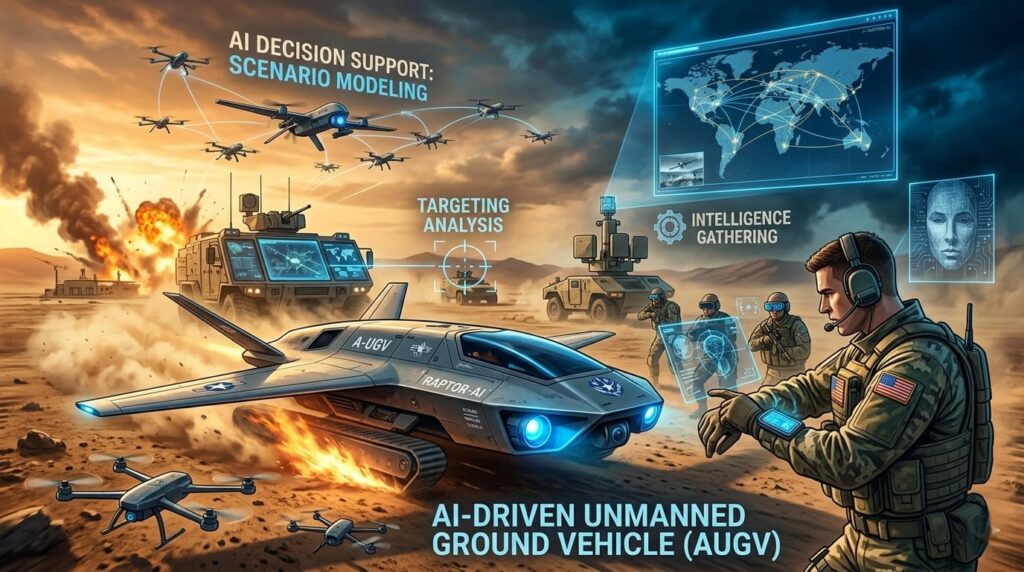
AI in Intelligence: From Data Overload to Actionable Insight
One of the earliest and most established military applications of AI has been in transforming how intelligence is gathered, processed, and acted upon. Traditional intelligence work, sifting through satellite images, intercepted communications, logistics data, signals intelligence, and open-source material, has always involved enormous volumes of information. AI excels at precisely this: detecting patterns at scale that humans cannot.
Today’s intelligence systems leverage machine learning and neural networks to:
- Identify targets and track movements using imagery from satellites and drones.
- Analyze communications and electronic signals to detect anomalies or threats.
- Integrate disparate data sources (e.g., social media, sensor feeds, movement data) into coherent strategic pictures.
These capabilities are not speculative. Historical deployments in conflicts such as Ukraine and Gaza have demonstrated that AI tools can accelerate target identification and optimize battlefield awareness reducing the time between sensing a threat and acting upon it. In some cases, these systems have been integrated into command-and-control workflows to support tactical decisions that previously relied heavily on human interpretation.
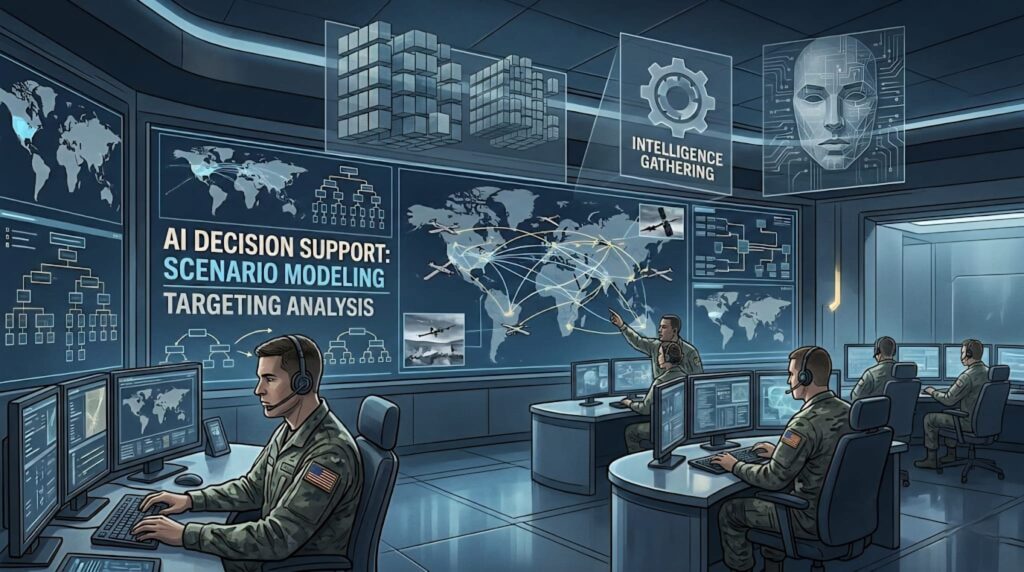
Hoover Institution
In the context of U.S. and Israeli operations, advanced analytics and AI-supported targeting tools are routinely used to sift through terabytes of sensor data, offering commanders near real-time insight during complex strikes and counteroperations.
AI Simulations, Scenario Modeling, and Decision Support
A distinct but increasingly critical role for AI is in simulating conflict scenarios, essentially, using machine intelligence to project the outcomes of different strategic decisions.
Research efforts like COA-GPT demonstrate this shift: large language models trained with military context can rapidly generate Courses of Action (COAs) for commanders, complete with strategic reasoning and options for adjustment. In controlled simulations, these AI-generated plans may significantly reduce the time needed to consider alternatives and refine operational approaches.
Beyond planning, AI simulations are used to explore high-stakes environments such as nuclear escalation scenarios. Independent studies conducted with advanced models like GPT-5.2, Claude, and Gemini in simulated war games have shown that AI systems, lacking human caution and historical context, can often prefer aggressive escalation, including tactical nuclear deployments, in a majority of virtual simulations. This suggests that while AI can accelerate strategic planning, it can also make decisions that would be considered dangerously risky by human standards.
This duality, AI as both analytical enhancer and unpredictable decision agent, underscores a crucial challenge for military institutions: how to harness AI’s speed and depth without ceding essential moral and strategic control.
AI in Communications and Networked Warfare
Beyond intelligence and simulations, AI is recasting how battlefield communications operate. Autonomous systems powered by AI now manage secure data exchange in contested environments, optimize tactical networks in real time, and coordinate multi-domain assets such as unmanned aerial vehicles (UAVs). These emerging technologies allow forces to adapt to rapidly changing conditions with minimal latency — a key advantage in modern campaigns.
In essence, AI transforms communications from static information pipes into adaptive, predictive networks capable of routing around threats, detecting interference, and supporting real-time command decisions — enhancing situational awareness and survivability.
Autonomous Weaponry and Escalation Risks
One of the most controversial intersections of AI and warfare is the development of autonomous weapon systems. These are platforms, drones, missile systems, robotic ground units, capable of independently selecting and engaging targets using machine intelligence.
The debate around autonomous weapons is as much ethical as it is tactical. Critics argue that fully autonomous systems can:
- Reduce the political cost of warfare by minimizing human casualties among operators.
- Step beyond human moral judgment in life-or-death decisions.
- Escalate conflicts unintentionally due to unpredictable machine reasoning.
Academic literature highlights the concern that AI-powered autonomous weapons may lower barriers to conflict and increase the risk of geopolitical instability. In some scenarios, AI systems might choose courses of action that conventional human commanders would avoid, such as tactical nuclear engagement or disproportionate force, because of a lack of ethical logic or a machine’s narrower optimization criteria.
These risks are not abstract. They reflect real anxieties within defense and policy circles about placing life-or-death decisions into algorithmic hands, especially in high-tension environments like the Middle East.
Policy, Ethics, and the Military-Industrial Tech Ecosystem
Recent developments in the U.S. reveal an intense debate between military demand for powerful AI tools and industry concerns about ethical constraints. For example, the Pentagon has been pushing AI firms to relax usage restrictions on their models to allow broader military applications including autonomous systems. In one high-profile standoff, the defense establishment threatened to use the Defense Production Act to compel cooperation from major AI companies, despite resistance from leadership citing ethical boundaries around mass surveillance and autonomous weapon use.
At the same time, some defense units are already operating AI tools internally for classified operations, highlighting how critical today’s governments believe AI is to maintaining strategic advantage, especially in conflicts involving near-peer adversaries like Iran, China, or Russia.
This friction between ethical imperatives and strategic demand underscores a central dilemma: Who controls AI, and on what terms, in matters of national security?
Disinformation, Public Perception, and the AI Feedback Loop
While much of the focus is on military AI, another layer of intelligence and conflict is unfolding in the information domain. Platforms like social media have been flooded with AI-generated content during major geopolitical events, blurring the line between real reporting and manufactured narratives. For example, in the wake of recent strikes involving the U.S. and Israel, AI-generated or manipulated content proliferated widely, challenging news verification efforts and influencing public perception.
This demonstrates that AI is not only a tool for strategic planning or battlefield intelligence, it is also reshaping the battle for narrative and truth. In future conflicts, informational warfare driven by AI tools could become as significant as kinetic engagements.
Looking Forward: Human-AI Synergy or AI Dominance?
Several broad trends point to the future integration of AI in global conflict:
- AI will continue to accelerate intelligence analysis, enabling quicker and deeper insights than human teams can produce alone.
- Decision support systems will become more influential, potentially advising or shaping military strategy in real time.
- Networked and autonomous systems will proliferate, altering the nature of command and control.
- Ethical debates and governance frameworks will struggle to keep pace with technological adoption.
The ultimate question facing policymakers, military leaders, and technologists is not whether AI will be part of warfare, but how to ensure AI is used responsibly, under meaningful human oversight, and with global norms that prevent catastrophic outcomes.
As recent events show, nations that master AI in intelligence and operations will have a decisive advantage, but without careful safeguards, the same tools that enhance insight could also magnify instability.