Beyond the Gear #2
Part of the “Beyond the Gear” series on the deeper side of audio.
👉 Explore all articles in the series
Let’s be honest: the question of whether audiophiles truly enjoy music, or simply enjoy something else, is an uncomfortable one.
Not because there’s no answer, but because many of us have already decided what that answer should be. After all, we’ve invested years, money, time, knowledge, countless listening sessions, endless comparisons. Of course we hear better. Of course we experience music more deeply.
And yet, over time, as our ears become more refined, another, quieter question begins to emerge:
What if we’re not experiencing more, just something different?
When Music Stops Being the Center
One of the most unsettling realizations for a seasoned audiophile is noticing that you no longer listen to full albums. Not because you lack the time, but because you’re hunting for specific tracks.
Most of us have them: These test tracks. Deep bass passages, shimmering cymbals, exposed vocals, recordings that reveal more about the system than about the music itself.
At that point, music stops standing on its own, and becomes a tool. A benchmark and raw material. This is where a subtle but meaningful shift happens:
Instead of the system serving the music, the music begins to serve the system.
A music lover, by contrast, is rarely troubled by this. They can listen to an imperfect recording on a modest setup and still feel something. They don’t pause an album halfway through to question whether the soundstage drifted slightly to the right. They just keep listening.
The Real Difference Isn’t in the Ears
A common belief in audiophile culture is that the difference between an audiophile and a music lover comes down to sharper hearing. In reality, the difference is not physiological, but intentional.
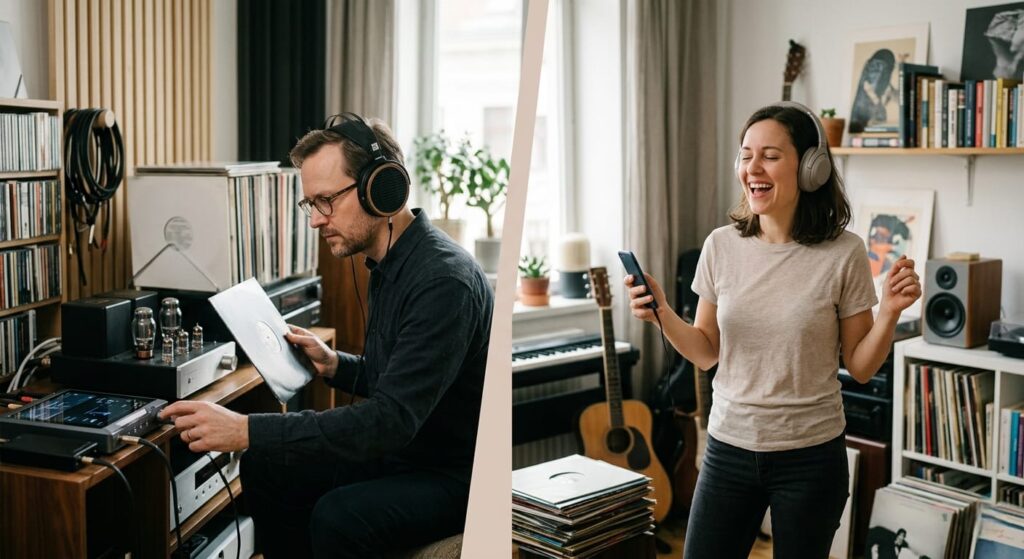
While an audiophile listens with the intent to analyze, a music lover listens with the intent to feel.
Both approaches are valid, but tension arises when the audiophile forgets that analysis is a choice and still expects the same spontaneous emotional response.
To be fair, there’s something deeply compelling about breaking sound down into its components: depth, space, microdynamics, texture. It creates a sense of control, understanding, even mastery.
But it also introduces distance.
Audiophilia as an Intellectual Exercise
At a certain point, for some audiophiles, listening to music becomes less about sensation and more about cognition. It’s no longer spontaneous, yet becomes ritualized. You need to have the right seat, correct angle, carefully calibrated volume and deliberately selected tracks.
There is beauty and depth in this discipline, but there is also a cost.
Because when every listening session becomes an evaluation, it becomes harder to let go, lose yourself, and allow music to do what it does best. Move you without permission.
A music lover, on the other hand, isn’t chasing perfection, only connection. They’re less likely to ask whether the recording is good, and more likely to ask whether the song is.
They won’t hesitate to be moved by music played through something as simple as a Bluetooth speaker.
The Weight of Audiophile Discourse
Here’s something rarely acknowledged: audiophiles don’t listen in a vacuum.
They arrive at every session carrying opinions, reviews they’ve read, rankings they’ve internalized, expectations about what should sound right. And that discourse shapes perception.
Because instead of discovering music, we begin validating it. And instead of encountering something new, we check whether it meets expectations.
A music lover, by contrast, operates with more freedom. Not necessarily with better ears or deeper knowledge, but with fewer constraints.
Good Recording vs. Good Music
Within audiophile culture, there is often a quiet but significant confusion between musical quality and recording quality. If we’re honest, we’ll admit that entire song lists are sometimes dismissed, not because they lack artistic value, but because they are poorly recorded.
And this raises a difficult question: Are we willing to give up meaningful music simply because it isn’t presented in the best possible sonic form?
It turns out that prioritizing sound quality isn’t just a technical preference, but can reshape the boundaries of our musical world.
Conclusion
For many, audiophilia is more than a hobby. it’s an identity. And when something becomes part of your identity, it becomes difficult to question. It’s not easy to admit that enjoyment may have shifted, or even diminished.
It’s not easy to ask whether all this knowledge brings us closer to music… or quietly distances us from it.
A music lover doesn’t need to defend an identity. They simply listen.
So who enjoys music more?
To my understanding, there’s no single answer, but there is one uncomfortable truth:
Enjoyment is not proportional to the quality of your system.
A music lover can experience emotional intensity that an audiophile with a perfect setup might struggle to reach, simply because they are present in the moment. At the same time, an audiophile can experience moments of depth and realism that a casual listener may never encounter.
So the real difference isn’t who hears more. It’s who allows themselves to feel more. Maybe the answer isn’t about choosing sides, but about balance.
Knowing when to be an audiophile, and when to simply listen.
Knowing when to analyze, and when to close your eyes.
Because in the end, music wasn’t created to be evaluated.
It was created to be heard.
And perhaps the real question isn’t who enjoys it more, but who is still able to set aside knowledge, expectations, and comparisons… and remember why they started listening in the first place.