Beyond the Gear #1
Part of the “Beyond the Gear” series on the deeper side of audio.
👉 Explore all articles in the series
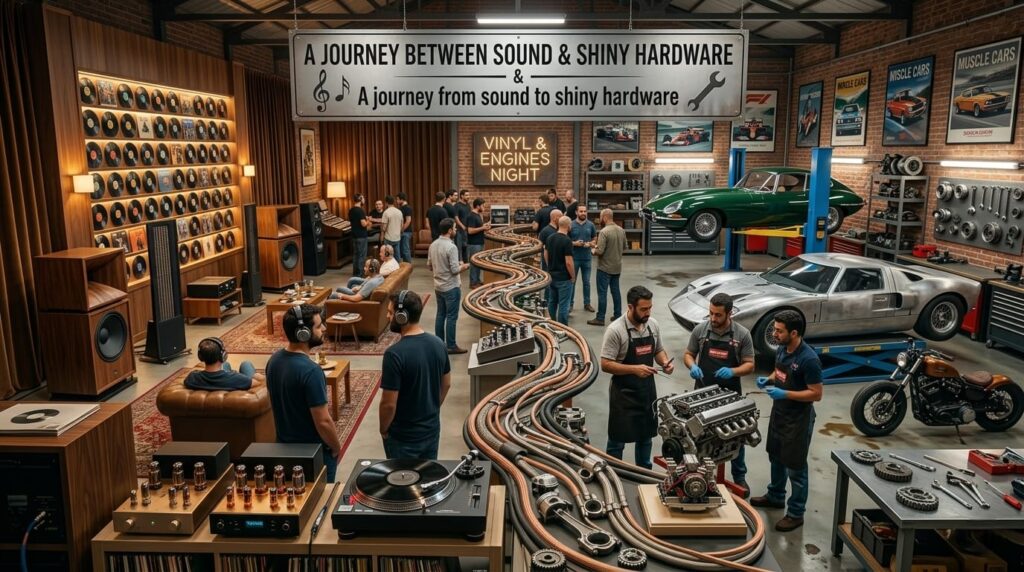
In the world of home audio there are two passionate layers of enthusiasts who sometimes seem to be speaking entirely different languages: those who fall in love with the sound itself, and those who fall in love with the equipment that produces it.
This distinction goes far beyond the culture of vinyl lovers, CD player collectors, and speaker aficionados. It runs deep enough to create entire communities, heated forum debates, and, let’s be honest, more than a few bruising arguments. The kind of exchanges that turn into “my system is bigger and more expensive than yours,” or the less diplomatic “Your system isn’t even worth to be placed in the bathroom,” words that have actually appeared in audio forums.
Some of those comments have even led to temporary or permanent bans for forum members.
Before diving into the differences, it’s important to understand the central idea: an audiophile is not simply someone who claims that music sounds better through a more expensive system.
An audiophile is someone who devotes thought and attention to the sonic landscape itself to the way a musical phrase travels through speakers, amplifiers, conditioners, cables, and even isolation weights before reaching the ear.
A gearhead, on the other hand, what some jokingly call an “equipment-phile”, is someone fascinated by the hardware itself. In that mindset, the device becomes the star of the show, rather than the music.
The Love of Music vs. the Obsession with Gear
The audiophile, as many describe them, is someone who finds magic in listening to a song down to its smallest details. Their goal is an experience that feels as authentic and lifelike as possible, something that approaches the sensation of a live performance or the original recording.
For audiophiles, the central discussion revolves around what the system does to the music: how it reconstructs texture, dynamics, the breath in a singer’s voice, or the depth of the bass. An audiophile seeks not only high resolution but also natural relationships between notes, a convincing sense of space, and a detailed sonic perspective.
The gear-focused enthusiast approaches the hobby differently. They often derive pleasure from the visual and physical presence of the equipment itself. The perfectly arranged rack filled with glowing tube amplifiers, luxurious network players, gold-plated cables, and beautifully crafted speaker stands, organized by color and finish, can be the centerpiece.
In some cases, it matters less whether the music sounds objectively better and more that the system looks impressive in the living room.
What excites them might be how valuable the equipment is, how stunning it looks in photographs, whether it has been featured in a magazine like Mono & Stereo, or how many likes the system receives on forums and social media.
Some people jokingly say that gearheads are the ones who, before even listening to the recording, are already admiring the packaging and the soldering.
It’s no surprise, then, that many forum discussions gradually drift toward the visual and collectible aspects of equipment instead of purely audiophile considerations.
Online Forums: The Battleground
To understand the tension between audiophiles and gear-focused enthusiasts, you only need to spend some time browsing a typical two-channel audio forum.
There you’ll find an exciting mix of learning, experience-sharing, and passionate discussion, but also plenty of friction.
Some participants complain that technical discussions often spiral into debates that make it difficult for newcomers to learn. Others argue that without deep knowledge of equipment, it’s impossible to even begin evaluating true sound quality.
In other words, the typical two-channel forum reflects the entire spectrum: from theory and technical analysis to practical advice and, inevitably, arguments about what actually sounds better.
One of the most common debates revolves around listening tests designed to determine whether price jumps between components actually reflect real sonic improvements, or whether they’re mostly the result of clever marketing.
Some insist that expensive gear genuinely sounds better because it is more precise and better engineered. Others warn that rigorous measurements sometimes show differences that may be extremely difficult, or even impossible, for the human ear to detect.
Enjoying Audio vs. Enjoying the Upgrade
It’s important to understand that being a gear enthusiast is not necessarily a negative thing.
In fact, many gear lovers are simply a subset of audiophiles. They love music too. The difference is that what excites them most is the equipment itself.
Some people find enormous enjoyment in evaluating a new DAC, noticing the resolution of a newly released amplifier, or comparing the craftsmanship of different turntable designs.
By contrast, the music-focused audiophile will almost always choose listening to a favorite recording over purchasing another component.
When describing their system, the audiophile is more likely to talk about how the system sounds, the sense of space, realism, and musical flow, before mentioning that the amplifier weighs 220 pounds or where it was manufactured.
This difference leads to familiar arguments in forums, not only about sonic preferences but also about priorities. For example: is it worth investing in cable lifters before investing in the actual hardware that produces the sound?
High Prices, Social Status, and the “Bigger and Better” Contest
Almost every hobby that pushes toward the limits of technical performance eventually encounters a powerful emotional trigger: price.
In high-end audio, the cost of amplifiers, players, speakers, and DACs can climb into ranges that exceed the annual household budget of many enthusiasts.
This reality often sparks competitive dynamics, sometimes playful, sometimes not, about who owns the most expensive, most impressive, or most prestigious equipment.
In many discussions you’ll see a wide range of perspectives. Some people carefully balance spending with the search for maximum value. After all, not everyone who loves music can afford an amplifier that costs as much as a house.
This is where the difference between audiophiles and gearheads becomes especially visible.
Audiophiles evaluate sound through the musical experience. Gear enthusiasts often discuss prices, specifications, investment value, and resale potential, sometimes almost the way collectors talk about financial assets.
From the outside, it can look like a kind of dance: one person chasing the perfect musical experience, the other admiring the equipment almost like a collection of luxury art pieces.
The Big Trend: When Audio Gear Became Shockingly Expensive
In recent years, a clear trend has emerged in the world of high-end audio: equipment whose price has long since departed from what most consumers would consider rational.
If speakers priced at $15,000 or even $30,000 once represented the pinnacle of aspiration, today it is not unusual to see loudspeakers exceeding $100,000, or entire systems reaching into the millions.
Examples such as flagship loudspeakers from Wilson Audio, amplifiers from CH Precision, or complete digital systems from dCS have become symbols of the extreme high end.
These prices are not always determined purely by the cost of materials or engineering. They often reflect a combination of branding, exclusivity, limited production, and a narrative of uncompromising performance.
As a result, price itself sometimes becomes a perceived indicator of quality within parts of the community, even when demonstrating a clear sonic difference is difficult.
For the average audiophile, this trend can create a mixture of alienation and fascination. But one thing is certain: it changes the rules of the game.
Audio equipment is no longer just about playing music. It has become a statement.
Audio Shows: Where Million-Dollar Systems Feel Normal
Global audio exhibitions, especially the Munich High End show in Germany, may be the clearest symbol of how extreme pricing has become normalized in the audio world.
Inside the luxurious hotel and exhibition halls of Munich, systems costing $500,000, $1 million, or more are often presented as standard demonstrations rather than rare exceptions.
Speakers such as the Wilson Audio Chronosonic XVX are sometimes paired with amplifiers and sources whose combined cost approaches the price of a house.
At these shows, almost no one raises an eyebrow at price tags that would once have seemed unimaginable. Conversations quickly move on to topics like room acoustics, speaker placement, and cable choices.
For gear enthusiasts, these exhibitions are a celebration of engineering limits and industrial design.
For audiophiles, they can feel like a spectacular, but somewhat detached, display far removed from the realities of a normal listening room.
Either way, these shows have a powerful psychological effect: if it is presented here, it must be legitimate. And that legitimacy gradually filters down into the broader market.
Audio Meetups: A Bridge Between Worlds
Despite the arguments, disagreements, and occasional forum clashes, there is an important bright spot worth highlighting: social audio gatherings.
Meetups, whether in a hobbyist’s living room, a showroom, or a dedicated event, often succeed in breaking down the barriers between audiophiles and gear enthusiasts.
When people sit together in front of a playing system, with a cup of coffee or a plate of sushi, the conversation often returns to something simpler and healthier: the music itself.
Even those who came primarily to see expensive equipment often find themselves moved by a great piece of music.
And even those who insist that equipment doesn’t matter sometimes pause to admire a beautifully finished amplifier or turntable.
These gatherings remind us that the disagreements between enthusiasts are often about emphasis rather than essence.
Because in the end, whether someone is fascinated by the screws, weight, and designת or by the harmonic beauty of a recordingת they arrived there for the same reason: a love of sound.
The Limits of Proof and the Challenge of Objectivity
If heated discussions are inevitable, it’s partly because there is no single objective method for declaring that one piece of audio equipment is definitively superior.
Technical specificationsת power output, distortion figures, or frequency responseת do not always capture the full listening experience.
Sometimes the numbers blur the real impact on how music feels.
That’s why forum discussions often split into two camps: those who rely on scientific measurements and those who prefer blind listening and personal perception.
For some, the oscilloscope tells the truth. For others, only the ear can decide.
Conclusion: Two Worlds, One Window
In the end, audiophiles and gear enthusiasts belong to the same extended family of people who love music. They simply represent different perspectives on that passion.
The audiophile seeks to be immersed in musicת to recreate the most faithful sound possible. The gear enthusiast wants to be surrounded by the beautiful machines that make that music possible, celebrating every impressive new component.
Sometimes these worlds clashand sometimes they complement each other. But like many hobbies, the tension between them is part of what keeps the conversation alive.
Because ultimately, what unites both is the same thing: a love of music and the pursuit of great sound.
And what about you?
Where do you fall on that spectrum?