
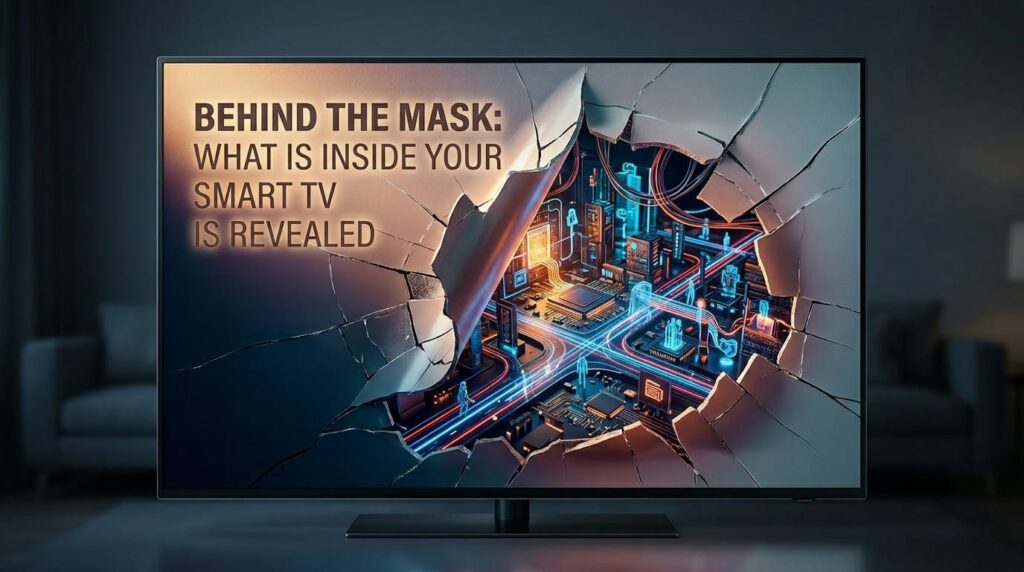
Walk into any electronics store in the United States, or browse a retailer like Best Buy online, and you’ll quickly notice a pattern. Modern TVs aren’t just displays anymore, they’re sold as intelligent machines. The language surrounding them feels almost cinematic: artificial intelligence, cognitive perception, neural processing.
Names like Cognitive Processor XR from Sony, Neural Quantum Processor from Samsung, and Alpha AI Processor from LG sound less like components and more like breakthroughs pulled from a research lab.
It’s hard not to be impressed. These names suggest something deeply advanced, processors that don’t just display images, but understand them the way humans do. They promise a viewing experience that feels more natural, more immersive, almost perceptually aware.
But once you look past the branding, a different, and far more nuanced story begins to emerge.
The Power of a Name
There’s a quiet psychological effect at work when we shop for technology. Give something a sophisticated, almost scientific name, and it immediately feels more valuable. If a TV claims to use “neural networks” or “human-like perception,” most people will instinctively assume that the hardware itself must be unique, perhaps even custom-built by the manufacturer.
That assumption isn’t accidental. It’s part of the design.
In reality, many smart TVs are powered by System-on-a-Chip platforms developed not by the TV brand itself, but by semiconductor companies like MediaTek. These chips are often shared across multiple brands and price categories. The same underlying silicon can appear in both a mid-range model and a flagship TV costing significantly more.
What changes is not necessarily the hardware, but the story told around it.
Manufacturers wrap these chips in layers of proprietary software, tuning, and branding. The result is something that feels exclusive, even if the foundation is widely used. Because most companies don’t openly disclose the exact chip model inside their TVs, the gap between perception and reality has plenty of room to grow.
Lifting the Curtain
For those curious enough to dig deeper, there are ways to peek behind the marketing.
Applications like AIDA64, which can run on many Android TV or Google TV devices, offer a glimpse into the hardware beneath the surface. They can sometimes reveal the actual SoC model, along with details about CPU cores and graphics capabilities.
It’s not a perfect window. Manufacturers often limit what the operating system is allowed to expose, so the information you see may be incomplete. Still, tools like this provide something rare in the TV world: a more grounded, technical perspective that goes beyond polished marketing pages.
And occasionally, what they reveal is surprising.
A Closer Look at Sony
Take Sony, for example. The company leans heavily into its Cognitive Processor XR, describing it as a system that analyzes images the way the human brain would, focusing on what matters most in a scene and adjusting the picture accordingly.
It’s a compelling narrative, and it resonates strongly with buyers looking for a premium experience.
But when users examine certain Sony models using diagnostic tools, a pattern begins to appear:
Televisions like the Bravia XR A95L and the Bravia XR X90L, very different products in terms of positioning and price, have been shown in multiple cases to run on the same underlying chip: the MediaTek Pentonic 1000, also known internally as MT5897.
Sony doesn’t officially publish this information, so findings like these come from user testing rather than official specifications. Still, they point to something important:
The branded “processor” is not always a unique piece of hardware. In many cases, it’s a combination of a shared chip and a proprietary software layer built on top of it.
Same Chip, Different Experience
At first glance, that might seem to undermine the value of higher-end models. If two TVs share the same processor, shouldn’t they perform the same?
In practice, they rarely do.
The reason is that the chip itself is only part of the equation. What truly shapes the viewing experience is everything built around it: the algorithms, the tuning, the way the TV interprets and enhances content in real time.
One model might deliver cleaner upscaling when watching older HD content. Another might handle motion more naturally during fast-paced sports. Color accuracy, contrast handling, HDR tone mappingת these are all areas where manufacturers can differentiate their products, even when the underlying silicon is identical.
It’s a bit like two chefs working with the same ingredients. The final dish depends on technique, not just what’s in the pantry.
The Subtle Consumer Conflict
For the average buyer, this creates a quiet tension.
On one hand, you’re presented with bold claims about revolutionary processing power and human-like intelligence. On the other hand, your actual usage might be fairly straightforwardת streaming shows on Netflix, watching clips on YouTube, or gaming on a console at 120Hz.
In that context, the processor becomes less of a mythical centerpiece and more of a supporting player. And yet, price differences between models can be substantial, even when they share the same core chip.
The missing piece in that puzzle is software. Manufacturers invest heavily in image processing engines, AI-driven enhancements, and calibration techniques that sit on top of the hardware. That’s where much of the real differentiation happens, and it’s also where much of the perceived “magic” comes from.
A Broader Industry Pattern
This approach isn’t unique to Sony. It’s common across the industry. Brands like TCL, Hisense, and Vizio also rely heavily on chipsets from MediaTek. While their marketing language may differ, the underlying strategy is similar:
Combine widely available hardware with proprietary enhancements and present the result as a distinct product experience.
Sometimes the differentiation is meaningful, other times it’s more subtle, but the pattern itself is remarkably consistent.
Seeing Through the Branding
None of this means that premium TVs aren’t worth their price. In many cases, they absolutely are. Better panels, more refined processing, and superior tuning can all contribute to a noticeably better viewing experience.
The processor name alone doesn’t tell the full story and in some cases, it may tell a very incomplete one.
Understanding this can change how you evaluate a TV. Instead of focusing on branding, it becomes more useful to look at real-world performance: how the TV handles motion, how it upscales lower-resolution content, how natural colors appear, how responsive it feels when gaming.
Tools like AIDA64 can help peel back a layer of abstraction, but even without them, a more critical perspective goes a long way.
The Takeaway
The modern smart TV is a blend of three elements: standardized hardware, customized software, and carefully crafted marketing.
The hardware often comes from companies like MediaTek. The software is where manufacturers make their mark. And the marketing is what shapes how we perceive the entire package.
Once you start to see those layers separately, the picture becomes clearer. Because in the end, not every bold, futuristic processor name represents a groundbreaking piece of silicon. Sometimes, it’s a familiar chip: refined, optimized, and wrapped in a story compelling enough to make it feel entirely new.
Help Pull Back the Curtain
There’s an opportunity here to turn curiosity into something bigger: a shared project that benefits everyone reading this.
If you own a TV running Android TV or Google TV, whether it’s from Sony, TCL, Haier, or any other brand, you already have the tools to peek behind the curtain. With a simple app like AIDA64, you can uncover the actual processor and GPU powering your TV.
Now imagine what happens if not just one person does it, but dozens, or hundreds.
Take a screenshot of what you find and share it in the comments.
Over time, those individual snapshots can come together into something much more meaningful: a living, crowdsourced map of the chips that really power today’s TVs. The kind of transparency that manufacturers rarely provide on their own.
It’s a small action, but it adds up. And in a space where marketing often leads the conversation, contributions like these help bring the discussion back to reality, one screenshot at a time.