A journey from placebo to science, from cool gear to perceived truth in sound.
Think about this: you read a review describing a system with a soundstage that feels almost unreal. Then you hear it yourself, and suddenly it’s the most immersive listening experience you’ve had in years. Why? What just happened? Is it really the sound? Or is something deeper in our brain playing tricks on us?
This question has followed the world of audiophilia for decades: not just what we hear, but how we interpret what we hear, and sometimes even more than that, what we believe we’re hearing.
This becomes especially relevant when the discussion turns to one of the hottest topics in audio: do we actually perceive real improvements when using high-resolution formats, premium gear, or different sound settings, or is it simply belief guiding our perception?
The Scientific Debate: What Do Studies Say?
In the scientific world, there are several key points worth understanding. Anyone curious enough to dig deeper will quickly realize that the results don’t point to a single clear answer, but rather a complex landscape shaped by conditions, context, and psychology.
A large-scale 2016 study published in the Journal of the Audio Engineering Society, and later reanalyzed by multiple researchers, examined 18 different experiments involving over 400 participants and more than 12,500 trials comparing standard formats (44.1–48kHz at 16-bit) with high-resolution audio.
The results showed a small but statistically significant ability to distinguish between formats, especially when participants were well-trained for the task. It reminds me of a forum thread where someone insisted he could identify differences between components in a system just by listening.
However, an important detail in the findings is that this difference was subtle, only a few percentage points above random guessing, and required significant training to become consistent.
In other words, under certain conditions, people really can hear a difference. But the bigger question is whether that holds up in everyday listening. And that depends heavily on context, setup, familiarity with the material, and, very often, expectation.
Does Expectation Shape Sound? The Audiophile Placebo Effect
In discussions, both locally and globally, the question often comes up: how much of what we perceive is truly objective hearing, and how much is placebo?
Some argue that the placebo effect in audiophilia is enormous, that price, branding, and expectation shape the listening experience far more than the sound itself. Some even suggest that as much as 97% of our enjoyment comes from the surrounding narrative rather than actual sonic improvement.
There are those who claim that if you let someone listen to a system in the dark and tell them it’s extremely expensive, their experience will be completely different than if you told them it was cheap. That’s a fascinating problem: expectation influences outcome, which is essentially the definition of placebo.
The Trained Ear vs. “Everyone Else”: What Does It Mean?
Science also recognizes the concept of the “golden ear”: someone with highly developed, often highly trained listening ability, capable of detecting differences that most people simply cannot.
In studies like the one mentioned earlier, participants who received specific training performed significantly better at identifying high-resolution differences than those who didn’t. This raises some important questions:
- Do audio professionals actually hear better?
- Can people with “golden ears” detect differences others cannot?
- Or do those who believe they have this ability simply experience sound differently, through expectation?
The truth is probably a combination of all of these, and perhaps even more.
Our ability to compare sound and make auditory judgments is highly interactive, shaped by social, psychological, and emotional contexts, not just controlled lab conditions.
Why Is This So Hard to Measure?
There are two fundamental challenges that need to be considered:
- Measurement difficulty: Very small sonic differences may fall below the perception threshold of untrained listeners, especially in double-blind tests where external cues are removed.
- Context dependency: Background noise, listener fatigue, expectation, and prior knowledge all influence the listening experience far more than any audio system can isolate.
The world produces sound, but the brain interprets it. This isn’t just about the senses; cognition plays a central role.
So What Are We Actually Hearing?
In past discussions, several points came up that technical studies don’t always fully capture:
- The role of expectation: People openly admit they experience sound differently when they know it’s expensive, even if the audio itself is identical. As one person wrote: “If I’m in a different mode, like in my car, I hear all the flaws, but my brain filters them out, and I still enjoy it.”
- Training vs. natural ability: How much of our listening ability comes from learned awareness, and how much is innate?
Perhaps most interesting is the idea that some people embrace placebo as a positive effect. As someone once put it:
“I know I wouldn’t pass a blind test, but I want to hear the difference, and that’s what I hear.”
And that’s an important point. Sometimes the experience we’re chasing is the act of listening itself, not just objective sound. It’s not only the gear that shapes our experience, but the mindset we bring into it.
A Glass of Whiskey, Changing Perception, and an Open Credit Card
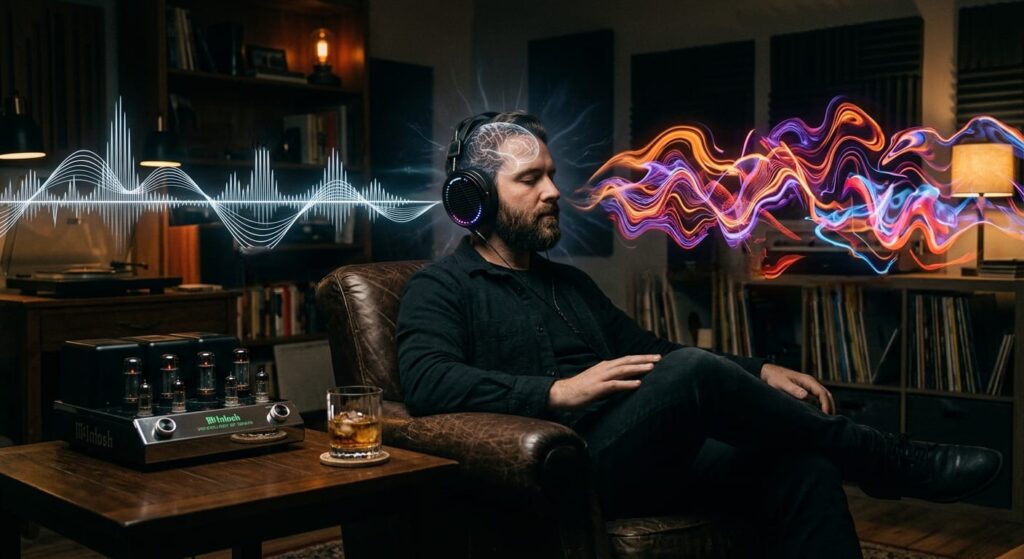
There’s a familiar, almost ritualistic phenomenon in the high-end audio world: listening sessions accompanied by a drink. In certain stores, launch events, exhibitions, and sometimes even in a home setting, you’re offered whiskey, wine, or cognac “to set the mood.”
On the surface, it’s hospitality. In reality, it’s a psychoacoustic variable.
Alcohol, even in moderate amounts, directly affects the nervous system. It lowers inhibition, softens critical judgment, reduces sensitivity to harsh details, and increases overall pleasantness. Studies in cognitive psychology show that light alcohol consumption improves subjective evaluations of sensory experiences, not because the stimulus itself changes, but because the threshold for judgment is lowered.
The sound doesn’t necessarily become better. It’s simply judged less critically. In that state, what feels more “fluid,” “musical,” or “smooth”? These are exactly the kinds of words that sell audio gear.
It’s important to clarify: research doesn’t suggest alcohol improves sound quality itself. Rather, it changes how the brain filters and evaluates the signal, potentially increasing enjoyment, even when the signal itself isn’t objectively better.
This isn’t just a reduction in critical judgment, but a shift in cognitive focus and interpretation of sonic details, something that can feel very much like a real improvement.
Is there a conspiracy here? Probably not. But there is a deep intuitive understanding that the listening experience doesn’t happen in the ear alone, it happens within a broader state of mind. And when we leave a store feeling slightly euphoric, credit card in hand, it’s worth asking honestly: did we buy a system that sounded amazing—or the memory of a pleasant evening where everything felt right?
A Conclusion That Isn’t Really a Conclusion
At the end of the day, the answer to “do we really hear better, or just want to believe we do?” isn’t simple. It’s not black and white.
And perhaps the most important insight? What reaches our ears isn’t just raw data, it’s the intersection of perception, expectation, culture, and inner experience. That’s what makes audiophilia so fascinating, and so confusing.
The Real Question
Maybe the real question isn’t whether differences in sound exist at all, but how you choose to experience them.
Because in the end, the psychology of listening may not be a side issue. It may be the very heart of audiophilia itself.