
In recent years, LG has become synonymous with OLED. This isn’t just a technology, but a full strategy: leading the premium display market through picture quality rather than price. But the company’s Q3 2025 financial report paints a more complex picture. On one hand, profitability is improving and the production chain is stabilizing. On the other, LG is seeing declining sales in its TV segment amid growing pressure from competing technologies like Mini-LED and QD-OLED.
To understand whether OLED is still a “good bet” for LG, you need to break down the story. We’ll do that using the company’s latest financial report:
TVs: A Decline That Hides a Bigger Story
According to the report, revenue from the “TV/audio/monitor/PC and others” segment reached 13,842,223 (KRW) in the first nine months of 2025, compared to 15,182,241 in the same period last year.
At first glance, this looks like a routine decline. But in reality, it’s one of the most important indicators for the entire market. While this category includes monitors and PCs, TVs make up the bulk of it, consistent with LG’s positioning as a premium OLED TV-focused brand. This drop aligns with broader market data showing that according to Display Daily, OLED TV shipments are barely growing, with just about 1.5% growth in 2025.
This suggests the issue isn’t unique to LG, but affecting the entire OLED TV market. The main reason is saturation: consumers simply aren’t upgrading their TVs as frequently. At the same time, technologies like Mini-LED deliver “good enough” performance at a lower price point. For LG, which has bet heavily on OLED as a premium solution, this creates pressure from both sides, volume and pricing.
That said, LG is still shipping millions of units annually, so this isn’t a collapse, it’s a maturing market.
Bottom line: the OLED TV market isn’t shrinking, it’s just no longer growing quickly.
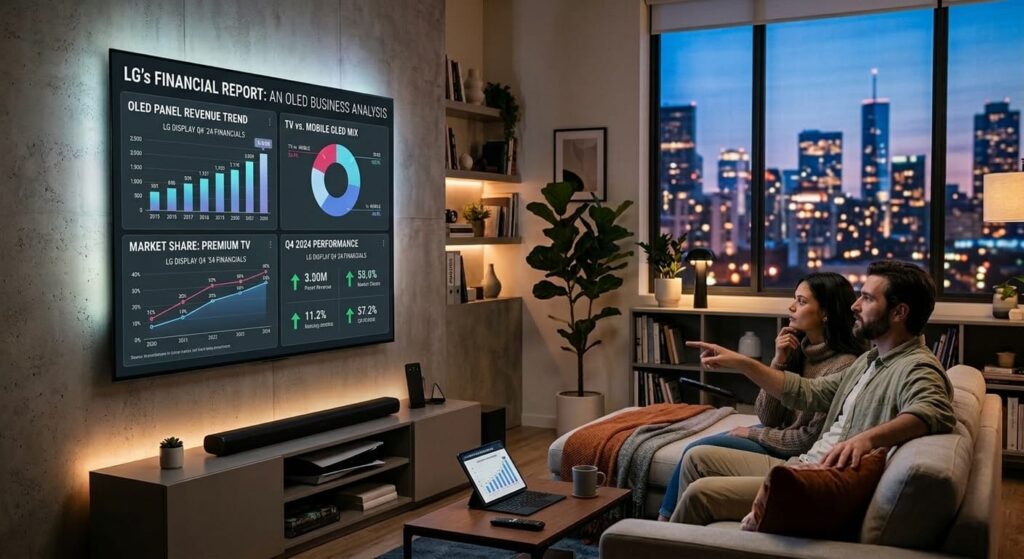
OLED Production Is Getting Stronger
The report notes that LG Display is responsible for “production and supply of display products.”
It also shows a major turnaround: a profit of 582,429 in the first nine months of 2025, compared to a loss of 1,644,843 in the same period last year.
To understand OLED, it’s critical to recognize that LG Electronics doesn’t actually manufacture its own panels, but relies on LG Display.
The key takeaway here is the shift from heavy losses to profitability. OLED production is becoming economically viable after years of massive investment.
This is also reflected in the broader market: Accrding to oled-info, LG Display is targeting around 6 million OLED TV panels in 2025, with continued growth.
In other words, production isn’t declining, but becoming more efficient and expanding. However, there’s a twist: improved profitability is partly driven by cost reductions, not just increased demand. Average panel prices have actually declined by about 5%.
This suggests a transition: OLED is moving from an investment phase to an optimization phase: less growth, more efficiency.
Not Just TVs: Where Growth Is Actually Happening
The same “TV/audio/monitor/PC and others” category tells another story, one that’s barely visible in the report itself.
While TV sales are stagnating, OLED in monitors is booming. According to wccftech, In 2025, OLED monitor panel shipments surged by roughly 65–70%. OLED laptops are also growing at a strong double-digit rate.
This means OLED isn’t declining, it’s shifting categories. According to PCGamer, LG itself isn’t the leader in OLED monitors, with roughly a 13% market share, but it remains a meaningful player. This also explains why the overall category in LG’s report is down: OLED monitor growth is still too small to offset weakness in OLED TVs.
Bottom line: OLED isn’t disappearing. It’s moving from TVs to monitors and laptops.
Competition: QLED, Mini-LED, and the Real Threat
It’s important to note that LG’s report does not directly mention QLED or Mini-LED, and that’s significant in itself. It suggests LG is still “all-in” on OLED. But the market isn’t. Technologies like Mini-LED, marketed as QNED by LG and Neo QLED by Samsung, offer higher brightness at lower prices.
At the same time, Samsung’s QD-OLED improves on LG’s WRGB-OLED approach, particularly in color performance. This is already impacting LG’s position. According to Biggo, Samsung increased its OLED TV sales by about 38% in 2025, closing the gap with LG.
Meanwhile, LG has even paused production and development of 8K OLED TVs, signaling a more cautious approach.
The competitive landscape has shifted: it’s no longer OLED vs. LCD, but OLED vs. “almost OLED” technologies like Mini-LED, and even OLED vs. OLED (QD-OLED).
Analysis: Is OLED Still the Right Bet?
On one hand, according to future market insights, the global OLED market is still expected to grow at a strong double-digit CAGR, LG Display is turning profitable, reducing execution risk, and OLED remains dominant in the premium segment, capturing nearly 45% of TVs priced above $1,500 citated in ked global. In addition, there is also strong growth in OLED monitors and laptops screens.
On the other hand, the OLED TV market, which is LG’s core business, is stagnating and reduced prices are putting pressure on margins. LG also faces strong competition from Mini-LED and QD-OLED, and has hHigh dependency on a single supply chain (LG Display).
El resultado final
OLED is no longer a pure growth story, but a mature market undergoing transition.
- In TVs: growth has nearly stalled
- In production: profitability is improving
- In computing: growth is accelerating
- In competition: pressure is intensifying
Conclusion: LG isn’t losing the OLED market, but realizing that OLED is no longer the future. It’s the present.