
What Robot Vacuum-Mops Can Really Do and What They Can’t
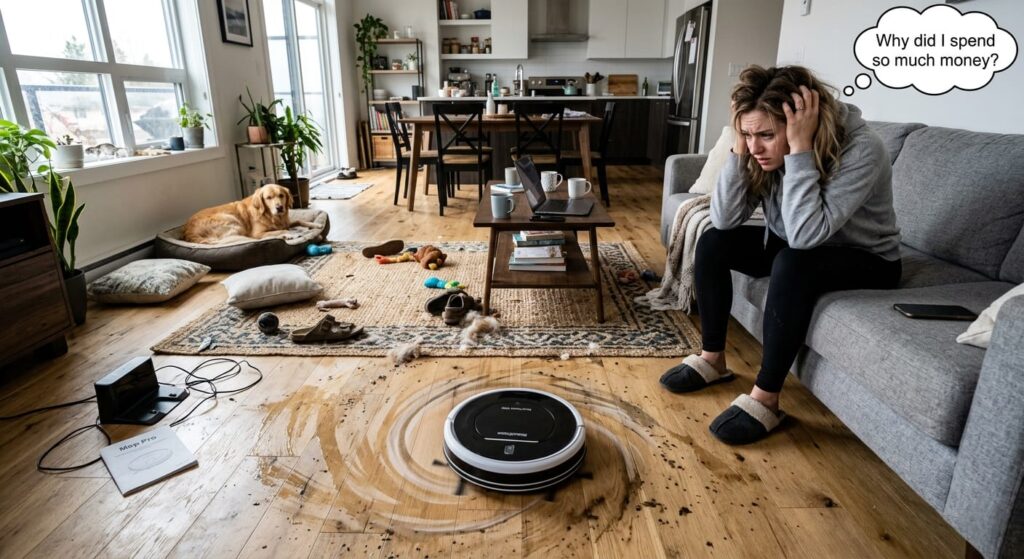
John thought he had made a smart decision. After weeks of watching YouTube reviews, comparing flagship models, and reading glowing comments, he finally pulled the trigger on a premium robot vacuum-mop. It wasn’t cheap, well over $1,000, and it came with a reassuring two-year warranty. The promise? Clean floors, less effort, and finally saying goodbye to vacuuming and mopping.
For the first few days, it felt like magic. The robot mapped his home, glided across the floors, and returned neatly to its docking station. But within weeks, the cracks began to show.
It missed spots, left faint streaks and sometimes left tiny water droplets behind it. Occasionally, it seemed confused, wandering, pausing, recalculating. And when John compared the results to a proper mop-and-bucket cleaning, it simply didn’t measure up.
That’s when John realized something most buyers only discover after they’ve spent the money:
Robot vacuum-mops are incredible, but only if you understand what they actually are (and what they aren’t).
What Robot Vacuum-Mops Are Really Designed For
Robot vacuum-mops are not replacements for deep cleaning. They are maintenance tools.
Even the best models, across brands and generations, share the same core reality:
- None are perfect
- Each has its quirks
- All deliver good enough daily cleaning but not perfection
Think of them like this: They maintain cleanliness between deep cleans, reduce manual effort and keep dust and light dirt under control. But they do not replicate manual mopping. Not even close.
The Biggest Misconception: “It Replaces Mopping”
Let’s be clear: A robot vacuum-mop does not clean like a human with a mop and bucket.
Traditional mopping involves pouring significant water, using detergent freely, applying pressure, scrubbing stubborn stains and removing dirty water completely.
Robot mops, on the other hand: use limited water flow, apply light pressure, rely on small pads or rollers and clean in passes, not scrubbing motions. This is a completely different scale of cleaning.
Even the best systems are gentle cleaners, not aggressive ones.
That’s why sticky stains may remain, corners may collect residue, and deep grime won’t disappear. And yes. You will still need to mop manually sometimes.
One Floor Only (Mostly): A Major Practical Limitation
This is one of the most overlooked issues, and one of the most frustrating.
Robot vacuum-mops are best suited for single-level homes.
Why? Because the docking station is heavy and fixed, the robot relies on its mapped environment and moving the dock requires precise repositioning. For these reasons, many robots don’t handle multiple floor maps reliably.
So if you have a multi-story house or split-level layouts, you’ll face a constant hassle to move the robot and the dock, rebuilding maps and losing accuracy.
This alone makes them far less convenient than expected in multi-floor homes.
Cleaning Imperfections: Streaks, Drops, and Missed Spots
Beware that no robot cleans perfectly.
Common issues include slight dirt along walls, occasional water droplets, streaks between mop passes and missed patches.
These imperfections depend on floor type, lighting conditions requied for navigation, furniture layout and robot design.
Even premium models sometimes leave lines between mop pads, occasionally skip tight corners and can spread moisture unevenly. This doesn’t mean they’re bad. It means they’re limited by design.
Time: Robots Are Slower. Much Slower
Another reality check: robots take their time.
While a human can vacuum, mop and dry, all within a short session, a robot does it differently. It navigates, cleans in passes, returns to wash mop pads, refills water and resume cleaning. It may also recharge mid-job, therefore a robot task for a big house can take hours.
And during that time the floor is partially wet, the robot may pause frequently, and cleaning feels “in progress” for long periods.
While it is convenient, it’s not even close to fast.
Maintenance: More Work Than You Think
Robot vacuum-mops are not maintenance-free.
In fact, they often require more attention than regular vacuums. You’ll need to clean the filters, remove hair from brushes, wash or replace mop pads, clean internal tubing of the water systems and maintain the docking station.
And this is critical, since neglecting maintenance increases failure risk significantly.
Wear and Tear: Things Wear Out Faster
SInce these devices combine dry debris, liquids and moving parts, they wear out faster than traditional vacuums. Therefore, you’ll expect faster degradation of the mop pads, rollers, brushes, seals and pumps.
Why? Because wet dirt is harsher than dry dust.
Cleaning Solutions: Limited and More Expensive
While with a bucket and mop, you can use any detergent and cleaning solution, with the robot vacuum-mops you often need brand-approved solutions, or at least low-foaming liquids.
Why? Because foam damages internal systems and residue clogs pipes.
Expect these robot solutions to be more expensive and less flexible. Also, some models also use deodorizers and specialized additives, all of which increase ongoing costs.
Complexity = Higher Failure Rates
This is one of the most important points.
Robot vacuum-mops are extremely complex machines.
Inside, they combine vacuum motors, water pumps, liquid extraction systems, navigation systems (LiDAR, cameras), wheel motors and dirt disposal systems. Each of these is a potential failure point.
Some units may last years without issues, but others will fail within weeks. It’s partly luck, but also usage and maintenance. And when something breaks, repairs can be expensive, parts are not always cheap and diagnostics can be tricky.
Navigation Isn’t Perfect (Even When It Looks Impressive)
Robots don’t see like humans. They scan, map and reorient constantly, but they don’t understand space holistically. Therefore expect the following limitations:
- They must re-check direction frequently
- They don’t see the whole room at once
- They rely on memory + sensors
So even the best robots will occasionally get confused, re-clean areas unnecessarily and even miss logical paths. Their efficiency is good, but it will never be equal to a human-level.
Why People Still Buy Them (And Love Them)?
After all that, here’s the surprising truth:
People still gladly spend thousands on them.
Why? Because they hate vacuuming, mopping and value convenience over perfection. So, even if the robot misses spots, takes longer and needs maintenance, it still removes a huge mental and physical burden.
And that’s worth it.
Back to John: The Real Ending
After his initial disappointment, John didn’t return the robot. Instead, he adjusted his expectations. He stopped expecting deep cleaning, perfect results, total replacement of manual work, and started using it as a daily maintenance tool and a time saver. Even as a helper, but not a replacement.
And now? He mops manually once in a while and lets the robot handle daily upkeep.
In short, John accepts the imperfections, and suddenly the same device felt like a great purchase.
If you understand that balance before buying, you’ll likely be satisfied. But if you don’t, you’ll probably end up like John in week two: confused, frustrated, and wondering what went wrong.
interesting article. I wish I knew it earlier