
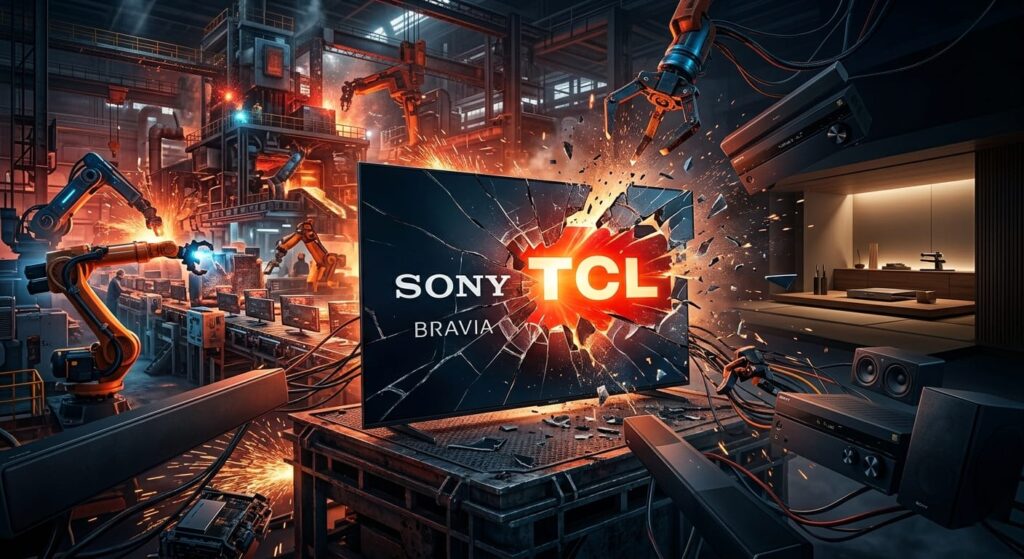
A Partnership in Name, a Transfer in Practice
When Sony and TCL first announced their January memorandum of understanding, the language was careful, almost diplomatic. It emphasized collaboration, shared innovation, and a mutual push toward the future of home entertainment. For many readers, especially in the U.S., this sounded like a strategic alignment, not a structural shift. Sony, after all, has spent decades building BRAVIA into a premium benchmark, and nothing in that early messaging suggested a fundamental change in control.
Sony’s March 31 announcement uses notably softer, more measured language, emphasizing collaboration, shared value, and continuity without explicitly addressing control or structural change. The TCL March 31 2026 announcement, however, cuts through that ambiguity. TCL’s own words are precise and difficult to reinterpret: the new company will be formed with “TCL holding 51% and Sony holding 49%.” That is not a symbolic distinction.
It defines control, governance, and ultimately who decides how this business evolves.
The language of partnership remains intact, but the underlying structure points clearly in one direction. This is less about two companies working side by side and more about one company taking the lead while the other steps back, carefully, deliberately, but unmistakably.
The Line That Changes Everything
There is one sentence in TCL’s release that reframes the entire story:
“The new entity “will succeed to Sony’s home entertainment business.”
It is a dense, almost clinical phrase, but its implications are far-reaching. This is not a limited collaboration around specific products or technologies.
It is the transfer of an entire operational ecosystem: development, design, manufacturing, logistics, and customer service, into a new structure controlled by TCL.
That distinction matters because it directly challenges the softer narrative introduced in January. “Working together” implies shared effort across independent systems. “succeed to Sony’s home entertainment business” implies replacement. The difference is not semantic; it is structural. For industry observers and informed consumers, this is the moment where the story shifts from partnership to transition.
Sony is not simply adding a partner. It is redefining its role within its own category.
It’s Not Just TVs. The Audio Business Is Moving Too!
One of the most underappreciated aspects of this deal is how many people still think it’s just the TVs. That assumption doesn’t hold up when you actually read the fine print. TCL’s own announcement states that the new company will take in addition to Consumer TVs (BRAVIA), B2B Flat Panel Displays (B2B BRAVIA), B2B LED Displays, projectors” also “home audio equipment such as home theater systems and audio components“.
That phrasing may look narrow at first glance, but in industry terms it’s anything but it is effectively shorthand for Sony’s entire consumer home audio stack.
Because once you follow that definition through, the scope becomes much broader. “Home theater systems and audio components” is the umbrella under which Sony’s AV receivers, soundbars, wireless speakers, and integrated systems sit. And when the same document clarifies that the new entity will “succeed to Sony’s home entertainment business” across development, manufacturing, sales, logistics, and service, it becomes clear that this isn’t a partial carve-out, but a full operational transfer of the category. In other words, this isn’t just about who builds your next BRAVIA TV; it’s about who builds and ultimately shapes the entire audio ecosystem that surrounds it.
That includes categories consumers often don’t immediately connect to “home entertainment”. Bluetooth speakers, multi-room audio systems, even parts of Sony’s broader wireless audio strategy are tied into this same ecosystem logic. While not every headphone line is explicitly listed, the direction is unmistakable: the center of gravity for Sony’s home audio hardware: everything that powers, amplifies, and projects sound in the living room, is moving under a TCL-controlled structure. What makes this particularly striking is how easily it gets lost in the headline narrative about TVs. The display is what people see, but the audio business is what defines the system, and that system is now part of the same transfer, whether consumers realize it yet or not.
Manufacturing Moves, Power Follows
If ownership defines control, manufacturing defines influence. TCL’s disclosure that “100% of the equity in Sony EMCS (Malaysia)… will be transferred to TCL” is not just a logistical detail: it is a strategic signal. Control over factories, supply chains, and production pipelines has always been the backbone of the TV industry.
By transferring these assets, Sony is effectively handing over the industrial core of its home entertainment business.
For TCL, this is a natural expansion of its strengths. The company thrives on scale, efficiency, and supply chain dominance. For Sony, the move reflects a broader shift away from capital-heavy operations and toward higher-margin differentiation: processing, software, and brand equity. But this balance is delicate.
Over time, manufacturing influence can quietly redefine design priorities, cost structures, and even perceived quality.
When one company controls how products are built, it inevitably shapes what those products become.
The Brand Stays, the Structure Changes
Sony’s messaging remains focused on continuity. The March framework reassures that products will continue to carry the “Sony” and “BRAVIA” names, preserving the identity that consumers recognize and trust. On the surface, this suggests stability.
Walk into a U.S. retailer in 2027, and the branding will look familiar, even reassuring.
But branding and control are not the same thing. Historically, BRAVIA’s reputation has been built on Sony’s end-to-end oversight: its ability to integrate panel technology, image processing, and acoustic design into a cohesive experience.
When that oversight becomes shared, or partially delegated, the equation changes.
Not immediately, and not necessarily negatively, but fundamentally. The logo remains constant; the system behind it evolves.
The Consumer Question Gets Harder
For the average buyer, this shift introduces a new layer of complexity. Imagine someone in the U.S. who bought a Sony OLED a few years ago and is now considering an upgrade. Their expectations are clear: top-tier processing, accurate colors, seamless integration with gaming and streaming. What they are not expecting is to evaluate corporate structures or joint venture dynamics.
And yet, that context now matters. A TV purchased in 2026 may still reflect Sony’s traditional operational model, even if the transition is already underway.
A model released in late 2027 or 2028 will almost certainly come from the new BRAVIA Inc. structure.
The difference may not be visible on a spec sheet, but it will exist in how the product is conceived, built, and delivered. This uncertainty is already influencing behavior. Some consumers are choosing to wait, particularly with both companies expected to share more concrete product details toward the end of May. The question is no longer just “Which TV is better?” but “What am I actually buying into?”
TCL’s Gain, Sony’s Repositioning
From TCL’s perspective, the move is decisive and strategically sound. Acquiring a controlling stake in a globally recognized premium brand accelerates its push upmarket. TCL has long competed on value; this partnership gives it immediate credibility in the high-end segment, backed by Sony’s legacy and brand equity.
For Sony, the logic is different but equally deliberate. The TV business has become increasingly competitive, with tightening margins and rising complexity. By transferring operational responsibility while retaining brand and technological influence, Sony is effectively reshaping its role. It is moving from being a full-stack manufacturer to something closer to a curator of experience, focused on processing, ecosystem integration, and user-facing innovation.
But this repositioning comes with trade-offs.
El Sony January 20th narrative emphasized collaboration and shared vision. The March reality introduces hierarchy and control. The two are not mutually exclusive, but they are not identical either.
2027: Inflection Point, Not Endpoint
When BRAVIA Inc. officially launches operations in April 2027, the structural transition will be complete. But the market impact will unfold gradually. Early products may feel indistinguishable from current Sony offerings, maintaining the performance and design language consumers expect. Over time, however, the influence of TCL’s operational model is likely to become more visible. Whether through pricing strategies, product segmentation, or release cycles.
The upside is clear: faster innovation, broader accessibility, and potentially more competitive pricing. The risk is equally clear: a gradual shift away from the tightly controlled, premium-focused approach that defined BRAVIA for years. Neither outcome is guaranteed. The reality will likely fall somewhere in between, shaped by how effectively the two companies balance their strengths.
Beyond the Messaging
It is tempting to take corporate language at face value, to accept “partnership” as a complete description of what is happening. But the details tell a more nuanced story. Ownership, operational control, and asset transfer all point toward a deeper transformation, one that goes beyond collaboration.
This does not diminish Sony’s role or its continued influence. The company remains a key stakeholder, with a strong voice in the future of BRAVIA. But it does clarify the direction of change. The center of gravity is shifting, and with it, the dynamics of one of the industry’s most recognizable brands.
The Real Test
In the end, this transition will not be judged by press releases or corporate framing. It will be judged by performance: by how these TVs look in real-world conditions, how they sound, how they integrate into broader home entertainment systems, and how they hold up over time.
For consumers, the advice is not to panic or to rush, but to pay attention. The BRAVIA name still carries weight, and Sony’s engineering DNA is not disappearing. But the structure behind that name is evolving, and that evolution will shape the products that follow.
Partnership or transfer, whatever label one prefers, the outcome will be defined not by intent, but by execution. And that is where the next chapter of BRAVIA will truly be written.