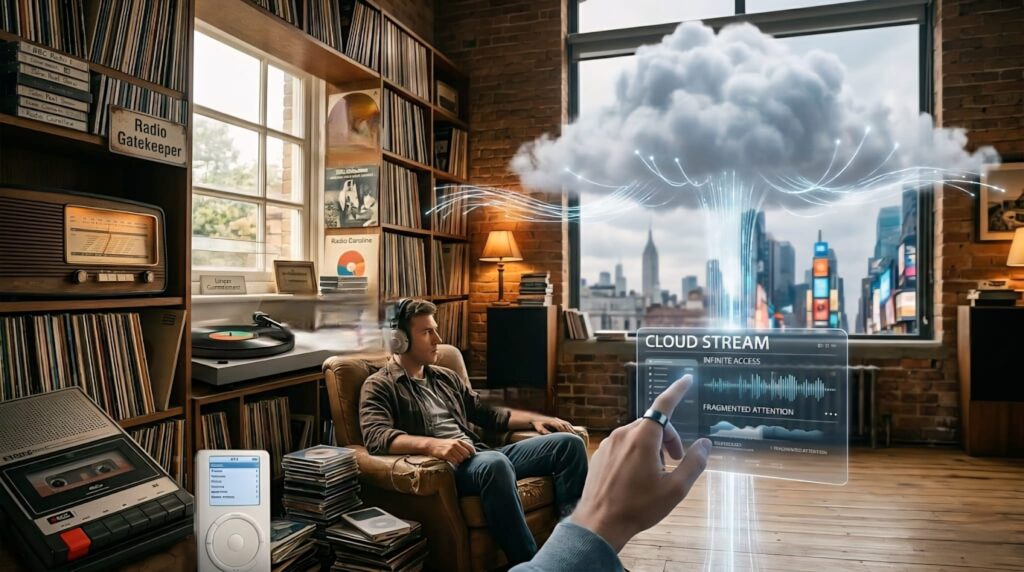
There are changes that happen so gradually that we cannot point to the exact moment when something essential shifted. The way we listen to music is one of them.
There was no morning when I woke up and decided to stop listening to full albums on physical media. No dramatic farewell to the radio. It simply happened, quietly, as technologies designed to make life easier slowly reshaped our habits, and with them, our relationship to music.
This piece is not written out of blind nostalgia. It is an attempt to understand how the format through which we consume music shapes our connection to it, how it affects the time we dedicate to listening, and whether we still truly listen at all.
Radio: When Music Required Patience
Before digital libraries and algorithmic playlists, radio was a gatekeeper.
If you grew up in the UK, perhaps it was BBC Radio 1, BBC Radio 2, or the legendary pirate spirit of Radio Caroline. Later, voices like John Peel became trusted cultural curators rather than playlist announcers.
Music wasn’t on demand. It arrived at a scheduled hour, selected by someone with taste, context, and a point of view.
As a teenager, I didn’t “have music on.” I listened.
If I missed a song, it was gone. There was no replay button, no streaming archive. Shows introduced artists, built narratives, created anticipation. A new track felt like an event.
The disadvantage was obvious: limited control.
If you didn’t like a song, you waited.
But the benefit was profound: music demanded presence.
Vinyl: Physical Commitment to Art
Vinyl was something else entirely.
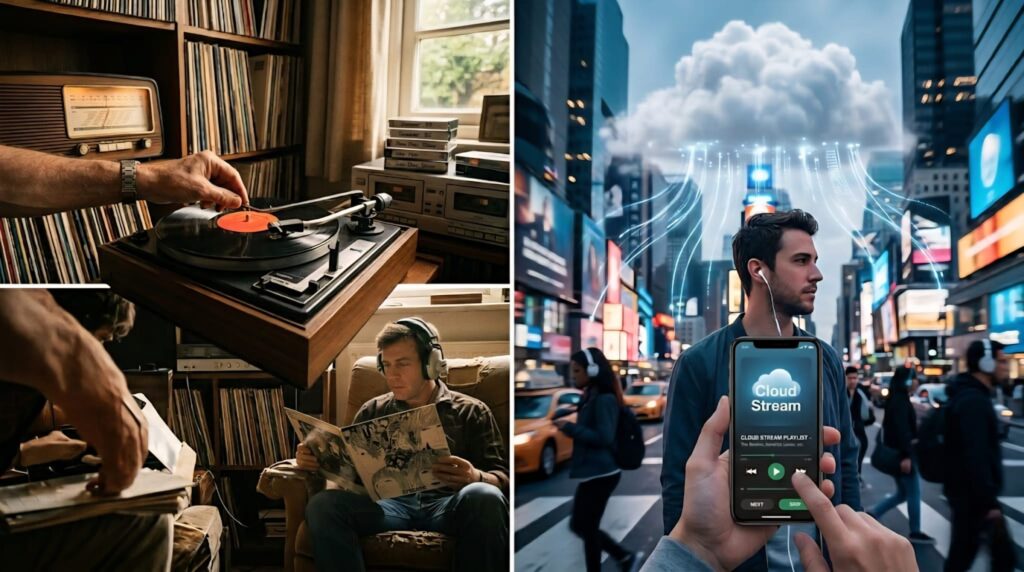
Buying a record meant investing money, time, and intention. You didn’t buy a track, you bought an album. A cover you held. Liner notes you read. A deliberate sequence: Side A and Side B.
When our first hi-fi system arrived in the early 1980s, it wasn’t just electronics, it was a statement. Music mattered in this house.
Placing the needle on a record required care. And once it was down, you stayed. Skipping wasn’t effortless. Even the “weaker” tracks received their chance, and sometimes became favorites precisely because you allowed them space.
Vinyl taught linear listening. Commitment.
The downside? Cost and access. You couldn’t own everything.
But scarcity created depth. It also created community, trading records, borrowing albums, debating them face to face.
Cassettes: Control, Creativity, Memory
Cassettes introduced freedom.
By thirteen, I was saving money not just to buy albums, but blank tapes. Recording songs off the radio, hoping the DJ wouldn’t speak over the intro. Waiting with a finger hovering above the REC button.
Mixtapes were my first playlists, not generated by code, but by patience and timing.
But radio wasn’t the only source.
In my case, it was a stall at Camden Market in London.
It looked modest, almost improvised. But to many of us, it was a gateway. The vendor curated unofficial compilation tapes: new dance tracks, extended 12-inch mixes, imports that hadn’t yet reached mainstream airplay.
There was always a tape deck playing. You’d stand there, listening to the opening minute of a track through slightly distorted speakers, exchanging glances with friends before deciding whether to buy.
Looking back, what strikes me is not the bootleg nature of it, but the human filter. One person’s ear, taste, instinct. No algorithm. No data mining. Just knowledge and passion.
Those tapes weren’t perfect. They hissed. They wore out.
But they carried stories. A specific afternoon. A shared decision. A moment.
Music consumption was slower. Friction existed. And that friction gave it weight.
CDs: Precision and the Beginning of Fragmentation
The compact disc promised perfection.
No hiss. No scratches (at least in theory). Crisp digital sound.
Suddenly you could skip tracks instantly. For someone with hundreds of tapes, this felt revolutionary.
My CD collection grew into the hundreds. Remastered editions. Imported singles. Hidden-track discoveries. Music sounded cleaner than ever.
But something subtle shifted.
Skipping became easy. Too easy.
The discipline of listening through began to erode.
Still, CDs required intention. You inserted one. You pressed play. You sat down.
There was still a ritual.
MP3: When Music Lost Its Weight
The real fracture didn’t begin with streaming. It began with MP3.
The moment I realized entire albums could become tiny compressed files felt almost magical. I painstakingly ripped my CD collection, hundreds of albums, using early software that required command-line instructions rather than friendly “Rip” buttons.
It was laborious. Technical. Almost sacred.
But once complete, my shelves of discs were reduced to a hard drive.
Music had lost its physical mass.
At first, this felt empowering. I could create impossible compilations, genres colliding, eras blending, albums disassembled and rearranged.
But something else was happening.
When everything is available, nothing insists.
Ownership blurred. Value softened.
Streaming: Infinite Access, Fragmented Attention
Today’s streaming platforms, such as Spotify, Apple Music, and others, represent the peak of convenience.
Nearly every song ever recorded is available instantly.
It is an extraordinary technological achievement.
And yet.
The abundance encourages skipping. Ten seconds here. Twenty seconds there. Songs are consumed like social media posts. Albums become data pools.
The algorithm, as intelligent as it may be, reinforces patterns. It optimizes familiarity. It reduces risk. It rarely challenges us the way a daring radio host or a strange record-store recommendation once did.
Perhaps the deepest shift is this: music has become background.
We listen while driving. Working. Scrolling. Rarely do we stop and say, “Now I am listening.”
The ritual has dissolved.
Between Past and Future
I still own a turntable. It’s not as nostalgia, but as resistance. Placing a record on the platter forces stillness. It creates a beginning and an end. It restores listening as an event rather than an accessory.
This journey, from needle to cloud, mirrors the cultural journey of music itself.
Not everything has been lost. Access is democratized. Discovery is easier. Independent artists can reach global audiences. But something changed. The real question is not which technology is superior.
It is how we choose to use it.
Can we reclaim moments of intentional listening within the abundance? Can we sit through an album without reaching for the skip button? Can we allow music to demand our full attention again?