Over the past decade, a clear shift has taken place in the world of wristwear. Traditional fashion watches have gradually disappeared from store shelves, and the line between fitness trackers and smartwatches has effectively vanished.
While legacy watchmakers attempted to compete through design and craftsmanship, the modern watch evolved into something far more versatile: a device that blends communication, health monitoring, payments, and deep smartphone integration.
Today’s smartwatch market is crowded with major players, including Apple, Samsung, Garmin, Google (via Fitbit), and Huawei.
According to recent market data, there are now roughly half a billion smartwatch users worldwide, with global revenue expected to reach about $50 billion in 2025, and continued growth projected through the end of the decade.
Health features are increasingly central to this category. What once started as simple step counting has evolved into continuous monitoring of heart rhythm, blood oxygen levels, sleep patterns, and stress.
The Competition
The rivalry between Samsung and Apple has pushed smartwatch innovation forward at a remarkable pace.
Samsung tends to emphasize hardware innovation, regularly introducing brighter displays, additional sensors, and new health metrics before they appear in competing products. Apple, on the other hand, focuses heavily on ecosystem integration and software polish.
One factor that still limits switching between the two ecosystems is the smartphone platform divide. Watches designed for Android devices rarely offer full functionality on iPhones, and the reverse is equally true.
Smartwatches as Health Devices – Real Measurement or Gimmick?
One of the biggest questions among users is whether smartwatch health features should be taken seriously. Features such as:
- Atrial fibrillation detection (AFib)
- Blood oxygen measurement (SpO₂)
- Sleep apnea detection
- Stress monitoring
- Abnormal heart rate alerts
have become standard on premium smartwatches.
Importantly, several of these capabilities now carry regulatory clearance, including approvals from the U.S. Food and Drug Administration (FDA) for certain models and functions. As a result, some physicians increasingly use smartwatch data as a supplementary monitoring tool, especially for long-term tracking between medical appointments.
While these devices are not replacements for clinical equipment, they are no longer just novelty features. In some contexts, they are already becoming part of everyday preventive healthcare.
Everyday Smartwatch Use
Not everyone buys a smartwatch for health monitoring. For many users, daily convenience features are just as important. Typical uses include:
- Viewing incoming calls and messages
- Contactless payments via services like Google Pay
- Music playback control
- Reminders and notifications
- Fitness tracking
This blend of productivity and health tracking is exactly where Samsung positions its Galaxy Watch series.
Galaxy Watch 8: Samsung’s Eighth Generation
Samsung traditionally unveils its smartwatch lineup during the summer at its annual Samsung Galaxy Unpacked event. Since 2018, the company has steadily strengthened its position as the leading smartwatch brand in the Android ecosystem.
This year marks the eighth generation of Samsung’s smartwatch lineup.
The Galaxy Watch 8 series includes several versions:
- Watch 8 Classic – featuring a mechanical rotating bezel
- Watch 8 standard model – slimmer and more minimalist
- Watch Ultra – the rugged model introduced last year and still available
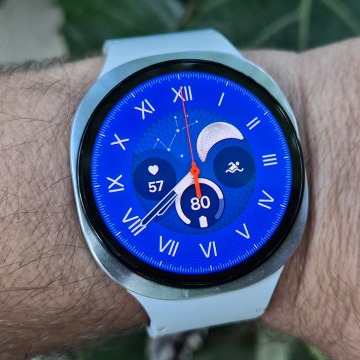
For this review, I tested the 44 mm Bluetooth version of the standard Galaxy Watch 8, which strikes a good balance between size and elegance.
What’s in the Box
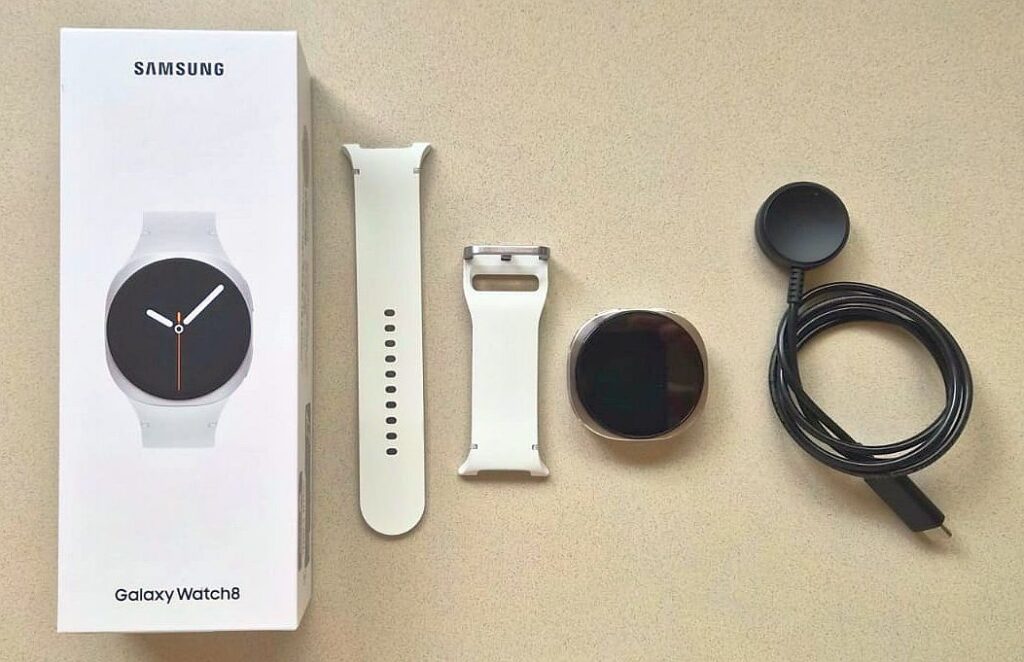
The packaging includes the watch body and the strap separately, requiring the user to attach the strap before first use.
At first this may seem unusual, but Samsung likely designed it this way to encourage users to experiment with different bands. Once you see how easy the attachment system is, swapping straps becomes almost effortless.
The box also includes a magnetic wireless charging puck with a USB cable, ensuring the watch aligns correctly during charging.
As with previous generations, no wall charger is included.
Design and Differences vs Watch 7
The Galaxy Watch 8 introduces a subtle design shift. Its case now follows a “cushion” shape, giving the underside a flatter surface against the wrist compared to the more rounded design of the Watch 7.
Samsung claims the flatter structure improves stability during workouts. In practice, the watch indeed feels secure and comfortable during daily wear and exercise.
The two physical buttons are now aligned parallel to each other, unlike the angled layout on the previous model. While visually cleaner, this change means the wrist sometimes needs to rotate slightly more to reach them.
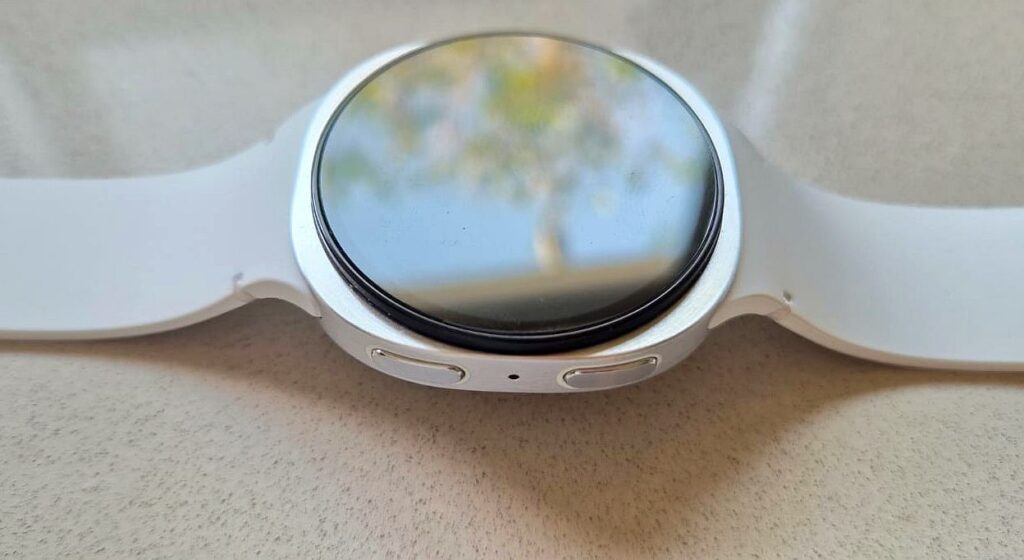
The Watch 8 is also 11% thinner and lighter than the Watch 7, further improving comfort.
The strap design has also evolved. On the previous model, release buttons were integrated into the strap itself. Now they are built into the watch case, making band changes even easier.
Display
The Galaxy Watch 8 retains Samsung’s Super AMOLED display, which remains one of the strongest features of the device.
Brightness has increased dramatically, from 2,000 nits on the Watch 7 to 3,000 nits on the Watch 8. At maximum brightness the screen can be dazzling, even under direct sunlight.
Samsung even uses the display to double as a flashlight when needed.
Resolution remains 480 × 480 pixels, but text rendering appears sharper thanks to subtle software optimizations.
Combined with the wide variety of customizable watch faces, the result is a display that looks both modern and visually striking.
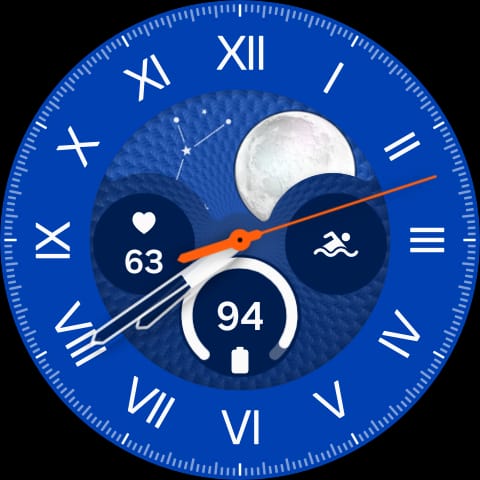
Text size in the interface can also be increased and displayed in bold mode, making the watch easier to read for users who wear reading glasses.
An always-on display option is also available.
Interface
The Watch 8 runs One UI Watch 8, Samsung’s latest smartwatch interface.
Navigation feels smoother than before, with fluid animations and faster app launches. Switching between screens is done via swipes in all directions left, right, up, and down, so there is a short learning curve for new users.
Hardware
Surprisingly, most hardware specifications remain similar to the Watch 7. The watch uses a 3-nanometer, five-core processor, paired with 2 GB RAM and 32 GB storage.
Water resistance is IP68, and the watch is rated for 5 ATM, allowing swimming and shallow diving.
The real upgrades this year are primarily software-driven.
Sensors and Health Tracking
The Watch 8 includes the same sensor array as its predecessor:
- Optical heart rate sensor (PPG)
- ECG for atrial fibrillation detection
- Blood oxygen sensor (SpO₂)
- Skin temperature sensor
- Accelerometer and gyroscope
- Barometer
In practice, Samsung appears to have improved measurement accuracy through updated algorithms.
A new metric called Antioxidant Index has also been introduced, estimating carotenoid levels in the skin to provide insight into antioxidant levels in the body.
Battery and Charging
Charging is wireless using the included magnetic charging puck. A full charge takes about 90 minutes. Battery capacity increased slightly to 435 mAh, up from 425 mAh in the Watch 7.
In real-world use, however, the watch still requires daily charging if you perform about 90 minutes of sports activity per day.
Power-saving mode can extend battery life, but it disables several key features such as sleep tracking, Wi-Fi connectivity, and high-frequency sensor sampling.
Operating System and Apps
The Galaxy Watch 8 runs Wear OS with Samsung’s One UI Watch layer, blending elements of Samsung’s former Tizen platform with Google’s ecosystem. Users benefit from access to the Google Play Store, which offers a vast range of apps including WhatsApp, Strava and MyFitnessPal.
The watch also integrates with the following Samsung apps:
- Galaxy Wearable – device management
- Samsung Health – activity tracking
- Samsung Health Monitor – medical metrics including ECG and blood pressure
These apps allow users to export reports and share them with healthcare providers.
User Experience
As someone who regularly trains with a Garmin Fenix 8, I was surprised by how enjoyable the Watch 8 felt in daily use.
The display is dramatically brighter, the interface more fluid, and the smartwatch features far more extensive.
Making phone calls directly from the watch works well thanks to its surprisingly powerful speaker. Voice replies to WhatsApp messages are also convenient, provided the phone is nearby.
However, there is one odd design choice: the speaker faces the elbow rather than the wrist, which makes listening to calls in noisy environments slightly awkward.
Sports Performance
During walking workouts the watch automatically announces average heart rate every kilometer, encouraging you to maintain your pace. The activity log pauses automatically when you stop moving and resumes once you continue.
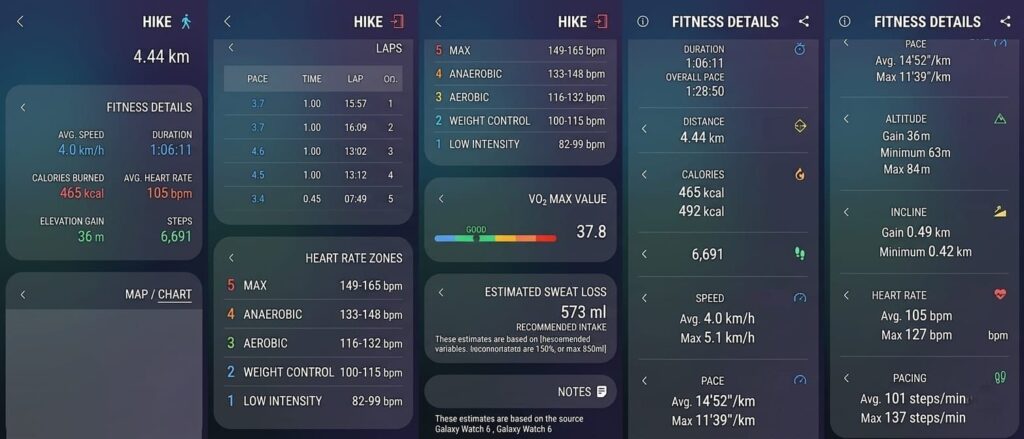
Workout summaries include detailed metrics such as heart rate zones, elevation, step count, distance, calories burned, estimated sweat loss and VO₂ max.
Route maps are displayed using data from Google Maps.
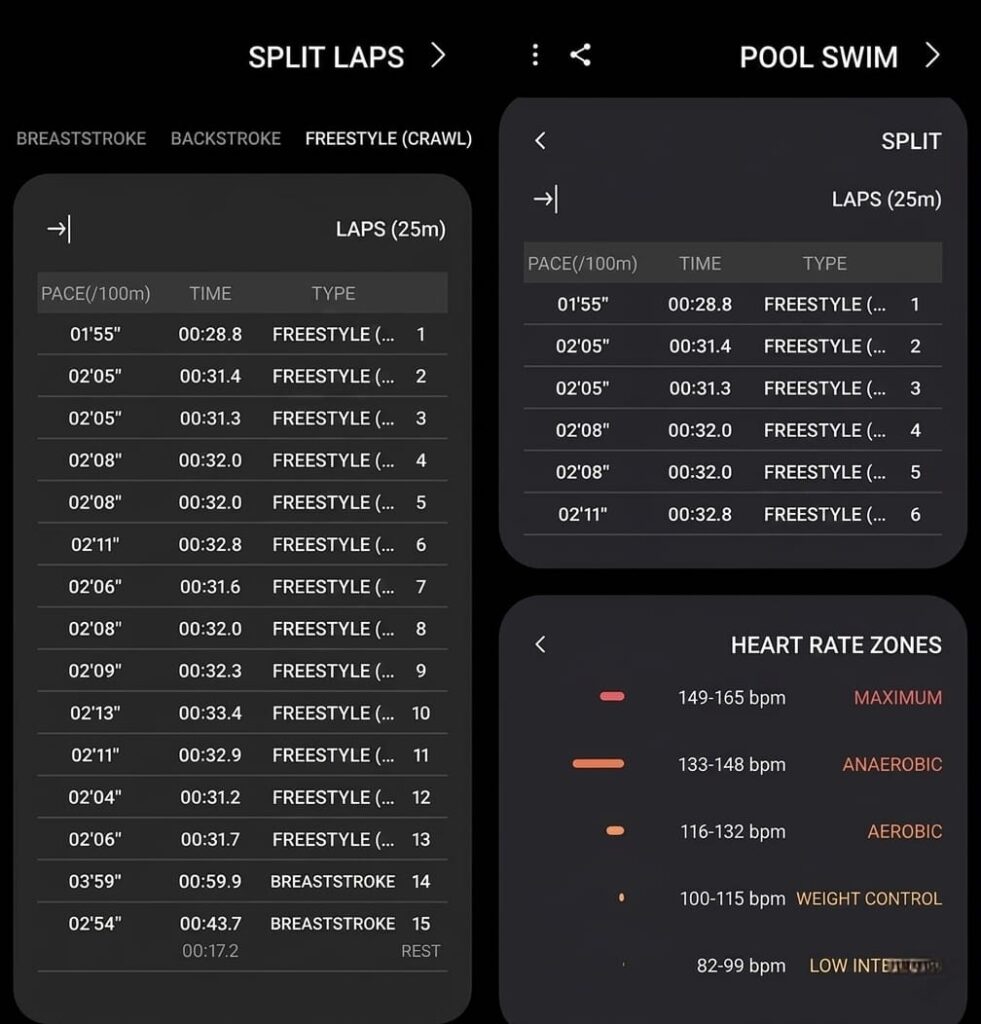
Swimming performance tracking is also impressive. The watch automatically detects swimming style for each pool lap and calculates pace accordingly.
One Design Limitation
Despite the large display, Samsung still uses relatively small fonts for key workout metrics.
Heart rate, the most important metric for many athletes, is displayed in the smallest font size. Users can increase font size by displaying fewer metrics on screen, but that requires sacrificing information.
For swimmers wearing goggles, reading the display can be challenging.
Final Verdict – Is It Worth It?
After extended use, the Galaxy Watch 8 left a strong impression.
It is arguably the most refined smartwatch Samsung has built so far.
It combines a gorgeous display, advanced health features, and an excellent smartwatch experience. For users with a Samsung Galaxy smartphone, the ecosystem integration makes the experience even better.
Dedicated sports watches from brands like Garmin and Suunto still offer advantages in battery life and hardcore training features. But they lack many of the smart capabilities that make everyday life easier.
Since most people don’t spend their entire day exercising, the smart features, calls, messaging, payments, and app integration, give the Galaxy Watch 8 a meaningful advantage.
The watch is not perfect. Battery life still requires frequent charging, font sizes during workouts could be improved, and WhatsApp notifications occasionally lose sync if the watch is disconnected from the phone.
Still, if you are looking for a smartwatch that blends fitness tracking, health monitoring, and full smart functionality, the Galaxy Watch 8 is a very strong contender, especially for Samsung smartphone users.