
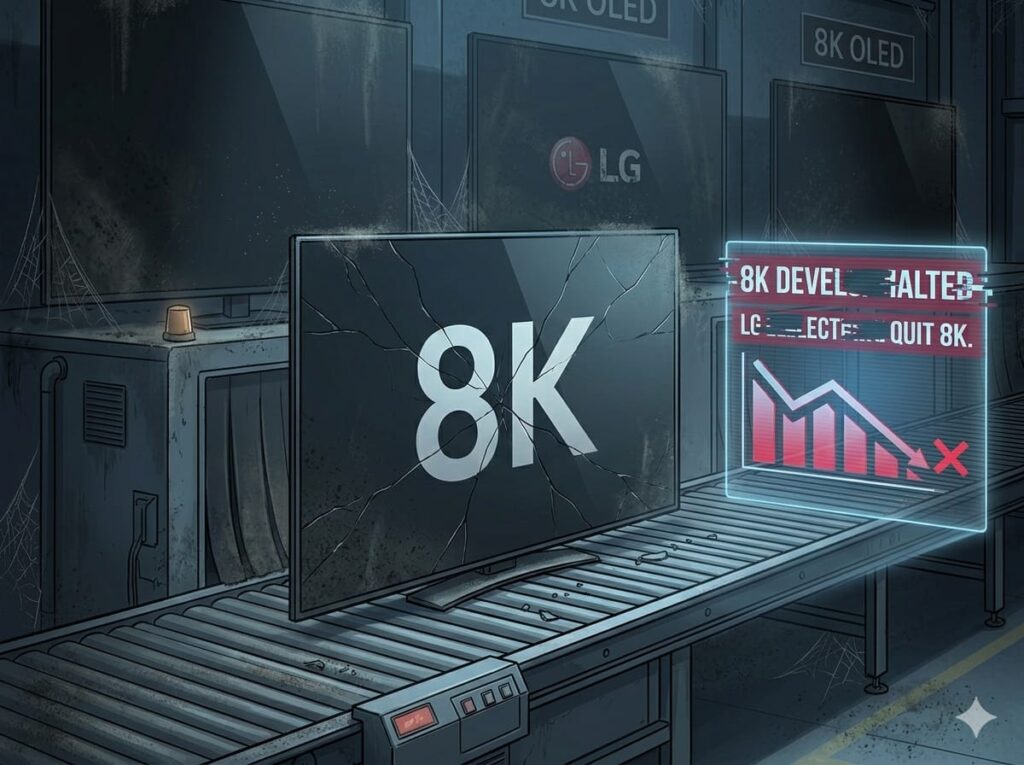
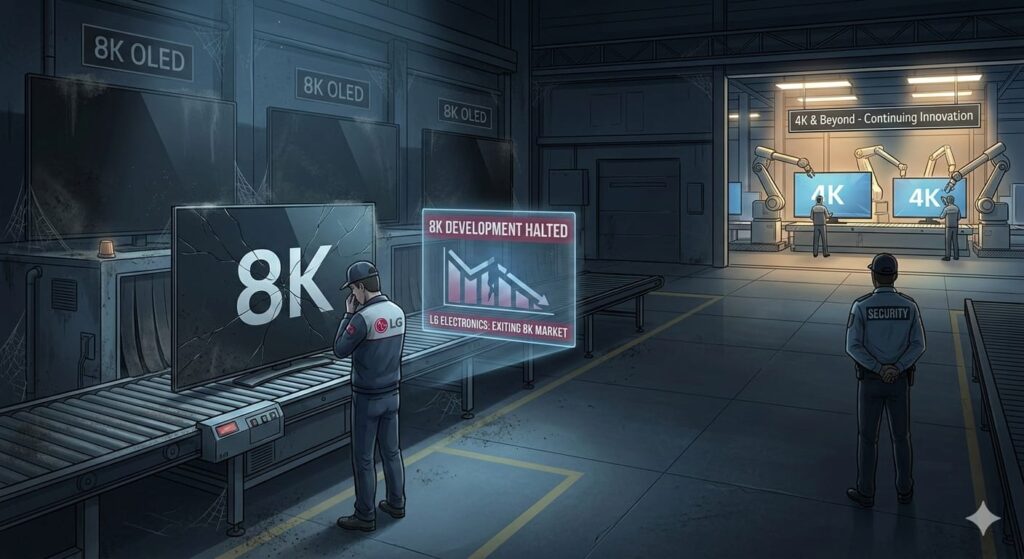
Recent industry reports point to a significant turning point in consumer television history. LG Electronics is discontinuing the development and production of 8K televisions across both OLED and LCD technologies, effectively ending 8K as an active category within its consumer lineup.
For years, higher resolution was treated as the natural evolution of television. Full HD gave way to 4K, and 8K was positioned as the next inevitable leap. LG’s move suggests that, at least for now, the jump to 8K may have been one step too far.
What makes this story particularly interesting is not just the decision itself, but the way it has unfolded.
Why Didn’t LG Make a Formal Announcement?
One of the most intriguing aspects is the absence of a clear, official press release declaring the end of 8K production.
From a corporate communications standpoint, this is not surprising. For years, LG presented 8K, especially through its premium Z series OLED models, as the future of television. A formal announcement ending the category could be interpreted as admitting that the future did not arrive as expected, or worse, that the company misjudged market demand.
Global technology companies rarely issue press releases about what they are discontinuing. They announce what replaces it.
There are several strategic reasons for handling it quietly:
8K models were halo products:
LG’s 8K TVs were never designed for mass sales. Models like the LG OLED Z3 carried extremely high price tags and served primarily as technological showcases. They reinforced LG’s innovation credentials across the entire lineup. Publicly closing the category could dilute that effect.
Consumer confidence in future upgrades:
If 8K were declared “dead,” consumers might reasonably ask why they should trust that the next generation of 4K innovation is truly future proof.
Impact on existing customers and channel inventory:
Early adopters who invested heavily in 8K OLED models could feel abandoned. Retailers may still hold unsold inventory. A quiet phase out minimizes reputational and financial friction.
It is also possible that the decision originated operationally within LG Display rather than as a customer facing strategic shift, and only later became visible through supply chain signals and regional website inconsistencies.
In some markets, 8K product pages remain live while actual availability has faded.
How Did We Get Here?
LG entered the 8K arena in 2019 with the LG OLED Z9, one of the first OLED televisions to offer a 7680×4320 resolution panel. Over time, LG expanded the lineup through Z1, Z2, and Z3 OLED generations, and also introduced 8K LCD models within its QNED series, such as the LG QNED99T.
On paper, 8K offers around 33 million pixels. That is four times 4K and sixteen times Full HD. Technically impressive, unquestionably forward looking.
But technology does not succeed on specifications alone. It depends on ecosystem support.
The Content Problem
The largest barrier to 8K adoption has been content availability. Major streaming platforms such as Netflix and Amazon Prime Video focus on 4K distribution, not 8K. YouTube does support 8K uploads, but the volume remains limited and far from mainstream.
Physical media has not bridged the gap either. Ultra HD Blu-ray discs are capped at 4K resolution. Gaming support exists in niche scenarios, but native 8K titles are rare. Without a compelling and abundant content pipeline, consumers have little incentive to upgrade.
There is also the practical viewing factor. On 65 inch screens and below, at typical living room distances, many viewers struggle to perceive meaningful differences between 4K and 8K. The resolution advantage becomes more visible on very large displays.
Cost Versus Demand
The economics further complicate the equation. Manufacturing 8K panels is significantly more expensive than producing 4K panels. The higher pixel density increases production complexity and reduces yield efficiency. Processing 8K content also requires more powerful image processors and greater energy consumption.
When you combine higher manufacturing costs, limited content, minimal perceptual gain for average screen sizes, and premium retail pricing, demand naturally softens.
For LG, the conclusion appears straightforward. At current market conditions, 8K is not commercially sustainable.
Who Remains in the 8K Market?
With LG stepping away, Samsung stands as the primary global manufacturer still actively promoting 8K televisions. Sony’s last 8K model, the Sony Z9K, has been phased out. Brands such as TCL and Hisense have also refrained from launching new 8K generations. For now, Samsung holds the category largely on its own.
Is 8K Gone for Good?
Not necessarily.
While resolution scaling appears to have stalled, 4K televisions continue to evolve rapidly. Advances in color science, high dynamic range performance, mini LED backlighting, OLED brightness improvements, and AI driven upscaling have significantly enhanced real world image quality without increasing pixel count.
However, screen size trends may eventually reopen the 8K conversation. As 98 inch and larger televisions become more affordable and mainstream, pixel density again becomes relevant. On 115 inch displays and beyond, the difference between 4K and 8K can become more noticeable.
In that sense, 8K may not be dead. It may simply be waiting for the market to catch up.
A Broader Reflection
This development highlights an important lesson in consumer technology. Innovation alone does not guarantee adoption. Ecosystem readiness, content support, perceptual benefit, and price alignment must converge.
Have you ever invested in a cutting edge technology only to see it quietly abandoned later?
The 8K chapter may turn out to be less of a failure and more of a pause in the evolution of television.
[…] Electronics recently discontinued the development and production of its 8K TV lineup. Not through a dramatic press event, but through […]