
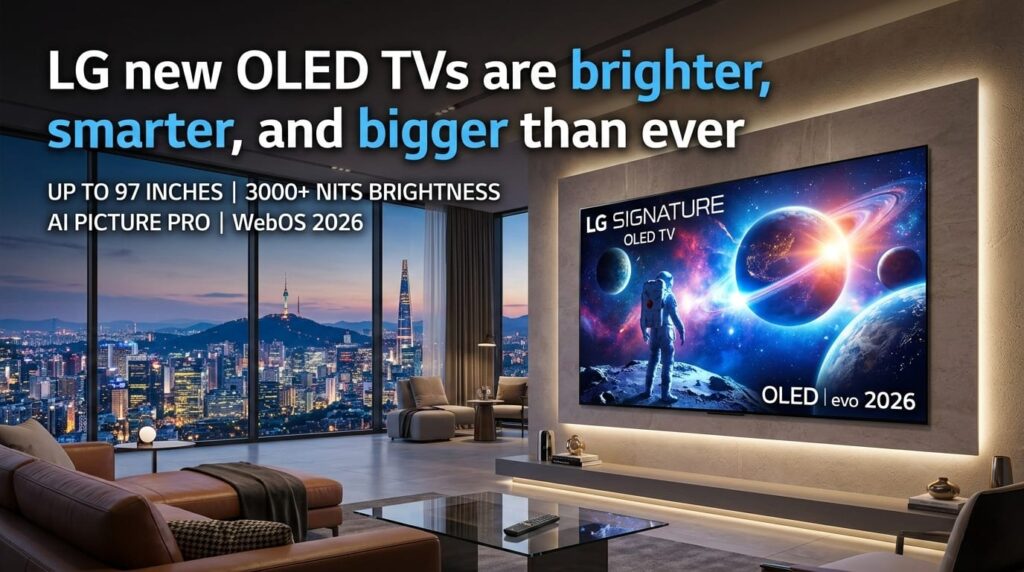
LG has officially introduced its 2026 television lineup, led by the new OLED evo G6 and OLED C6 series. The new models succeed last year’s G5 and C5 televisions and continue LG’s strategy of refining OLED technology with higher brightness, more advanced image processing and improved gaming capabilities.
While the new generation does not represent a radical technological leap, LG has improved nearly every key aspect of its OLED televisions. The upgrades focus on panel brightness, processing power and expanded screen sizes, while pricing remains largely consistent with the previous generation.
Just as importantly, the 2026 lineup signals LG’s growing ambition to compete in the market for ultra-large televisions, with OLED models now reaching sizes that were once dominated by Mini-LED competitors.
G6 vs. G5: Incremental but Meaningful Improvements
The G6 series remains LG’s flagship OLED offering for 2026. Compared with the G5, the most noticeable upgrade comes in brightness.
LG claims the new G6 panel delivers roughly 20% higher peak brightness than its predecessor. This improvement is particularly noticeable in HDR content, where highlights appear more intense and small bright elements retain more detail. Full-screen brightness has also increased modestly, helping the TV perform better in bright living rooms.
A significant part of the upgrade comes from LG’s new processor, the Alpha 11 AI Processor Gen3. This chip is designed to improve two areas that have become increasingly important in modern TVs:
- AI-based upscaling of lower-resolution content
- More accurate color gradation and tone mapping
In demonstrations shown during the launch events, the G6 appeared to reduce banding artifacts in dark scenes compared with the G5, producing smoother color transitions.
Design-wise, LG continues with its Gallery design philosophy. Like its predecessor, the G6 is engineered to mount flush against the wall, creating the appearance of a framed piece of artwork rather than a traditional television.
C6 vs. C5: A More Significant Upgrade
If the G6 represents a refinement of the flagship model, the C6 series arguably receives the more interesting upgrades compared with the C5.
Historically, LG’s C-series TVs have delivered excellent performance but used slightly less advanced panels than the G-series. In 2026, that gap begins to narrow.
Some larger C6 models now incorporate Primary RGB Tandem OLED technology, a newer panel structure designed to increase brightness and color efficiency.
While not every screen size receives this upgrade, the change brings the C-series closer to the performance level of LG’s premium models.
Another important shift involves processing power. In previous generations, the C-series typically used a slightly weaker processor than the flagship models.
Both the G6 and C6 use the same Alpha 11 Gen3 processor, narrowing the performance gap between the two lines.
For many buyers, this could make the C6 one of the most attractive options in the premium TV market, combining near-flagship performance with a lower price.
Screen sizes in the C6 range from 42 inches to 83 inches, continuing LG’s strategy of offering OLED televisions for both compact gaming setups and large home-theater environments.
Pricing Strategy: Stability in a Competitive Market
One of the most notable aspects of LG’s 2026 lineup is its pricing strategy. Despite improvements in brightness and processing power, LG has kept launch prices very close to those of the previous generation.
Early pricing for the C6 series in the United States includes:
42-inch: $1,399
48-inch: $1,599
55-inch: $1,999
65-inch: $2,699
77-inch: $3,699
83-inch: $5,299
The G6 series starts at a higher tier:
55-inch: $2,499
65-inch: $3,399
77-inch: $4,499
83-inch: $6,499
97-inch: $24,999
In several cases, prices are nearly identical to the 2025 models, and some larger sizes are even slightly cheaper.
This pricing stability reflects the increasingly competitive premium TV market. Manufacturers such as Samsung, TCL and Hisense have aggressively pushed Mini-LED televisions with high brightness and lower prices, forcing OLED makers to keep costs under control.
OLED Goes Giant: LG Expands Into Ultra-Large TVs
Another key theme in LG’s 2026 lineup is the company’s continued push into extremely large screen sizes.
For years, OLED televisions above 80 inches were considered niche luxury products due to manufacturing complexity and high costs. But the new lineup shows that LG is increasingly comfortable offering OLED at massive sizes.
The company now offers:
- 83-inch OLED models in both the C6 and G6 series
- A 97-inch flagship OLED in the G6 lineup
Although the 97-inch model carries a price tag approaching $25,000, its existence signals a broader industry trend: OLED technology is gradually moving into the territory traditionally dominated by giant LCD and Mini-LED displays.
This move also allows LG to compete more directly with brands like TCL and Hisense, which have recently gained attention for extremely large TVs at aggressive prices.
Gaming and Software Features
Beyond panel improvements, LG continues to position its OLED televisions as premium gaming displays.
The 2026 models support a wide range of gaming features, including:
- 4K resolution at up to 165Hz refresh rate
- Variable Refresh Rate (VRR)
- NVIDIA G-Sync compatibility
- AMD FreeSync Premium
- Input lag and response times around 0.1 milliseconds
These specifications make the new OLED TVs particularly appealing to PC gamers and console players using devices like the PlayStation 5 or Xbox Series X.
The televisions also run webOS 26, the latest version of LG’s smart TV platform. The updated system adds more AI-driven personalization features designed to automatically adjust picture settings, recommend content and optimize sound depending on the type of media being played.
The Bottom Line
LG’s 2026 OLED lineup represents an evolution rather than a revolutionת but it is a carefully targeted one.
The G6 refines the flagship formula with improved brightness and more powerful image processing, while the C6 brings higher-end technologies closer to the mainstream segment of the OLED market.
At the same time, stable pricing and the expansion into massive screen sizes demonstrate LG’s broader strategy: maintain leadership in OLED technology while pushing it into new segments of the television market.
As OLED TVs continue to grow larger and brighter, LG is clearly betting that the future of premium home entertainment will be both OLED and enormous.