
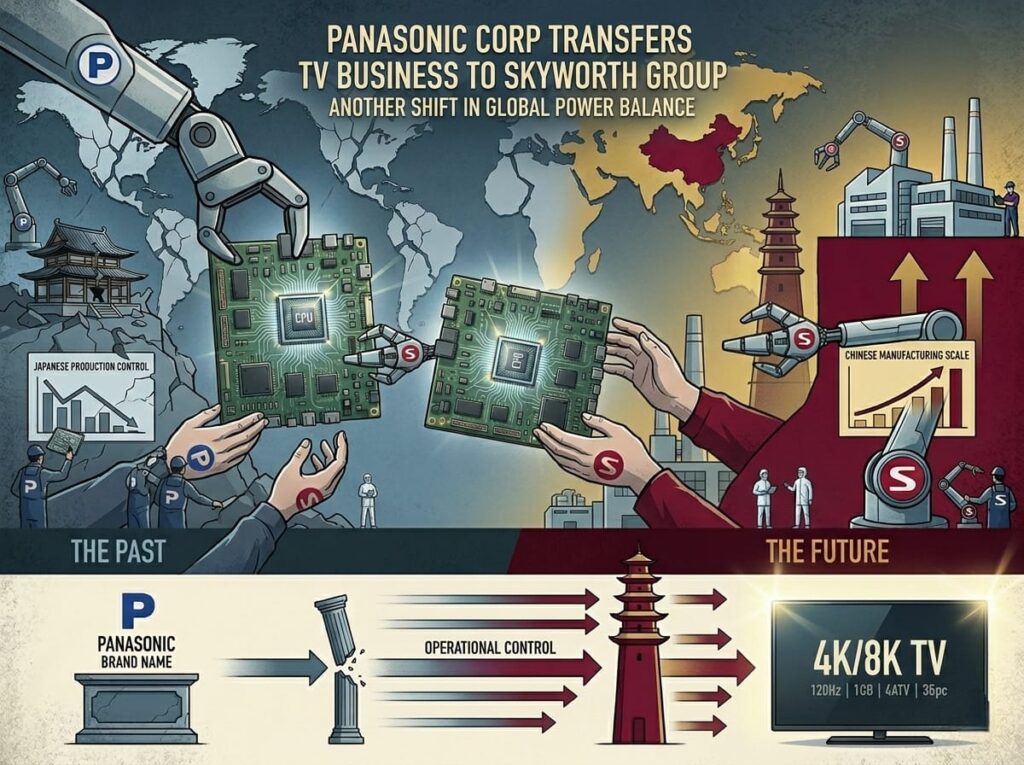
Panasonic has announced that beginning in April 2026 it will transfer its European TV operations into an operational partnership with Chinese manufacturer Skyworth, with other regions expected to follow.
Under the agreement, Skyworth will handle manufacturing, logistics, marketing, and distribution. Panasonic will continue to provide engineering expertise, quality control oversight, and joint development on premium models.
On paper, this looks like operational streamlining. In a broader context, it signals something much bigger: a structural shift in the global television industry.
The brand name stays. Operational control moves.
And this is not an isolated case but a Pattern Emerging Across the Industry.
When viewed alongside recent developments, Panasonic’s move becomes part of a clear trend.
LG Steps Away from 8K
LG Electronics recently discontinued the development and production of its 8K TV lineup. Not through a dramatic press event, but through a quiet phase out of the category. The message was clear. Even a major Korean manufacturer concluded that not every technological milestone translates into a profitable long term business.
Sony Forms a Joint Venture with TCL
At the same time, Sony Group Corporation signed a memorandum of understanding with TCL Technology to establish a joint venture that will manage Sony’s home entertainment business, including televisions and audio systems.
Under the agreement, TCL will hold 51 percent of the new entity, with Sony retaining 49 percent. Once again, the Japanese brand remains. Operational control shifts to a Chinese manufacturer.
TCL Surpasses Samsung in Monthly Shipments
In December 2025, TCL reportedly led global monthly TV shipments, overtaking Samsung Electronics on a monthly basis. While not yet a full annual reversal, symbolically it represents a major shift in momentum.
What Is Really Happening?
We are witnessing a deeper structural transformation. Long established Japanese brands are increasingly stepping back from full operational control, while large scale Chinese manufacturers consolidate production power. This shift is driven by two forces:
- Shrinking profit margins in the TV market
- Narrowing technological gaps between brands
The competitive battlefield is no longer defined solely by who produces the best picture quality. It is increasingly about who controls the supply chain, who manufactures at massive scale, and who can drive down costs efficiently.
Chinese manufacturers such as Skyworth and TCL have built enormous production capacity, vertical integration advantages, and global distribution networks. That scale changes everything.
What Does This Mean for Consumers?
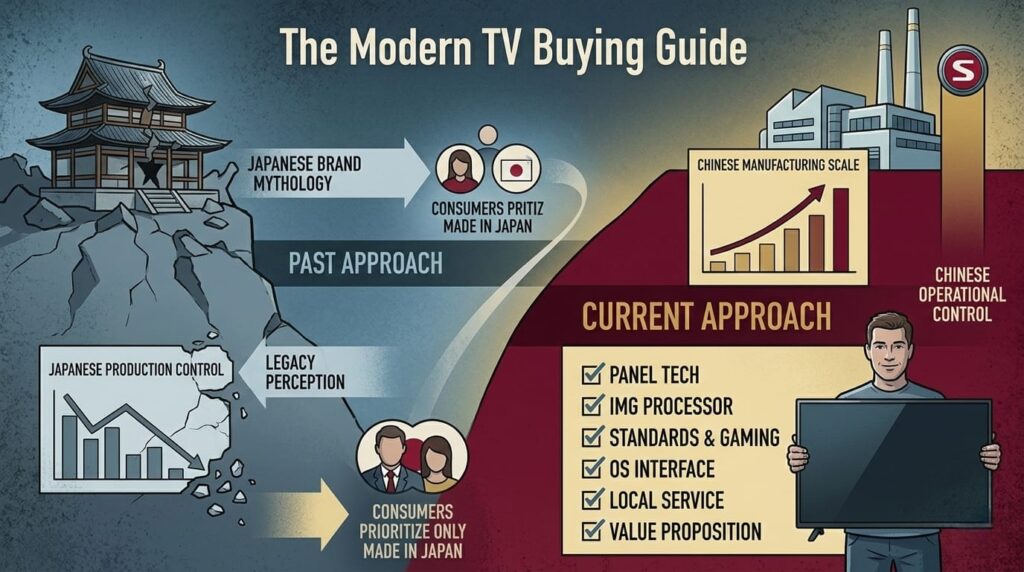
This is where things get interesting. For decades, brand identity was closely linked to manufacturing origin. “Made in Japan” once carried a distinct perception of quality. Today, manufacturing excellence is no longer defined by geography alone.
Chinese factories are technologically advanced, highly automated, and capable of producing premium panels and electronics at global standards.
The more relevant questions in 2026 will not be:
- Is this Japanese or Chinese?
They will be:
- What panel technology does it use
- How strong is the image processing engine
- Does it support key standards such as HDR formats and advanced gaming features
- What operating system powers the interface
- How reliable is the local service network
- Is the value for money compelling
If Panasonic TVs are produced by Skyworth, and Sony TVs by TCL, the traditional price gap between premium and mid tier brands may narrow significantly.
Consumers may reasonably ask: if production comes from similar facilities, why pay a substantial premium?
Not Necessarily Bad News
This shift is not automatically negative. A combination of Japanese engineering oversight and Chinese manufacturing scale could result in excellent products at more competitive prices. We have seen similar transformations in other industries, including automotive.
If managed properly, this model can deliver stronger value propositions and broader accessibility to high performance televisions.
The Bigger Picture
Panasonic’s decision is not a collapse of a historic brand. It is a redistribution of manufacturing power. Brand names remain. Production centers consolidate. Margins tighten. Efficiency becomes king.
In a market where differentiation is becoming more subtle, the smart consumer benefits by focusing on product substance rather than legacy perception.
The near future question will not be whether your TV is Sony, TCL, or Panasonic. It will be whether it is the right television for your needs at the right price.
In an era where brand identities blur, informed buyers gain the advantage, provided they evaluate the product itself rather than the mythology around the logo.