
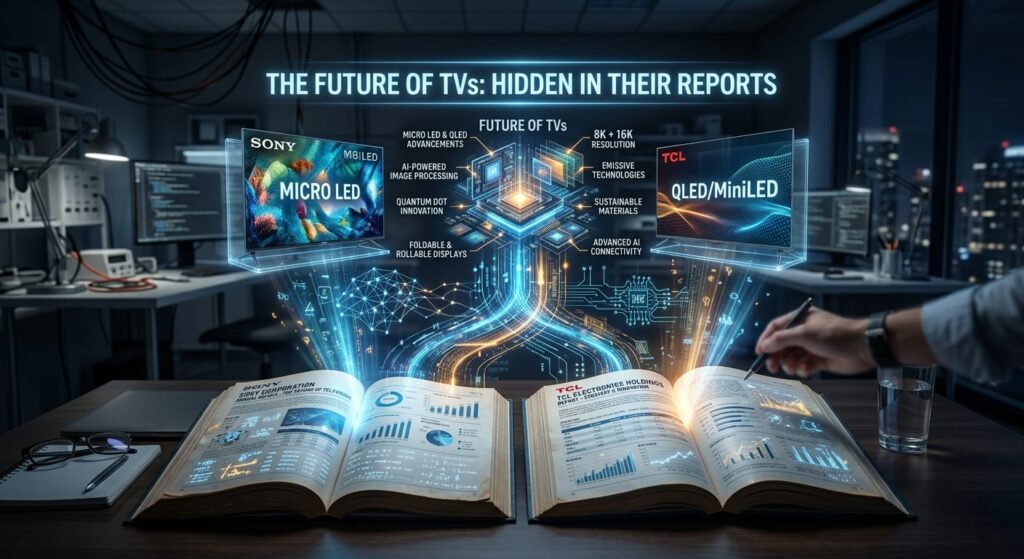
In my previous article, “The Global TV Market: A Changing Battle for the Top” I explored the shifting dynamics of the television industry and the growing pressure on traditional premium brands. Since then, one of the most dramatic developments in the market has become official: Sony and TCL have announced plans to form a joint venture that will take over Sony’s television and home entertainment business.
Under the memorandum of understanding announced in January 2026, the new company will be 51% owned by TCL and 49% by Sony, with operations expected to begin around April 2027 after regulatory approvals. The venture will manage everything from product development and manufacturing to logistics and sales for Sony-branded TVs and home audio products. �
This raises an obvious question: Was this move predictable?
To answer that, I went back to the financial reports of both companies to look for early signals. Two documents are particularly revealing
- Sony’s 2025 annual filing to U.S. regulators
- TCL Electronics’ 2025 financial report:
When examined side-by-side, the reports paint a fascinating picture of two companies moving in opposite directions
One gradually stepping back from large-scale consumer hardware manufacturing, the other rapidly expanding its industrial dominance in televisions.
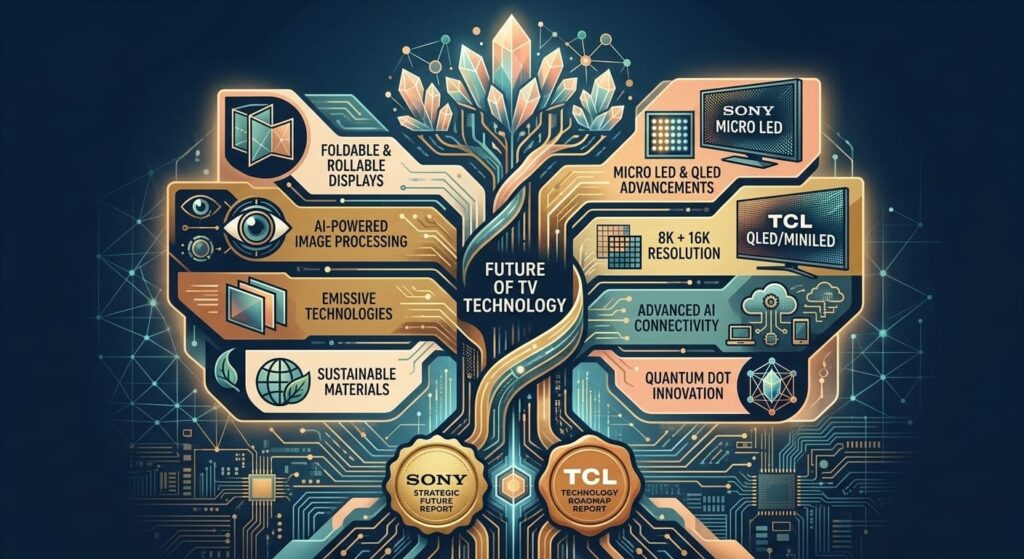
Sony’s Financial Report: A Premium Brand Under Pressure
Sony’s Form 20-F filing reveals a clear trend in the company’s consumer electronics segment, particularly in televisions and home entertainment hardware. The report shows that Sony’s television revenue declined significantly year-over-year. The company recorded:
- ¥624.3 billion in TV sales in FY2024
- ¥564.1 billion in FY2025
That represents a drop of roughly 9.6% in television revenue within a single fiscal year.
A similar trend appears in Sony’s broader Audio & Video category, which includes headphones, speakers, and other home entertainment hardware.
That segment declined from ¥412.1 billion to ¥391.7 billion year-over-year.
While these figures do not suggest a collapsing business, they highlight a sector facing intense competition and shrinking margins. Sony’s corporate strategy in the report reflects this shift. Over the past decade, the company has increasingly emphasized businesses with stronger profitability and differentiation, including:
- PlayStation gaming
- Music and film production
- Image sensors for cameras and smartphones
These areas now represent the company’s strategic growth engines, while traditional consumer electronics, once Sony’s core identity, play a smaller role in overall growth.
This strategic repositioning suggests that Sony’s priority is maintaining technological leadership and brand value, rather than competing on manufacturing scale.
TCL’s Financial Report: The Rise of a Manufacturing Powerhouse
If Sony’s report reflects caution in consumer hardware, TCL’s report tells a completely different story.
The company’s 2025 financial report highlights strong growth in its television business and a rapid expansion in advanced display technologies.
According to the report:
- Revenue from TCL’s TV business increased by 9.4% year-over-year
- Gross profit rose by 12.9%
- The average size of shipped TVs increased to 53.4 inches globally.
More striking is the growth in premium display categories:
- QLED TV shipments increased 73.7%
- Mini-LED TV shipments surged 176.1%
By the first half of 2025, TCL held 28.7% of the global Mini-LED TV shipment market, according to Omdia data cited in the report.
Mini-LED has become one of the fastest-growing display technologies in the premium TV segment, and TCL has invested heavily in it, both as a technology platform and as a differentiator against OLED.
The company’s strategy is built around a combination of:
- large-scale manufacturing
- vertical integration in the display supply chain
- aggressive expansion in international markets
In other words, TCL’s strength lies exactly where Sony’s has weakened: industrial scale and cost-efficient production.
Two Strategies, One Partnership
When the financial data from Sony and TCL are placed side-by-side, the logic behind the joint venture becomes much clearer. Sony and TCL bring fundamentally different strengths to the table.
Sony contributes:
- brand prestige in premium TVs
- advanced image processing technologies
- audio engineering expertise
- a loyal enthusiast customer base
TCL contributes:
- massive manufacturing scale
- control of display technology development
- strong cost efficiency
- expanding global distribution
Industry observers have noted that the alliance effectively combines Sony’s premium brand and image processing expertise with TCL’s industrial scale and display technology capabilities.
In practical terms, the new company will manage the full value chain, from product design to manufacturing and logistics, while Sony retains a significant minority stake. �
What This Means for the Global TV Market
The Sony-TCL partnership represents more than just a corporate restructuring. It reflects a deeper transformation within the television industry.
Over the past four decades, leadership in TV manufacturing has shifted geographically:
- The United States dominated the early era of consumer electronics.
- Japan took the lead in the 1980s and 1990s.
- South Korea rose in the 2000s with Samsung and LG.
- Today, Chinese companies like TCL and Hisense are driving the next phase.
Chinese manufacturers now dominate large-scale LCD and Mini-LED production, giving them a structural advantage in cost and supply chains.
Sony’s decision to collaborate with TCL is therefore not simply about cutting costs, it is about adapting to a global market where manufacturing scale and supply chain control have become decisive competitive factors.
The Bigger Question: What Happens to Sony TVs?
For enthusiasts and home-cinema fans, the key concern is whether Sony televisions will remain “Sony” in spirit.
The company insists that the partnership is designed to combine strengths rather than dilute the brand. Sony’s expertise in picture processing, tuning, and industrial design is expected to remain central to future products.
Meanwhile, TCL’s manufacturing capabilities could enable Sony to compete more effectively in segments where it has struggled, particularly mid-range televisions, where Chinese brands have gained enormous ground in recent years.
If the partnership works as intended, future Sony TVs may still deliver the image quality and processing the brand is known for, but produced with the efficiency of one of the world’s largest TV manufacturers.
A Turning Point for the Industry
The financial reports from Sony and TCL reveal that the joint venture was not a sudden or surprising move. Instead, it was the logical result of two long-term trends:
- Sony gradually shifting its business toward content, gaming, and high-value technologies.
- TCL expanding aggressively as one of the world’s largest television manufacturers.
Together, these trends set the stage for one of the most significant partnerships the TV industry has seen in years.
And for the global television market, it may mark the beginning of a new model, one where brand leadership and manufacturing scale are no longer found in the same company.