
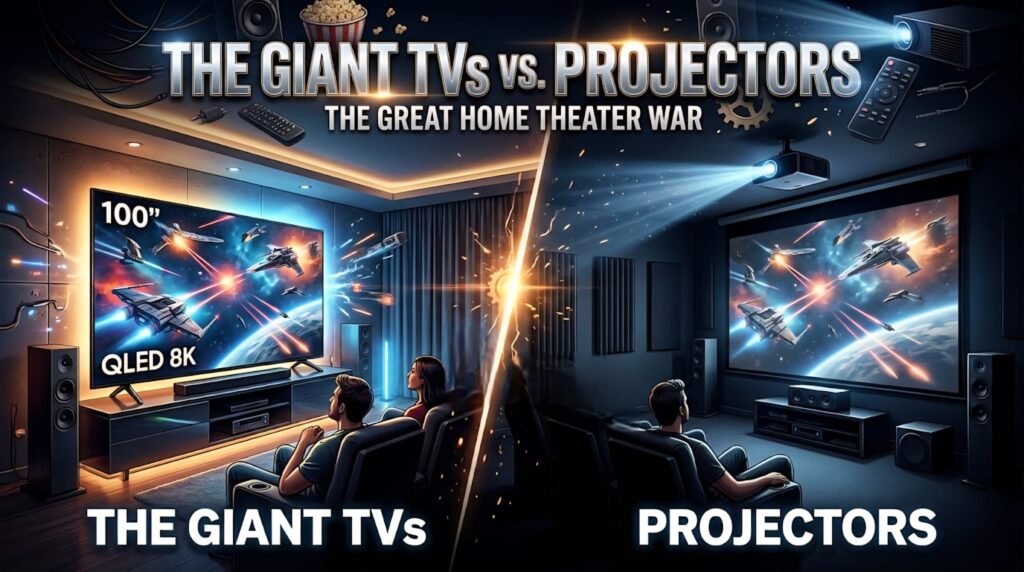
Over the past few decades, as home entertainment has become more accessible and widespread, a dedicated home theater subculture has emerged. Enthusiasts began recreating the cinematic experience at home by projecting movies, TV shows, or games onto large walls or projection screens. The goal was simple: replicate the immersive feeling of watching a film in a commercial cinema.
Early home projectors were large, heavy devices based on relatively simple technology. Over time, the category evolved significantly. Technologies such as DLP (Digital Light Processing) and LCD projection became common, and later gave way to laser-based projectors offering higher brightness, better optics, motorized lens systems, and the ability to project images far larger than what televisions could traditionally provide.
The leading manufacturers enabled enthusiasts to build dedicated home cinema rooms with projection systems designed specifically for movie viewing.
The popularity of home theater projectors was driven by several key advantages:
- Massive image size: Projection systems easily deliver 100–150 inch images and beyond, sizes that were once far beyond the reach of typical televisions.
- Flexible aspect ratios: Many projector setups allow switching between formats such as 16:9 or wider cinematic ratios like 21:9.
- Excellent cost-to-screen-size ratio: For many years, projectors were the most affordable way to achieve truly cinematic image sizes.
- Installation flexibility: Images can be projected onto walls or dedicated screens, and installations can be temporary or permanent, allowing users to enjoy a cinema-like experience without permanently dedicating living space.
Together, these benefits turned the home projector into a symbol of the “true” home cinema experience. Of course, enthusiasts also accepted several conditions: the room needed to be darkened, a quality projection screen was required, and additional equipment such as media sources and a capable sound system had to be carefully integrated.
The Rise of Giant TVs
In recent years, however, a clear shift has emerged. Ultra-large televisions have rapidly begun to dominate the home theater market, steadily encroaching on territory once reserved almost exclusively for projectors.
Today, manufacturers such as Samsung, TCL, LG, and Hisense offer televisions ranging from 98 inches to 115 inches and beyond, providing a direct, convenient alternative to projection systems.
The growth of these displays has been dramatic. Only a decade ago, TVs larger than 75 inches were rare and extremely expensive. Today, giant TVs have become more common, easier to ship and install, and far more affordable.
Large televisions now represent what used to be the classic projector screen size. For example, a 100-inch screen, once the standard goal for projector setups, is now directly achievable with a single display panel.
At the same time, prices have dropped dramatically. Consumers who once assumed that achieving a truly large image required a projector, a projection screen, room darkening, long HDMI cables routed across the room, and even black-painted walls are discovering that they can now achieve a comparable screen size simply by purchasing a large television.
The difference in complexity is enormous.
Why are so many of us, including long-time home theater enthusiasts, replacing projectors with giant televisions?
Installation Preparation
Anyone who has owned a projector knows that installation can be far from trivial.
A typical setup requires running a long HDMI cable from the equipment rack at the front of the room to the projector mounted behind the seating area. Dedicated enthusiasts often go even further by painting walls and ceilings dark colors to minimize reflections.
Some setups become extremely meticulous. It is not uncommon for enthusiasts to darken reflective surfaces, cover indicator lights from appliances, or even modify lighting fixtures to prevent stray light from hitting the screen.
By contrast, installing a television requires very little preparation. Aside from a power outlet and perhaps a wall mount, the system can be installed almost immediately. Media players, streaming devices, and audio systems can sit right next to the TV.
Additionally, because televisions are self-emissive light sources, there is no need to darken the room environment.
Convenience and Instant Use
Using a projector often involves a small ritual: lowering the screen, dimming the lights, waiting for the projector to warm up, and ensuring no one walks between the projector and the screen.
Ambient light dramatically affects projected images. Turning on a light can wash out the picture, while someone standing between the projector and screen casts a visible shadow.
This issue becomes especially noticeable in open-plan homes where the living room connects directly to the kitchen. Darkening the viewing area may also mean dimming lights throughout the entire shared space.
Televisions eliminate these complications. You simply sit down, press the power button, and start watching, regardless of the room lighting.
Brighter and Sharper Image in Any Lighting
Projectors rely on reflected light, meaning they project an image onto a surface that reflects light back toward viewers. Televisions, on the other hand, generate light directly from the display itself.
As a result, modern TVs deliver higher brightness, stronger contrast, and more vivid colors, especially in bright rooms. Premium televisions can reach peak brightness levels of 1,000–2,000 nits, while a typical projector on a 100-inch screen may achieve only 50–150 nits of perceived brightness.
This difference becomes especially noticeable with HDR content, which relies heavily on high brightness levels to create dramatic highlights and contrast.
For daytime viewing or rooms with windows, televisions maintain vibrant images while projectors may appear washed out.
More User-Friendly Software
Traditional projectors often rely on basic on-screen menus. Modern TVs, by contrast, include full smart operating systems with intuitive interfaces and built-in streaming apps.
Services such as Netflix, Disney+, and YouTube are deeply integrated into TV platforms, allowing viewers to start watching instantly.
Limited Lamp Lifespan
Most traditional projectors use high-performance lamps such as UHP (Ultra High Performance) bulbs. These gradually dim over time and often lose about half their brightness after several thousand hours of use. Replacing the lamp can cost hundreds of dollars.
Laser-based projectors are beginning to address this issue with lifespans of around 20,000 hours, but they typically come at a higher upfront cost.
The True Cost Calculation
Projectors may initially appear cheaper for achieving large images, but the total system cost often includes:
- Projection screen
- Long HDMI cables or signal extenders
- Ceiling mounting hardware
- Light-controlled room design
- Lamp replacements or maintenance
When these costs are added together, the price advantage can shrink significantly compared to large televisions.
Streaming Changed Viewing Habits
Another key factor in the shift toward large TVs is the evolution of how people watch content.
In the past, watching a movie often meant a dedicated “movie night” where the entire family gathered and watched a film from beginning to end.
Today, streaming services such as Netflix, Disney+, and Amazon Prime Video encourage more spontaneous viewing. People watch shorter segments, pause frequently, or switch content quickly. Televisions are perfectly suited for this behavior. They require no preparation and allow viewers to jump in and out of content instantly.
Design and Living Spaces
Modern interior design has also influenced this shift. Projector installations often involve ceiling mounts, retractable screens, and visible cabling. In contrast, large TVs can blend seamlessly into living room aesthetics.
A single large television mounted on the wall provides a clean, minimal look without the need for ceiling-mounted equipment or retractable screens.
As a result, living rooms can focus more on furniture and interior design rather than being built around a home theater system.
So Why Are Projectors Still Selling?
Despite the rise of giant TVs, projectors remain highly relevant for a particular audience.
First, projection still provides a fundamentally different visual experience. Because the image is reflected rather than emitted, many viewers perceive it as more natural and closer to the cinematic feel of a real movie theater.
The subtle sensation of light traveling across the room and reflecting off a large screen contributes to the psychological atmosphere of “going to the movies,” even inside the home.
Second, projectors still dominate when it comes to extreme screen sizes.
While consumer TVs typically max out around 98–115 inches for most buyers, projectors can easily reach 130–170 inches or even larger with minimal additional cost.
They also support cinematic aspect ratios such as 21:9 (CinemaScope) that are rarely available on televisions.
For dedicated home theater rooms designed specifically for movie viewing, complete with controlled lighting, acoustic treatments, and tiered seating, projectors remain the preferred solution.
In projector-based home theaters, it’s possible to place speakers behind an acoustically transparent projection screen. This effectively “hides” the front soundstage and allows dialogue and sound effects to emerge directly from the center of the screen rather than from its sides.
This advantage also comes with a built-in drawback, since the tiny perforations in an acoustically transparent screen slightly reduce the amount of light reflected back toward viewers. Therefore, part of the projected light passes through these holes and illuminates the area behind the screen.
Because giant TVs cannot accommodate speakers placed behind the display, their owners typically position speakers farther apart on either side of the screen, which can affect the cohesion of the front soundstage. As a result, some users choose to install a long horizontal speaker, often a soundbar, beneath the entire width of the large television to help compensate for this limitation.
Is the Market Moving in Only One Direction?
Sales trends clearly show rapid growth in the large-TV segment. However, this does not necessarily mean the end of the projector era. Instead, the market appears to be splitting into two categories:
- Mainstream consumers: Most households, especially those using a living room as their primary viewing space, will likely choose large televisions for their convenience and versatility.
- Dedicated cinema enthusiasts: For users who prioritize the authentic cinema experience above all else, projection systems remain irreplaceable.
Portable projectors also continue to grow in popularity, offering flexibility for outdoor movie nights, travel, or temporary setups.
Conclusion
The decline in demand for traditional home theater projectors in favor of giant televisions is not accidental. It reflects deeper changes in viewing habits, falling prices for large displays, and a shift toward convenience and immediacy.
Projectors were once the ultimate status symbol for movie lovers. But in today’s fast-paced, streaming-driven lifestyle, their sensitivity to ambient light, maintenance requirements, and setup complexity can feel less compatible with everyday use.
Giant televisions, on the other hand, provide a simple, immediate solution: bright images, sharp detail, minimal setup, and excellent performance in any lighting condition.
Yet it would be premature to declare the end of the projector era. For passionate cinema enthusiasts chasing the feeling of a real theater,, with massive screens and unique visual immersion, projectors still hold a powerful appeal.
So what about you?
If you already own a projector, are you considering the switch to a giant TV?