
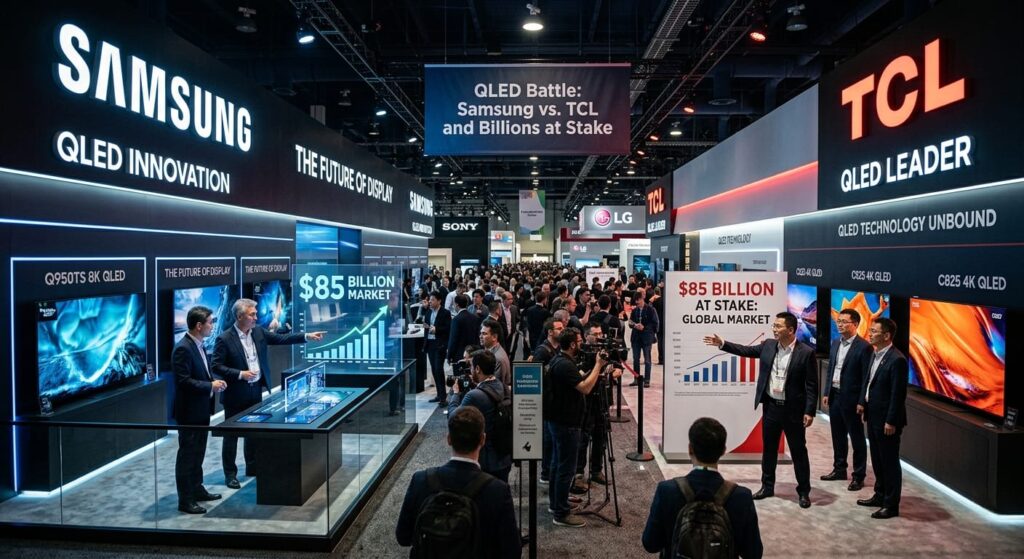
This QLED batle began like another technical dispute between two electronics giants. But within months, it evolved into one of the most consequential battles in the TV industry, one that goes beyond technology and cuts straight to the core question: who defines what’s real, engineers or marketers?
How It All Started
In April 2025, Samsung filed a lawsuit in Germany against the local subsidiary of TCL. The claim was sharp and straightforward:
TCL was marketing televisions under the “QLED” label, even though they did not truly meet the technological definition of QLED.
The dispute reached its peak in early March 2026, when the Munich Regional Court (Landgericht München) ruled in Samsung’s favor.
The court determined that TCL had violated Germany’s unfair competition laws by misleading consumers through its use of the term “QLED”.
Specifically, it found that certain models, such as the QLED870 series, failed to deliver the level of color performance expected from Quantum Dot technology. As a result, labeling them as “QLED” constituted consumer deception.
But in many ways, that ruling is just the beginning of a much larger story.
What Is QLED, and Why Does It Matter?
To fully understand the implications, it helps to go back a decade.
Samsung was the company that pushed the term “QLED” into the mainstream during the mid-2010s. The technology is built around a layer of Quantum Dots, nanoparticles designed to improve color accuracy, increase brightness, and enhance durability over time.
According to widely accepted industry definitions, a true QLED display requires a Quantum Dot layer positioned between the backlight and the panel, with measurable improvements in performance.
In TCL’s case, however, the court accepted the argument that its implementation of Quantum Dot technology was minimal or ineffective. In some instances, key materials were reportedly absent altogether.
And that’s the critical point: not every TV labeled “QLED” is necessarily delivering what consumers believe QLED represents.
Until now, no one had seriously challenged that.
Interestingly, about a year ago, Samsung published an article titled “what is QLED TV”. That wasn’t a coincidence, but a part of a broader effort to educate consumers and protect a technology the company believes has been stretched beyond its intended definition.
How Many Models Are Affected?
According to the ruling and subsequent reports, at least six specific TCL models have been banned from being marketed as QLED in Germany. These include series such as QLED870, C805, C655, and C69B.
But the real impact goes far beyond those individual models.
The court clarified that the restriction applies to any TCL television using the same technological approach. In practice, that could mean dozens of models across Europe, and potentially other markets as well.
The Financial Context: Why This Is a Big Deal for TCL
To grasp the scale of the issue, you have to look at the numbers.
The global TV market stands at roughly 200–220 million units per year. TCL is one of the two largest manufacturers in the world, with a market share that has reached around 15–16% in certain periods. That translates into tens of millions of TVs sold annually.
But how many of those are QLED?
There’s no official public breakdown. However, market trends show that premium technologies, including QLED, OLED, and Mini-LED, are key growth drivers. QLED and Mini-LED, in particular, dominate the mid-range and upper-mid segments.
A conservative estimate suggests that even if just 30% of TCL’s sales are QLED, we’re talking about millions of units per year, representing billions of dollars in revenue.
What Happens If TCL Loses the QLED Label?
The issue here isn’t just legal, but fundamentally about branding.
Over the years, QLED has become synonymous with premium positioning. Without that label, a TV risks being perceived as just another standard LED display. The consequences could include:
- Price erosion
- Weaker market positioning
- Reduced profit margins
Europe is one of the most important markets for any TV manufacturer, and this impact is already beginning to materialize there.
And What About Samsung?
Samsung, by contrast, has led the global TV market for roughly two decades, maintaining a stable double-digit market share. QLED TVs are a cornerstone of its strategy.
Although Samsung’s financial reports don’t provide an exact breakdown of QLED unit sales, industry estimates consistently point to Samsung as the world’s largest seller of QLED televisions.
That’s why this lawsuit isn’t just about protecting a technology. It’s about defending an entire market segment that Samsung effectively created.
Not Just TCL: A Battle for the Industry’s Future
This is far from an isolated case. Similar lawsuits have already been filed in the United States, and Hisense is also facing scrutiny. Regulators are beginning to take interest for a simple reason: there is no unified standard for terms like QLED or Mini-LED.
And without a standard, the question becomes unavoidable, who’s right?
Samsung argues that QLED is a technological standard, meaning any TV carrying that label must meet specific structural and material criteria.
TCL, on the other hand, maintains that even partial use of Quantum Dot technology is legitimate, and that real-world performance matters more than technical implementation details.
Honestly? Both arguments have merit, but at different levels.
And that’s precisely what the court tried to resolve: not whether Quantum Dots exist in the panel, butwhether consumers are actually getting what they were promised.
Where Does This Go Next?
Looking ahead, several scenarios are likely.
- Regulation could step in, especially in Europe, to formally define what qualifies as QLED and what manufacturers are allowed to claim on packaging.
- Legal escalation is also likely. Samsung has already filed additional lawsuits in the United States and may expand its efforts globally, turning this into a broader patent and marketing war.
- At the same time, the industry is already shifting toward new terminology: QD-OLED, MicroLED, potentially moving away from the QLED label altogether.
For TCL, the risk is clear: if rulings expand, premium TV sales could decline, putting pressure on pricing and margins.
And yet, TCL’s strength in value-for-money positioning means it is unlikely to disappear. More realistically, it will adapt.
The Bottom Line
At first glance, this may look like a dispute over a name. In reality, it’s about something much deeper: control over how technological truth is defined.
- Samsung’s position is that there is one truth, and it’s rooted in engineering.
- TCL’s view is that the market defines reality, not the lab.
For now, in this first major ruling, the legal system has taken Samsung’s side.
But this is not a final, precedent-setting decision. It’s a commercial rulin, one that could still change on appeal. And TCL is expected to challenge it.
Which means one thing is certain: This battle is just getting started.