and What Happens When They Stop?
In today’s connected world, a smart TV is no longer just a display panel. It’s essentially a large computer connected to the internet, apps, streaming services, cloud platforms, and continuous software updates.
Updates are not a luxury, they are a critical part of the ownership experience.
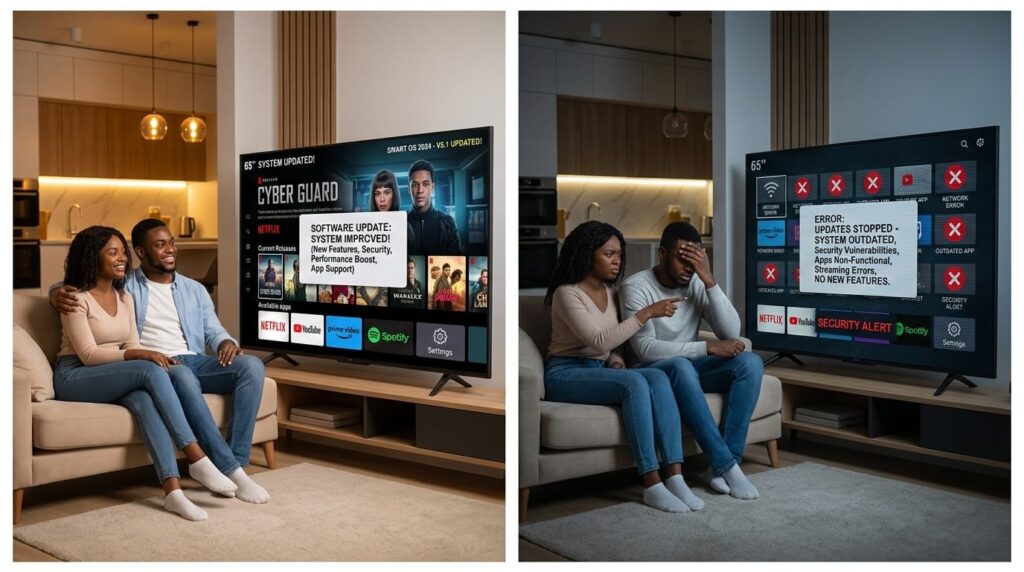
Software updates don’t just introduce new features. They improve performance, enhance the user interface, patch security vulnerabilities, and maintain compatibility with modern streaming apps. When a manufacturer slows down or stops meaningful updates, what initially seemed like a great purchase can gradually turn into a compromised long-term experience.
Unfortunately, conservative software update policies are still common among some traditional TV manufacturers.
Sony and BRAVIA Software Updates
Sony uses Google TV / Android TV in its BRAVIA lineup. These platforms receive updates partly through Google and partly through firmware releases issued by Sony.
Unlike smartphones, where update commitments are often clearly communicated, smart TV update policies tend to be less transparent. Each manufacturer operates according to its own internal support strategy.
In practice, there have been user reports suggesting that certain Sony models, including premium-priced series, have not received major Android TV version upgrades. Some users report that specific models remained on older Android versions while newer platform versions were already available in the market.
This does not mean devices stop functioning, security patches may still arrive, but it may limit access to newer system features, UI optimizations, AI capabilities, or app compatibility improvements that are tied to newer OS versions.
Additionally, software update availability can sometimes depend on setup choices and privacy agreement confirmations during initial installation. Over time, older models may also reach official end-of-support status, after which firmware downloads are no longer provided.
The practical outcome? A premium television purchased at a high price point may continue operating — but on an aging operating system.
Samsung and LG: Public Long-Term Update Commitments
Samsung and LG, two of the largest global TV manufacturers, have recently moved toward clearer long-term update strategies.
Samsung announced that newer smart TVs running Tizen will receive operating system updates for up to seven years. This marks a significant shift toward long-term support, including not only bug fixes but also feature updates and major OS improvements.
LG, with its webOS platform, has similarly emphasized five year support, with some previous models receiving upgrades to newer webOS versions rather than only minor patches.
While no company guarantees indefinite updates for every model ever produced, publicly stated support timelines provide consumers with greater clarity and confidence about product longevity.
TCL: Mixed Support Transparency
TCL does not publicly advertise a fixed multi-year software update commitment in the same way as Samsung or LG. Its support documentation typically explains how to perform updates (via OTA or USB) but does not clearly define how long devices will receive OS upgrades.
Interestingly, independent online communities have formed to track TCL firmware releases, sometimes identifying update files before they appear via official over-the-air channels. These are not official support channels, but they highlight how strongly consumers care about software longevity.
This mixed transparency makes it harder for buyers to evaluate long-term support expectations before purchase.
System Version Differences in Practice
When comparing recent models from different manufacturers, one noticeable distinction can be operating system version progression. Some brands appear to push newer Android/Google TV versions more aggressively, while others prioritize stability over major upgrades.
The implication is not immediate malfunction, but potentially slower access to newer UI refinements, AI features, performance optimizations, or enhanced app compatibility that are introduced in newer OS releases.
Security updates may continue, but the overall pace and depth of system evolution can vary significantly between brands.
Pricing vs. Software Commitment
Premium pricing traditionally implies better hardware, higher-quality panels, advanced processing, superior build quality.
However, in the modern smart TV era, software longevity has become equally important.
When consumers pay a premium price, they often expect not only strong hardware but also long-term system evolution. If long-term software support is unclear or limited, the price gap between brands becomes a more complex value equation.
Why This Matters for Consumers
A smart TV today is part hardware, part software ecosystem.
When manufacturers commit to extended update policies, televisions remain modern, secure, and compatible for longer. When update policies are conservative or undefined, the product may age faster, not because the panel fails, but because the software ecosystem evolves around it.
Even brands with strong update commitments may set limits and exclude older models. However, transparent policies provide consumers with clearer expectations.
The Consumer Takeaway
Software updates are not optional extras. They are central to long-term usability.
When choosing a smart TV, especially in premium price ranges, buyers should consider:
- Length and clarity of update commitment
- Major OS upgrade history
- Security patch support
- App compatibility over time
In an era where streaming platforms, AI features, and smart home integration evolve constantly, software longevity can be just as important as brightness levels or panel technology.
A television may last physically for a decade, but without software support, its smart features may not.