

From neuroscience and perception to songs by U2 and Depeche Mode: how loudness became the hidden driver of emotion in music
This article is just one part of a series named “Beyond the Gear“. Explore how sound affects your brain, hearing, and the way you experience music, then dive into more unique content.
There’s a moment almost everyone recognizes. You’re driving alone. A song comes on, one you’ve heard a hundred times before. Maybe it’s Sunday Bloody Sunday by U2. The opening drum pattern kicks in: tight, militant, unmistakable. It’s already powerful, even at a moderate volume. But without thinking, your hand moves. You turn the knob a little louder.
Then louder again, just before the vocals enter. By the time the chorus hits, the volume is no longer about hearing. It’s about feeling.
The same thing happens with Enjoy the Silence by Depeche Mode. The iconic synth line begins, spacious and hypnotic. At low volume, it’s beautiful but distant. As you raise the volume, something shifts. The bass fills in, the reverb opens up, and suddenly the track surrounds you. By the time Dave Gahan sings “Words are very unnecessary…”, the sound isn’t just in your ears. It’s inside your head.
So why do we do this?
Why, when we love a piece of music, do we almost instinctively make it louder, often louder than we intended, sometimes louder than we know is healthy?
Loudness Is Not Volume. It’s Presence
Imagine walking into a nightclub. The lights are low, people are moving, but the music is barely above conversation level. Something feels off. The energy isn’t there. Now imagine the same room, but the bass hits your chest, the kick drum locks into your pulse, and the entire space feels alive. Nothing changed about the song. Only the level. And yet, everything changed about the experience.
Here’s where precision matters.
The following article deals with the question “Why People Enjoy Loud Sound“. The authors argue that loud sound is not inherently pleasant, but becomes associated with positive experiences over time.
Loudness increases arousal, a physiological and psychological state of activation. Over time, we learn to associate that heightened state with positive experiences.
The Brain Doesn’t Just React. It Learns
Earlier, we loosely connected loudness with reward chemistry. This research suggests something more nuanced. It introduces the CAALM model: Conditioning, Adaptation, and Acculturation to Loud Music, which explains that our preference for loud sound develops over time.
Through repeated exposure to emotionally intense moments, as as concerts, parties and workouts, loud music becomes linked with excitement, social connection, and emotional peaks. The authors explain that loud music becomes a conditioned stimulus through repeated pairing with rewarding experiences.
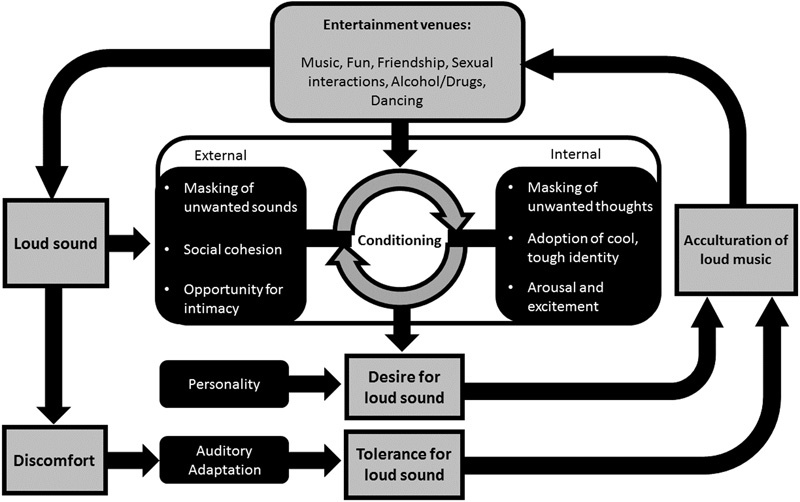
The CAALM Model. Source Hearing Journal
So when you turn up Sunday Bloody Sunday, you’re not just increasing volume, but activating learned associations. The intensity you feel is not just in the sound. It’s in memory, context, and expectation.
The Ear Doesn’t Hear Everything Equally
Equal-loudness contours show that at lower volumes, our ears are less sensitive to bass and high frequencies. So when you turn up the volume, bass becomes fuller, highs become clearer and the sound feels more balanced. But this alone doesn’t explain why we prefer louder sound.
The CAALM framework adds the missing layer: Even if louder sound reveals more detail, the desire for loudness is largely learned and not purely physiological.
High Frequencies – What Comes Alive
Take Hotel California by Eagles. At low volume, the intro guitars sound pleasant, but when you turn it up, suddenly you hear the room, the fingers on the strings, the air between notes.
It’s not that these details weren’t there. They were simply below your perceptual threshold. At low volume, fine details of high frequencies fade into the background. When you turn the volume up, they reappear, not just because they are louder, but because your auditory system and brain are tuned to recognize that opened up sensation as a richer experience.
Midrange – Understanding vs. Hearing
Unlike bass and treble, the midrange, where the human voice sits, is the most naturally sensitive region of our hearing, meaning it requires far less compensation at lower volumes. Nevertheless, when someone says something important, you say: “Can you turn it up”?
It’s not because you failed to hear the sound, but since you failed to decode it. Loudness enhances clarity, separation, and intelligibility. It allows the brain to parse complex signals more efficiently. The issue is rarely about audibility. Instead, it is about cognitive separation.
In real listening environments, especially noisy ones, speech is not just competing with silence. It is competing with other sounds. The ear can still pick up the midrange clearly, but the brain struggles to isolate it from background noise. What suffers is not hearing sensitivity, but the signal-to-noise ratio: the clarity of the target sound relative to everything around it.
This is why we ask someone to “turn it up.” We are not fixing a frequency problem; we are trying to improve speech intelligibility and attention focus. Even in relatively quiet environments, the same effect can happen. When we are tired, distracted, or not fully focused, speech can feel less present, even though it is physically audible. Increasing volume creates a sense of sharper definition, not because information was missing, but because it is being pushed more strongly into our attentional field.
In simple terms: The midrange doesn’t need amplification to be heard, but to win against noise and compete successfully for our attention.
This extends beyond media. When people raise their voices, it’s not always about emotion. It’s about transmission. A stadium announcer doesn’t speak softly because the goal isn’t politeness. it’s penetration. The message must cut through noise, distance, distraction.
Volume, in that sense, is a tool of meaning. Research highlights that loudness increases salience: how much a sound stands out and captures attention. Louder sounds are more likely to be processed as important.
This explains our everyday behavior: people raise their voices to be understood, we increase volume when we want clarity. Loudness is not just about sound, but about priority.
Low Frequencies – When Sound Becomes Physical
Now we arrive at the reason no one complains about loud music in a club. Bass is not just heard, it’s felt. Low frequencies are where sound crosses into the body. Research describes how loud sound increases physiological activation: heart rate, alertness, and engagement. It does not claim that this is always pleasurable, but it clearly increases intensity of experience.
That’s why when we’re in the gym, louder music feels more motivating, and in clubs it creates immersion. It’s also why genres like heavy metal, hip-hop, and electronic music are almost inseparable from high volume. At low volume, the same track can feel flat or incomplete.
Song That Demand Volume
When you listen to Smells Like Teen Spirit by Nirvana, the quiet-loud dynamic is not just a stylistic choice. It builds expectation. Research describes how anticipation and release are key emotional mechanisms in music. Loudness amplifies both. That’s why when the chorus hits, raising the volume enhances the transition your brain is already preparing for.
Genres like metal are culturally tied to high volume. When played quietly, they can feel incomplete, and not because of missing data, but because they violate expectation. The song Enter Sandman by Metallica demonstrates how culture also plays a role, and social norms shape expectations for sound levels in different environments.
In the song Lose Yourself by Eminem, as the track builds, listeners often increase volume. Not because the mix requires it, but because the emotional tension builds, and we’ve learned that higher intensity should be matched with higher loudness. Here you can feel the exact moment when the tension builds up.
Loudness as a Social and Emotional Signal
Research also emphasizes that loudness functions as a signal. Loud sounds are associated with urgency, importance, and emotional intensity, and this extends beyond music.
Why do people shout? Not always because they’re emotional, but because louder sound is more likely to be heard, processed, and taken seriously. A raised voice demands attention. It overrides competing signals and forces the listener to prioritize the message.
The same applies to public announcements, speeches and dramatic performances. Volume is a tool of communication, and we feel the message different when it’s louder.
When we say “I can’t hear you,” we often mean “I can’t process you”. And when we say “turn it up”, we’re asking not just for sound, but for clarity, presence, and meaning.
Opera: When Loudness Becomes Meaning
In Turandot by Giacomo Puccini, the aria Nessun Dorma builds gradually toward its final line: “Vincerò”!
At that moment, the singer doesn’t just sing louder. He projects with enough power to soar above a full orchestra and reach the farthest seat in the hall.
Why? Because drama requires scale. Emotion requires space. And loudness is the bridge between the two. Opera singers are trained not only for pitch and tone, but for power. A soprano must be able to cut through orchestral density. A tenor must command attention without amplification. The audience expects that moment, that surge of intensity where sound becomes almost physical.
That moment is not just louder, but a structurally and emotionally designed to peak. Research describes mechanisms like emotional contagion, where the intensity of sound enhances the transmission of emotion from performer to listener. Without that rise in intensity, the emotional resolution would feel incomplete.
Do We Actually Enjoy Loud Music?
This is where the most important correction lies. Research demonstrated that when listeners compare identical recordings at different levels, they consistently prefer the louder one. But when levels are matched, the preference disappears. This suggests that loudness creates an illusion of quality.
It’s not that loudness itself is inherently pleasurable. Instead, it shows that loudness increases arousal, arousal enhances engagement and repeated pairing with positive experiences creates preference.
In simple terms, we don’t love loudness because it is loud, but because of what it has come to represent. We don’t necessarily hear more, but simply experience more. And over time, this has shaped the entire music industry. The so-called Loudness War pushed producers to make tracks increasingly louder, often compressing dynamic range in the process.
The result? Music that grabs attention instantly, but sometimes at the cost of depth and nuance.
Loudness Button: The Forgotten Shortcut to “Better Sound”
Back in the era of classic hi-fi, receivers from brands like Pioneer, Yamaha, and Sansui, had one small button that appeared on almost every amplifier: Loudness.
It wasn’t there to make music louder in the simple sense. Instead, it was designed to compensate for how our ears actually work at lower listening levels. Based on the same principles behind equal-loudness contours, the loudness button boosted bass and treble when listening quietly, restoring what the ear naturally loses at low volumes.
In a way, it simulated the effect of turning the volume up, without actually increasing overall sound pressure. This connects directly to our instinct to raise volume: when music feels thin or lacking energy, what we’re really missing is balance and presence.
The loudness button tried to solve that problem technically, while today most people solve it instinctively by reaching for the volume knob. And maybe that’s why the button slowly disappeared: not because it didn’t work, but because emotionally, it never quite replaced the feeling of simply turning the music up.
So Why Do We Turn It Up?
Because loudness sits at the intersection of biology, psychology, and culture. We turn it up because:
- Our ears need it to perceive the full frequency spectrum
- Our brains reward intensity with pleasure
- Our bodies respond physically to low frequencies
- Our experiences have taught us that loudness equals immersion
But more than anything, we turn it up because loudness transforms music from something we hear into something we live inside.
Final Thought
We don’t turn music up just to hear it better. We do it because over time, our brain has learned that loudness means presence, importance, intensity and connection. And once that association is built, quiet no longer feels like enough.
Coming Next
In the next article, we’ll explore how this learned preference for loudness, combined with physiological adaptation, can gradually affect hearing quality over time, even when the volume doesn’t feel “too loud”.