
For decades, buying a television was a long-term decision. Many households around the world purchased a single TV and kept it for years, often well over a decade. The old CRT televisions, those bulky box-shaped sets, frequently lasted 15 to 20 years before they finally failed.
Then came plasma displays, which delivered excellent picture quality but generated significant heat and consumed a lot of electricity. After that, LED-backlit LCD TVs improved energy efficiency and reliability while maintaining strong image quality.
Today, the television market is largely divided between OLED and Mini-LED technologies. Both promise exceptional visual performance, but they raise an increasingly important question for consumers:
how long will this new television actually last, and what is the real cost of premium picture quality?
The OLED revolution and its hidden cost
OLED (Organic Light Emitting Diode) displays represent one of the most significant breakthroughs in television technology in recent years. Unlike traditional LCD panels that require a backlight, OLED pixels emit their own light. This allows the display to achieve:
- extremely vibrant colors
- perfect black levels
- near-infinite contrast
- very wide viewing angles
For many viewers, OLED delivers the most cinematic image currently available in consumer televisions.
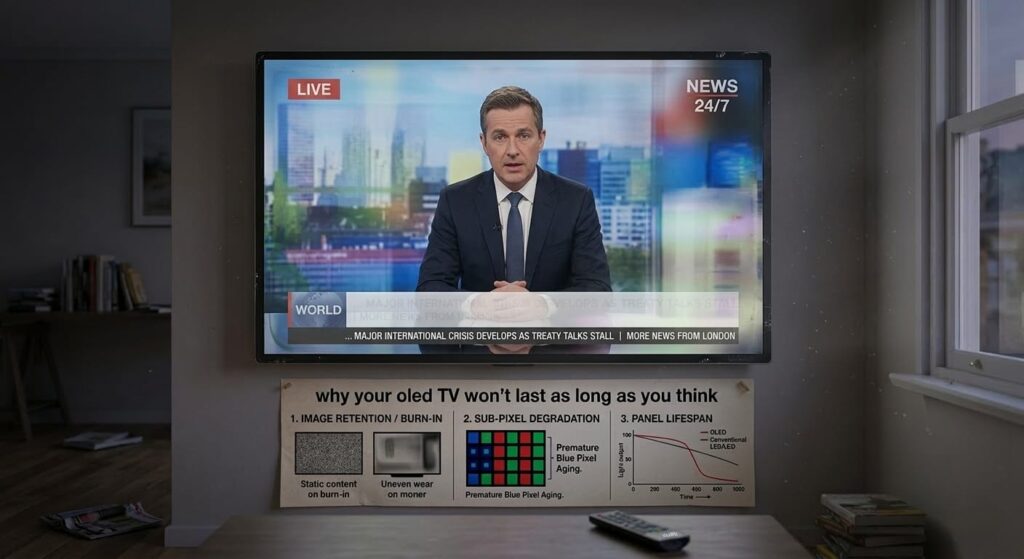
However, OLED technology relies on organic compounds that produce light, and like all organic materials, these compounds degrade over time. As the pixels age, several issues may appear:
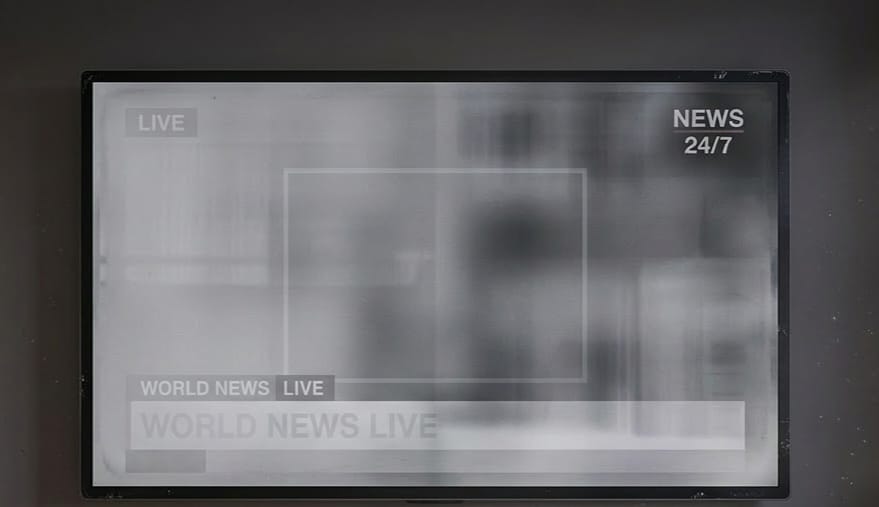
- Burn-in: A faint, permanent “shadow” of static elements such as channel logos, news tickers, or gaming HUDs.
- Vertical or horizontal banding: Lines appearing due to uneven pixel wear.
- Reduced brightness: Especially noticeable in bright colors like white or red.
These problems were first observed in the early generation of OLED televisions introduced in the early 2010s. In the past couple of years, however, reports from users have increased, even among televisions that are only two or three years old.
The technological limitation: why OLED doesn’t last forever
The challenge lies in the fundamental structure of OLED panels. Each pixel in an OLED display is composed of subpixels that produce red, green, and blue light. These subpixels emit light independently, but they do not age at the same rate.
In particular, blue OLED materials tend to degrade faster than red or green ones. Over time, this imbalance can lead to color shifts, uneven brightness, or reduced overall panel uniformity.
The reason is rooted in chemistry.
OLED displays rely on carbon-based organic compounds, which naturally break down when exposed to heat, moisture, or heavy usage. The brighter the display operates, the faster these materials degrade.
Manufacturers attempt to mitigate these issues with various techniques:
- automatic pixel refresh cycles
- static brightness limiters
- logo detection systems
- panel designs such as WRGB OLED
These methods help reduce the likelihood of burn-in and extend the panel’s lifespan, but they cannot eliminate the underlying physical limitation: every hour of use gradually wears the pixels down.
Does Mini-LED last longer?
This is where Mini-LED technology enters the conversation.
Unlike OLED, Mini-LED displays are not based on organic materials. They are essentially advanced LCD panels that use thousands of tiny LED backlights for improved contrast and local dimming.
Because the image itself is produced by a traditional LCD layer, pixel burn-in is not an inherent issue.
As a result, Mini-LED televisions typically have a longer expected lifespan. Industry estimates often place them around 10 to 15 years of use, or roughly 100,000 hours, depending on brightness levels and usage patterns.
OLED panels, by comparison, may start showing changes in brightness or color accuracy after five to seven years of heavy use.
That does not mean Mini-LED is perfect. These displays can still experience their own issues, such as:
- uneven wear in the backlight LEDs
- dark spots or bright areas
- blooming, a halo effect around bright objects caused by imperfect local dimming
Nevertheless, the underlying technology tends to be more durable over long periods.
The reality of warranty policies
On paper, most television manufacturers offer one to three years of standard warranty, with optional extended coverage that can reach five or even six years.
In practice, however, the experience can be more complicated.
In cases involving burn-in or panel degradation, many consumers report that the manufacturer or service provider does not perform a traditional repair. Instead, the customer may receive one of several alternatives:
- a replacement television of similar specifications, sometimes refurbished
- a discounted upgrade offer to a newer model
- or in some cases, a rejection of the claim altogether
In simple terms, the solution offered to the customer is often to pay again, just a little less than before.
For some consumers, this begins to resemble an unofficial leasing model: every few years the television is replaced, but the customer continues paying over time whether they originally intended to upgrade or not.
What are users reporting around the world?
Across online communities, such as Reddit, AVForums, and various regional technology forums, discussions about OLED wear and burn-in have become increasingly common.
Some users describe burn-in appearing after one or two years, even when following the manufacturer’s recommendations. Others report panel uniformity issues or color changes after extended gaming or watching channels with static graphics.
It is important to note that these cases do not represent every OLED television. Many users operate their TVs for years without problems. Still, the frequency of such discussions highlights a broader concern about long-term durability.
What should you know before buying an OLED TV?
OLED televisions unquestionably deliver one of the best viewing experiences available today. For film lovers and home-cinema enthusiasts, the difference in contrast and color can be remarkable.
But buyers should understand the trade-off: higher image quality may come with a shorter practical lifespan compared with some alternative technologies.
Those who frequently watch channels with static logos, such as news networks, or who use their televisions heavily for gaming with fixed interface elements may encounter wear sooner.
Before purchasing an OLED TV, it is worth considering a few questions:
- What exactly does the manufacturer’s warranty cover?
- Is there an extended warranty option, and what does it actually include?
- Are you comfortable potentially replacing the TV after several years if performance declines?
For some buyers, a Mini-LED or QLED television may offer a more durable long-term solution, even if the contrast and black levels are slightly less impressive.
The bigger shift: televisions as semi-disposable technology
In the past, buying a television often meant making an investment that would last a decade or more, but today, that assumption is changing.
Like smartphones and other consumer electronics, televisions are increasingly becoming semi-disposable devices, products designed to deliver cutting-edge performance for a limited period before being replaced by newer models.
OLED technology embodies this shift perfectly. It delivers an extraordinary viewing experience, but it may require replacement sooner than many people expect.
In other words, purchasing an OLED TV is not just a statement about image quality, it is also a decision about how long you expect that quality to last.
Understanding that trade-off may be just as important as the picture itself.