
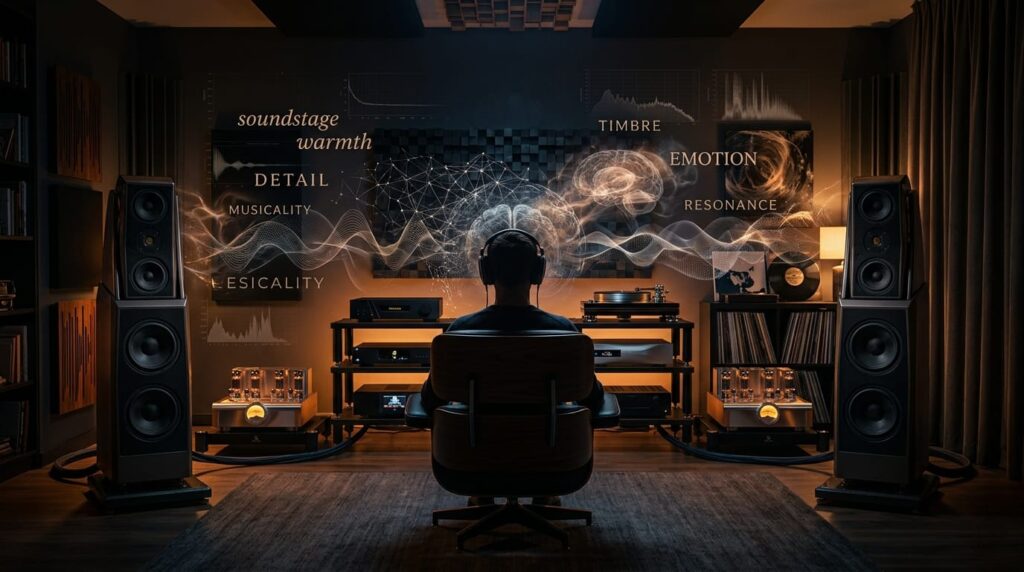
Why high-end audio is shaped as much by psychology, expectation, and identity as by measurements, frequency response, and engineering performance.
Part of the “Beyond the Gear” series on the deeper side of audio.
👉Explore all articles in the series to learn how sound affects your brain, hearing, and the way you experience music, then dive into more unique content.
In this article, I will focus on the non-measurable factors that shape our audio decisions far more than most of us realize. This is not an attempt to dismiss the importance of sound quality itself, but rather to understand why, in a hobby where we often believe we are being purely rational, emotion still plays a massive role.
There is a moment almost every serious audiophile knows intimately. I’m standing in front of a new component: an amplifier, speakers, a DAC, maybe even a cable. Before the first note is played, something has already happened. My posture changes. My attention sharpens. Anticipation builds. Deep down, I already know I’m not merely evaluating the component. I’m experiencing it. And that moment matters.
The longer I live inside the world of high-end audio, and the more research I encounter on consumer behavior, sensory perception, and decision-making, the clearer an uncomfortable truth becomes: audiophile decisions are not based solely on hearing. They are also shaped by the same psychological mechanisms that govern broader consumer behavior.
Not in the simplistic sense of we’re all being fooled, but in the much deeper sense that audio is an emotional, cognitive, social, and sensory experience all at once.
The Physical Truth of Sound
Let’s begin with the obvious foundation: sound is a measurable physical phenomenon. Frequency response, harmonic distortion, signal-to-noise ratio, dynamic range, dispersion characteristics, impulse response, all can be objectively measured independent of the cognitive biases discussed later in this article.
There are also extensive scientific studies, such as those conducted by Floyd Toole and Sean Olive, demonstrating meaningful correlations between acoustic measurements and listener preferences. In other words, there is a physical reality and real differences exist. Objective performance often predicts listener satisfaction surprisingly well.
Acknowledging cognitive influence does not invalidate genuine sonic differences. It simply reminds us that the final listening experience emerges from an interaction between physics and perception.
This article is not an attempt to argue that everything is in your head. Nor is it meant to dismiss measurements or engineering. Quite the opposite. It is an attempt to present a fuller picture where the ear never operates alone.
The Brain Is Not a Microphone
The experience audio creates is never purely technological. It also involves psychoacoustics, cognition, emotion, memory, identity, and social influence. Anyone trying to understand what they are truly purchasing when buying audio equipment should understand both sides of the equation: the physical and the psychological.
This becomes especially true in two-channel audio, where there is often no universally obvious winner. One listener may prefer an analytical, highly revealing system, while another gravitates toward warmth, forgiveness, and emotional ease. A technically superior system does not automatically become universally enjoyable.
The highly resolving, hyper-detailed setup may objectively outperform the warmer system in measurable ways, yet still fail to emotionally connect with certain listeners. And that matters.
Important Caveats
It is important to state honestly that most of the research referenced throughout this article was not conducted specifically within high-end audio. Much of it comes from broader fields such as consumer psychology, cognitive science, medicine, and sensory perception.
To my knowledge, there are no massive controlled studies isolating ultra-high-end audio components in perfectly calibrated listening environments while simultaneously analyzing the full psychological influences described here. So this article is not claiming definitive proof that every effect discussed operates identically inside audiophile listening. However, because these behavioral patterns repeatedly appear across other multisensory consumer experiences, it is highly plausible they influence audio perception as well.
Additionally, no single study fully captures the complexity of the audiophile experience itself: room acoustics, component synergy, prior exposure, emotional investment, social validation, expectation, aesthetics, identity, and long-term ownership. For that reason, any conclusion here is necessarily partial.
But perhaps that is precisely why we should adopt a more layered perspective, that recognizes both the physics of sound and the psychology of the listener simultaneously.
The Illusion of Expertise: When We Believe We Know How Sound “Should” Sound
The more time I spend in audio, the more I notice a strange paradox: the more I learn, the more convinced I become that I hear more. But theoretical knowledge does not always sharpen perception. Sometimes it simply sharpens the narrative we tell ourselves.
In forums and reviews, we learn terms like soundstage depth, microdynamics, imaging precision, black backgrounds, air between instruments, liquidity, texture, and holography. These concepts become internalized vocabulary. Once the brain learns the language, it already knows what to search for.
Listening training absolutely can improve auditory discrimination. But when knowledge is built primarily from forum language rather than controlled listening experience, it can also create overconfidence. Cognitive psychology describes this phenomenon as the Illusion of Expertise.
In other words, we may develop a strong feeling of expertise based on mastering the vocabulary itself, even when our actual analytical listening abilities remain largely unchanged. In audio, this can create situations where we perceive improvement not solely because the system changed, but because we finally acquired words capable of describing what we hear.
And at that point, distinguishing between genuine perception and persuasive self-narrative becomes far more difficult.
The Ear Hears and The Brain Interprets
Perception research repeatedly shows that humans do not perceive stimuli absolutely, but relatively. Our listening anchor is never fixed. Every evaluation becomes relative to prior experience, reference points, and environment. When the reference point changes, the entire framework shifts with it.
Our truth about sound evolves through accumulated exposure to different systems, rooms, recordings, and performances. Experience creates knowledge, knowledge creates conclusions and conclusions formed through repeated experience begin approaching something closer to objectivity.
This explains why an audiophile can feel completely satisfied with a system, only to hear another setup and suddenly perceive their own system as flat, constrained, veiled, or lacking depth.
- Did the system change? No.
- Did the ear change? Perhaps slightly.
- But the cognitive framework changed dramatically.
And from that moment, one of the most powerful drivers of upgrades is born: not dissatisfaction, but expanded imagination.
The Upgrade Spiral
One of the most common assumptions in audiophile communities is that upgrades happen because people are unhappy with their systems. But often, the opposite is true: we become exposed to something better, or at least something presented as better.
Until hearing that other system, we were perfectly satisfied, and then suddenly we encounter a deeper soundstage, lower noise floor, more effortless dynamics, greater realism, or a stronger sense of flow. So now our existing system no longer feels complete.
A recent example that comes to mind was a listening room demonstration at a recent audio event. Several tracks were played during the session which left listeners visibly stunned. Some openly said they needed to return with friends. Others joked that listening at home afterward would no longer feel satisfying.
Research into Hedonic Adaptation explains this phenomenon well: the brain adapts quickly to any level of pleasure, and what once felt extraordinary gradually becomes normal.
In audio, that baseline constantly shifts because we continually encounter new reference points. As a result, many upgrades are not attempts to solve problems, but to recapture emotional impact.
Expectation Bias: When the Brain Arrives Before the Ears
In consumer psychology and neuroscience, expectation bias is one of the most extensively documented phenomena. A famous 2008 study by Plassmann et al. demonstrated that identical wine was perceived as higher quality when participants believed it was more expensive. Medicine has repeatedly demonstrated similar placebo effects.
If people are told a product is superior, they are dramatically more likely to experience it as superior, even when objective differences are minimal or nonexistent. In audio, expectation bias becomes especially powerful. Audio forums are filled with vivid descriptions: The soundstage opened up. There’s more air between instruments. The system breathes now. The bass gained texture. The music flows more naturally.
These descriptions are poetic and emotionally compelling. But they also pre-program our listening expectations. When I approach an audition after reading pages of glowing descriptions, I am no longer listening neutrally. My brain is actively searching for what it was told to hear.
And like most human brains, it usually finds it. That does not mean the experience is fake, because it is absolutely real. But its origin may involve both sound and expectation simultaneously.
Language Shapes Listening
Language is not merely a tool for describing audiophile experiences. Sometimes it actively creates them. When I read that an amplifier is analytical but not sterile, or that a speaker is warm yet still resolving, I no longer approach the audition neutrally. The language itself creates interpretive framing.
This aligns closely with psychological priming: an exposure to concepts that later shape how sensory information is interpreted. In audio, we do not merely hear sound. We hear through an internal vocabulary that has already been loaded into memory.
Over the years, listening experiments have repeatedly shown that when listeners know which component is more expensive or prestigious, they often rate it more favorably. Not always. Not universally. But statistically often enough to matter.
Again, this does not mean differences are imaginary, yet expectation itself becomes part of the listening process.
Short Auditions vs Living With a System
Over the years, many of my own purchasing decisions were based on short listening sessions at dealers, trade shows, or friends’ homes. Many of those experiences were thrilling, and some even led to full in-home reviews.
But looking back, those auditions almost always occurred under idealized conditions: carefully selected tracks, optimized volume levels, heightened concentration, and emotional anticipation. And living with equipment is entirely different.
There is a phrase often repeated in audiophile communities: Equipment that lives with you eventually stops trying to impress you. Some systems dazzle instantly yet become fatiguing over time, while others seem understated initially but slowly reveal long-term musical satisfaction.
Distinguishing between immediate excitement and long-term compatibility may be one of the hardest skills in high-end audio.
Price as Sound Quality
Few topics in audio remain as taboo as the relationship between price and perception. Yet honesty demands we acknowledge it: price changes how we listen.
When I sit down in front of an expensive component, I automatically become more patient, more attentive, and often more forgiving. Small flaws may even become interpreted as character. In audio communities, certain assumptions become deeply internalized: a $2,000 amplifier should not realistically compete with a $20,000 amplifier. A modest DAC cannot possibly outperform an ultra-premium flagship. A lightweight amplifier somehow feels suspicious before a single note plays.
These assumptions are not purely technical but cultural. Over time, price becomes psychologically linked with legitimacy, seriousness, and expected performance. Long before the first sound emerges, the brain already expects superiority. And often ensures that superiority is perceived. At the same time, exceptions absolutely exist.
I remember forum members conducting home amplifier comparisons where less expensive amplifiers occasionally outperformed dramatically pricier competitors within their own systems. But such comparisons remain rare because few people can realistically audition multiple ultra-high-end components side by side inside their own homes.
Weight, Design, and Physical Presence
There is a reason premium audio equipment looks the way it does. The thick aluminum faceplates, symmetrical layouts, oversized transformers, precision-machined knobs and sheer physical mass.
These elements do more than serve engineering functions. They create trust. When we lift a heavy amplifier or see massive capacitors arranged with military precision, we are not merely analyzing hardware, but experiencing authority.
Certainly, weight can correlate with meaningful engineering choices like larger power supplies, improved chassis rigidity, and vibration control. But perception begins before sound ever enters the equation: A heavy amplifier simply feels more serious.
Research into Embodied Cognition demonstrates that physical sensations directly shape cognitive evaluation. Heavy objects are perceived as more important, cold materials feel more precise and symmetrical designs feel more harmonious.
When I touch a massive amplifier chassis, part of me already believes it will sound exceptional. When I see speakers designed like modern sculpture, I begin expecting elegance and refinement before listening even begins. The eyes often hear before the ears.
We Never Listen Alone
Audiophilia may appear solitary, but it is deeply social. We sit alone in front of our systems, yet our decisions are shaped inside noisy ecosystems: forums, YouTube reviewers, dealer demonstrations, audio shows, Reddit threads, Discord communities, group chats, influencer culture, and social validation.
Solomon Asch demonstrated decades ago how powerful group consensus can become. Robert Cialdini later explored how social proof shapes consumer decision-making. Audio fits these conditions perfectly: expensive products, complex evaluation, subjective interpretation, high emotional investment.
And once respected community members become enthusiastic about a component, remaining fully neutral becomes surprisingly difficult. Part of us quietly wonders: Am I missing something everyone else hears?
The Narrative Problem
As someone who also writes audio reviews, I increasingly recognize how powerful storytelling itself can become. A great audio review is often a miniature work of literature. And the better the writing becomes, the more dangerous it may become for objectivity.
When a reviewer describes the moment everything clicked, readers do not simply process information. They imagine the experience. Research into mental simulation suggests the brain responds strongly even to vividly imagined experiences. Emotion begins before direct exposure ever occurs. By the time we finally hear the product ourselves, expectations are already deeply loaded.
The Joy of the Chase
Audiophilia contains a fascinating paradox: the moment a system finally feels complete is often the moment something emotionally ends. The searching, comparing, anticipation and dreaming. Much of the dopamine in this hobby comes not from ownership itself, but from pursuit.
Hedonic adaptation research explains why new purchases create intense excitement initially, only for that excitement to normalize later. Many audiophiles openly admit this: I miss the search. Everything sounds too good now. I don’t even know what to upgrade anymore.
That is not failure, but simply human nature.
Fear of Being Wrong
Beneath the pursuit of better sound often hides another powerful force: fear of discovering we made the wrong decision. Because expensive audio purchases are rarely just financial. They become part of identity. Admitting a mistake can feel like admitting incompetence.
This becomes especially difficult when purchases are public: forum announcement threads, system showcase photos, social validation, enthusiastic reactions from peers. Cognitive dissonance research explains why publicly committed decisions become psychologically harder to reverse.
The larger the investment, emotionally and socially, the harder it becomes to admit regret. And this pattern appears repeatedly throughout audiophile communities. Not because enthusiasts are irrational, but because they are human.
Final Thoughts
If you’ve read this far, perhaps the most important realization is this: The ear never listens alone. It is connected to memory, expectation, identity, aesthetics, emotion, social influence, and imagination.
Audio equipment may be technological hardware, but the experience it creates is profoundly human. Once we accept that, audiophilia stops becoming an endless race toward perfection and becomes something more interesting: an ongoing dialogue with ourselves.
Not merely: What do I hear? But: Why does this matter to me so deeply?
And perhaps that is exactly what makes audiophilia so addictive in the first place. It was never only about sound.