
For years, premium phones meant more screen, more cameras and more hardware. But 30 years ago luxury phone used to be small. Foldables could bring luxury back to something much simpler: making technology disappear.
I was reminded of that question while spending time with Samsung’s latest generation of foldables, including the Galaxy Z Fold 8, Galaxy Z Fold 8 Ultra and Galaxy Z Flip 8, an experience I recently described in my hands on report. The Fold 8 Ultra is a fascinating example of where the premium smartphone market has arrived. Open it and you are looking at a device designed to give you more screen, space for multitasking, room for video, documents and applications, and a sense that you are carrying something considerably more ambitious than an ordinary smartphone. Samsung itself now describes the Fold family as a mature premium category rather than an experiment, and the Ultra model takes that idea even further.
But here is the question I cannot get out of my head:
When did “more” become the same thing as “more luxurious”?
Because it was not always this way. There was a time when the language of luxury in mobile phones was almost completely different. The impressive phone was not the one that looked as though it wanted to become a tablet. It was the phone that disappeared.
Smartphone luxury once meant getting smaller. Think back 20 or 30 years, before smartphones turned the mobile phone into a pocket computer, before every device was expected to display a web page, stream a movie and run dozens of applications at the same time. Back then, the basic engineering challenge was almost the reverse of today’s.
People wanted phones to become smaller, lighter and easier to carry. A large, thick mobile phone was not necessarily impressive. Quite often, it was simply a cheaper phone whose manufacturer had not yet figured out how to make the technology small enough.
The ultimate expression of that idea was Motorola’s StarTAC. When Motorola introduced the StarTAC in 1996, it was promoted as one of the smallest mobile phones available, weighing only about 88 grams. Its tiny physical footprint was not a compromise that consumers were expected to tolerate. It was the product’s attraction and the actual point.
It was expensive. The StarTAC was introduced at around $1,000, equivalent to roughly $2,000 in today’s money, and historical accounts put some full retail versions at approximately $1,500 to $2,000. In other words, you could pay an extraordinary amount of money for something whose great selling point was that it took up remarkably little space.
That is almost difficult to explain to someone who has grown up in today’s smartphone market. Imagine walking into a phone store in 2026 and being told that the phone with the smallest display, the smallest body and the least amount of visible technology was the one that cost the most. That was not an absurd proposition then.
It was the luxury proposition. The StarTAC’s appeal was partly technological, but it was also psychological. It communicated that the manufacturer had succeeded in miniaturizing something that had previously been large and cumbersome. The smaller device suggested sophistication because miniaturization itself was difficult.
There is an important distinction here. Small did not mean technologically inferior. It meant that engineers had succeeded in making something difficult smaller. That is why the old mobile phone market can look almost upside down when viewed through today’s eyes.
When big phones were cheap phones
The mobile phone industry spent years trying to make components smaller, batteries more efficient and electronics more compact. Consumers watched phones shrink from objects that demanded their own carrying arrangements into devices that could slip into a pocket.
A large handset could be perfectly functional, but its size did not automatically communicate status. In fact, the visual language of the period often suggested the opposite. A bulky phone could look like something designed primarily to get the job done. A small phone could look like a precision object, almost like a piece of jewelry or a luxury watch.
The Motorola StarTAC became particularly important because it transformed compactness into an object of desire. The device was not merely small enough to carry. Its size was part of its identity. That brings us to the question that matters today.
Why did we reverse the equation?
Why did the phone industry move from a world in which smaller could mean more desirable, sophisticated and expensive, to one in which the largest screen in the range is so often positioned as the ultimate flagship?
The answer begins with the smartphone.
The smartphone changed what we were actually buying
The arrival of the smartphone did something profound to the meaning of size. A mobile phone had traditionally been a communications device, yet a smartphone became a screen. That sounds like a small difference, but it changed almost everything.
Once the phone became the place where we read email, browsed the web, watched video, edited photographs, navigated cities, played games, read books and eventually managed much of our working lives, display area stopped being merely a specification.
It became usable real estate.
A larger screen was no longer simply a larger piece of hardware. It could mean more information at once, a larger keyboard, easier reading and a more immersive experience.
Research supports this shift rather well. A 2014 study examining the psychological effects of smartphone screen size compared users working with 5.3 inch and 3.7 inch displays and found that the larger screen could improve both utilitarian and hedonic qualities, which in turn influenced perceived ease of use and attitudes toward the device. In other words, consumers were not simply being persuaded that bigger was better. For many tasks, bigger really was better.
The problem was that something else happened along the way. The useful feature gradually became a status feature.
When Bigger Became Premium
Apple did not invent the large smartphone, and it would be historically inaccurate to say that the company single handedly created the relationship between screen size and premium pricing. But Apple played an enormous role in normalizing the idea that a larger iPhone could also be the more expensive iPhone.
The turning point was particularly visible with the iPhone 6 generation in 2014.
Apple introduced the iPhone 6 with a 4.7 inch display and the iPhone 6 Plus with a 5.5 inch display. The company described the two devices as offering different screen sizes, while the Plus also brought additional hardware advantages. In the United States, the 16GB iPhone 6 started at $649 without a contract, while the 16GB iPhone 6 Plus started at $749.
That $100 difference is important because the larger display was no longer simply a matter of personal preference.
It had become part of the premium ladder.
An analysis by IHS, reported by CBS, estimated that the iPhone 6 Plus cost only about $15.50 more to manufacture than the equivalent iPhone 6, while Apple charged a $100 retail premium. The additional manufacturing cost included the larger display, larger case, larger battery and other components, but the gap between production cost and consumer price demonstrated something larger than the hardware itself.
Apple had discovered, or perhaps more accurately refined, an extremely powerful pricing principle and turned screen size into part of the pricing hierarchy.
Consumers do not necessarily pay only for what a component costs.
They pay for what the component means.
A bigger screen could mean more usefulness, but it could also mean more prestige. That distinction would eventually become one of the most important ideas in the smartphone business.
Bigger became the language of the flagship
Once consumers began using their smartphones as miniature computers, manufacturers had a very good reason to make screens larger, and there was another reason as well.
A larger phone gave manufacturers more physical space.
More space meant larger batteries, more elaborate cameras, more cooling, additional sensors and increasingly sophisticated internal components. The smartphone could become more capable without requiring every component to become dramatically smaller at the same time.
The result was a positive feedback loop.
- Consumers wanted bigger screens because they were useful.
- Manufacturers could put more technology into larger bodies.
- The larger models could then be positioned as the most capable products.
- The most capable products could be priced higher.
Because consumers associated the higher price with the flagship, the larger phone increasingly became a symbol of status.
The equation was now almost the exact opposite of the StarTAC era.
Then: miniaturization created luxury.
Now: maximization creates luxury.
That reversal is one of the most interesting stories in the history of personal technology.
The market never completely stopped wanting smaller phones
There is a temptation to look at today’s enormous smartphones and conclude that consumers have unanimously chosen size, but they have not.
The demand for compact phones has never disappeared. It has simply become less visible because manufacturers have learned that the economics of large smartphones are difficult to ignore.
Forrester reported in 2020 that 21% of U.S. online adults had a smartphone with a display smaller than five inches, while 15% said they wanted their next phone to have a display below five inches. The research also described persistent demand among users who valued pocketability, particularly among people using their devices for work.
More recently, a 2025 Which? UK survey found that 33% of respondents considered modern smartphones too large in general, while 21% said they would prefer their next phone to have a display of 5.5 inches or smaller. The reasons were strikingly practical: difficulty fitting phones into pockets or bags, one handed usability and weight.
An Ipsos Consumer Tracker US survey published in March 2026 found that 51% of Americans believe modern phones are becoming too wide to grip securely. Ipsos described the broader historical irony rather beautifully: mobile phones became smaller and more pocketable after starting as bulky objects, only to grow dramatically again as manufacturers prioritized larger displays.
That is the part of this story that interests me most.
The industry may be moving toward larger screens, but consumers are not necessarily becoming more enthusiastic about larger physical objects. Those are two very different things.
In the past I used to carry a smartphone in a belt clip case, and now I carry almost nothing
This is also where the story becomes personal for me. I have spent enough years reviewing mobile phones to remember when carrying one meant thinking about where you were going to put it. The time when my smartphone had a case with a belt clip are over, and the whole arrangement was simply accepted as part of being a mobile phone user.
Today, since I switched to carry a Galaxy Z Flip, I no longer carry that side holster and phone combination, and I genuinely love it. The satisfaction in taking a full candybar smartphone, folding it in half and putting it into a pocket in a form that feels much closer to the mobile phones, is priceless compared to the giant slabs that dominate today’s market.
The irony is that when the phone is open, I still get the large smartphone experience, and when I close it, I get the thing that I increasingly value more than another tenth of an inch of display.
A device that disappears when I do not need it.
Sometimes I find myself looking at people carrying enormous phones asking them a question that I cannot quite answer:
Why hasn’t anyone followed me?
Why are we still accepting phones that make pockets uncomfortable, require two hands for certain tasks and increasingly demand physical space from us simply because the industry has decided that more screen is a premium feature?
The answer, of course, is that the large phone gives a lot back. That is where the story becomes much more complicated.
The paradox of the premium smartphone
This is where the modern smartphone becomes almost contradictory. We have spent years being told that the most luxurious phone is the one with the largest display and the most cameras, yet many of the things that make a phone genuinely pleasant to live with have very little to do with maximizing any of those measurements.
I have felt that contradiction every day since I moved to a Galaxy Z Flip. When the phone is open, I have a screen that is large enough for practically everything I want to do. When I am finished, I close it, put it in my pocket and almost forget that it is there. After years of carrying a phone that seemed to occupy an ever increasing amount of physical space, that small act of folding it has changed my relationship with the device.
I no longer think about the phone as something I have to carry, yet as something I can put away. That distinction sounds trivial until you experience it. The modern smartphone has become so central to our lives that we have gradually accepted the idea that its physical presence should also become larger. A bigger screen gives us more room, but it also gives the phone more presence in our pockets, our hands, our bags and, increasingly, our daily routines.
The Galaxy Z Flip reverses that relationship. It gives me the big screen when I need it and the small phone when I do not. That is precisely why I keep wondering whether the next great premium phone could eventually be the one that becomes smaller rather than larger.
The smartphone industry has already tried to go small again
This is not a completely hypothetical idea. The industry has repeatedly experimented with compact smartphones, and the results have been fascinating because they demonstrate that there is a genuine audience for smaller devices, but also that the economics and expectations of the flagship market make compact phones extraordinarily difficult to position.
Apple’s iPhone mini experiment is perhaps the clearest recent example.
The iPhone 12 mini and iPhone 13 mini offered flagship performance in a much smaller package, with a 5.4 inch display, but Apple ultimately stopped producing a mini version after the iPhone 13 generation. The experiment did not prove that people hate small phones, but proved something more complicated: a relatively large number of people may appreciate the idea of a small premium phone without enough of them actually buying one at a premium price.
That distinction is crucial. There is a difference between saying, “I wish someone made a smaller phone,” and actually walking into a store and paying flagship money for one.
The same tension has appeared repeatedly across Android. Sony’s Xperia Compact models once demonstrated that a serious smartphone could be dramatically smaller than the industry’s mainstream flagships, while Asus and other manufacturers have periodically tried to serve enthusiasts who wanted flagship specifications without a gigantic chassis.
But the category never became dominant, because a large phone had acquired something that the small phone struggled to reproduce: it had become both a tool and a status object.
Bigger does not just mean bigger
The academic research helps explain why the industry was able to make this transition so successfully. A 2014 study published in Cyberpsychology, Behavior, and Social Networking compared users interacting with 5.3 inch and 3.7 inch smartphone displays. The researchers found that the larger screen improved both utilitarian and hedonic perceptions of the smartphone, meaning users could perceive it as more useful while also enjoying the experience more. Those perceptions then influenced ease of use and attitudes toward the device.
That finding matters because it means the large screen was never merely a marketing trick. There is real psychological and practical value in having more display area. Reading and typing become easier, video is more immersive, maps are more useful, photos are more impressive and multitasking becomes more comfortable.
A large screen can make a smartphone feel less like a telephone and more like a computer, and that is exactly what happened.
A smartphone stopped competing with the phone and started competing with the laptop, television, tablet, game console and eventually almost every other personal computing device. Once that happened, bigger became remarkably easy to sell.
Then came the Ultra
The word Ultra tells us almost everything we need to know about the modern premium smartphone. Ultra does not mean compact but more.
More cameras, bigger battery, larger storage, stronger processing power, more screen. More everything. The Samsung’s Galaxy S26 Ultra which I reviewed here sits squarely inside that philosophy, and my experience reviewing it reinforced how thoroughly the industry has associated premium status with physical and technological abundance. The phone is not merely designed to perform well, but to communicate that it is the phone at the top of the hierarchy.
The same principle is now visible in Samsung’s foldable range: The Galaxy Z Fold 8 Ultra pushes the concept further, with a price beginning around $2,099 in the United States, positioning it firmly among the most expensive mainstream smartphones available.
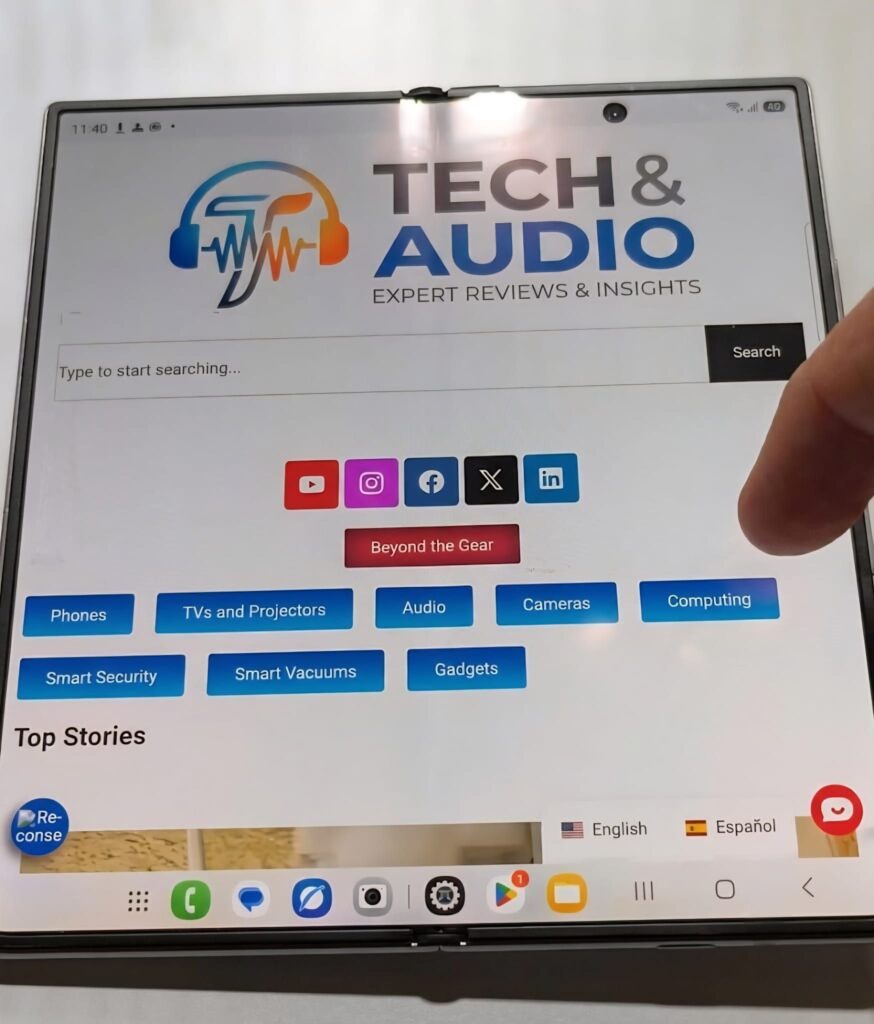
That is remarkable when you think about the history of the mobile phone. The Motorola StarTAC was expensive because it represented technological miniaturization, and the Fold 8 Ultra is expensive because it represents technological maximization.
One was a triumph of making technology smaller and the other is a triumph of making one device do more. Yet there is an important twist hidden inside the foldable category:
The Fold may be large when you use it and the Flip is small when you carry it. That may turn out to be much more important than the industry realizes. The Flip is perhaps the first luxury phone that gives size back to you, and this is why I have such a soft spot for Samsung’s Galaxy Z Flip series.
I do not love it because it has the largest display, but since it does not force me to carry that display all the time. That is a completely different philosophy of design.
The conventional smartphone says, Here is your screen. Carry it everywhere and the Flip says, Here is your screen when you need it. Close it when you don’t. For me, that has changed the physical experience of owning a phone more than almost any specification upgrade has done in recent years.
I can put the phone into a pocket without giving it much thought. Perhaps the strangest part is that when I open it, I do not feel that I have sacrificed much at all. That is why I sometimes look at the enormous phones around me and wonder whether we have confused screen size with quality.
Maybe the better question is not, How much screen can we carry, pero How much screen can we have without having to carry it all the time?
That is a very different design challenge.
What if the Galaxy Z Flip were 25% smaller?
Now we arrive at the question I think the industry should be asking. Imagine a device that folded once again, or has a smaller screen that folds, becoming genuinely miniature when closed. Not a tiny novelty phone with a two-inch display. Just the same basic idea, scaled down enough to make the closed phone dramatically easier to carry. Imagine a phone that could disappear into the smallest pocket, yet still unfold into a display large enough for messaging, navigation, photography and ordinary smartphone tasks.
This is not a product Samsung has announced. It is simply a thought experiment.
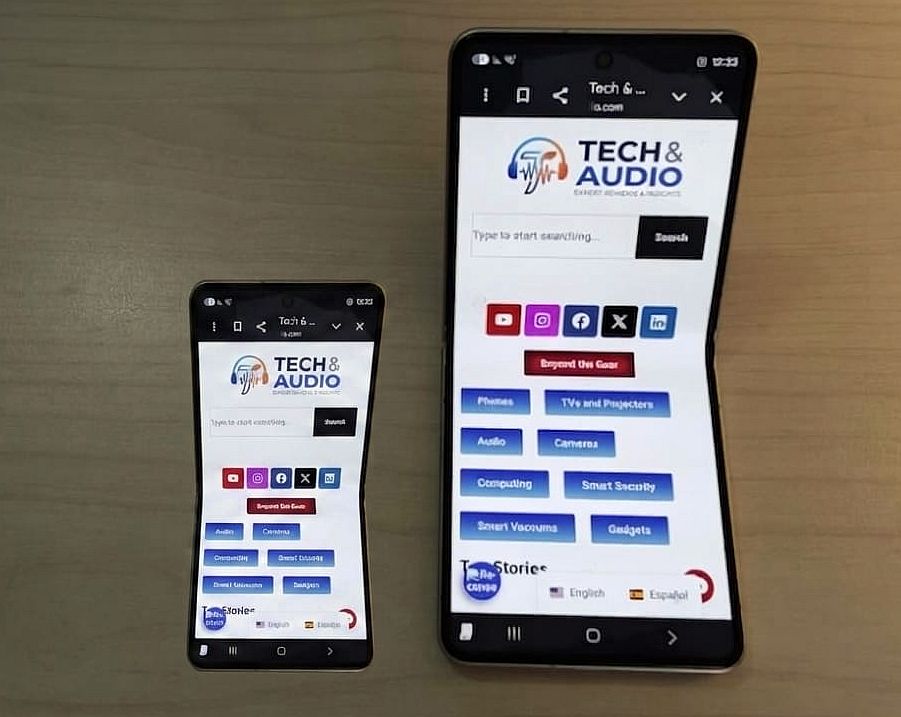
Would consumers perceive that device as cheap because it was smaller?
Or could its smallness become the luxury feature?
History suggests that the answer is not as obvious as it first appears. The StarTAC demonstrated that miniaturization can itself become a status symbol. Luxury watches do not become luxurious because they are enormous. Jewelry does not become more valuable simply because it takes up more space. High end mechanical engineering has often been admired precisely because extraordinary complexity can be contained inside something surprisingly small.
Why should the smartphone be permanently different?
There is even a technological reason to believe that foldables could eventually make the old relationship between size and luxury obsolete.
- A foldable phone can separate the dimensions that conventional smartphones have forced us to combine.
- A traditional phone has one physical size.
- A foldable can have one size in your pocket and another in your hand.
The market is already telling us something else
There is another side to this story, and it is the reason I do not believe the era of gigantic flagship phones is about to disappear.
Consumers genuinely use the extra space.
Recent buying guides still describe phones around 6.5 to 6.8 inches as the natural choice for people who want large displays, while phones below six inches have become increasingly difficult to find. Tom’s Guide noted in its 2026 recommendations that the small phone market has become extremely limited, even though phones around 6.1 inches can still feel relatively compact because of modern display technology and reduced bezels.
That is the crucial point. The industry is not simply ignoring consumers. It is responding to what many consumers actually do.
People watch YouTube on their phones, read documents and use navigation. Smartphones have become a portable entertainment and productivity device, and the larger screen makes many of those activities better.
So perhaps the real future is not small versus large, but large when needed and small when carried. That is exactly the promise of the foldable.
The most interesting thing about Samsung’s Fold 8 may not be the Ultra
There is another detail in Samsung’s latest generation that I find particularly revealing. The standard Galaxy Z Fold 8 is actually receiving praise from reviewers for being more comfortable and more practical than the larger and more imposing Fold 8 Ultra. Some reviewers concluded that the standard Fold 8’s shorter and wider proportions made it more comfortable to use, with reviewers repeatedly preferring it to the taller Fold 8 Ultra despite the Ultra’s superior camera hardware.
That is significant, since the market may have spent years teaching us that the Ultra is the ultimate expression of a product, yet we reviewers are also choosing the smaller model because it works better as a physical object.
That is precisely the tension I am talking about. Even within the premium foldable category, reviewers may prefer the physically smaller and more comfortable model over the technologically more extravagant Ultra.
What if luxury becomes the absence of inconvenience?
For years, smartphone luxury has been measured by additions of cameras, newer processor, more storage and higher brightness. Perhaps the next generation of luxury will be measured by subtraction, removing the bulk, weight and overall feeling that your phone is taking over your pocket.
Remove the constant temptation to look at the screen. That last point may be especially important, since a conventional large smartphone is always there, face up or face down, ready to demand attention, but a folded phone is physically closed. That small mechanical action creates a psychological boundary that a conventional slab simply does not have.
I have noticed it in my own use, since when my Flip is closed, it feels finished. When my old phone was sitting in my pocket, it felt like an open invitation to look at it. That may not appear on a specification sheet, but it is one of the most meaningful differences between the two designs.
So what should a luxury phone look like in 2030?
Perhaps it will still be enormous. The Galaxy S26 Ultra and its successors are the beginning of an era in which consumers simply decide that six and a half inches is the minimum acceptable amount of screen. The Fold 8 Ultra represents the inevitable direction of premium smartphones, where the flagship becomes increasingly powerful, expensive and tablet like.
We may approach the moment when consumers begin to ask a different question than how big is the screen? They might ask How small is the phone when I am not using it? That would completely reverse the industry’s definition of premium.
And if that happens, I would not be surprised if the next generation of luxury smartphones looks surprisingly familiar to anyone who remembers the StarTAC: Small, compact, elegant and expensive. Except this time, it would not have a tiny screen, but one that unfolds.
If you had two phones with comparable cameras, processors, battery life and software, but one gave you a huge screen that remained physically large all day, while the other folded into something dramatically smaller and gave you the large screen only when you needed it, which one would you consider more luxurious?
Would you rather carry the biggest screen possible because the size itself represents power, productivity and status, or one that effectively disappears into your pocket, knowing that you can unfold it whenever you need a large display?
After years of testing phones, I know where I have landed. I want the screen, just not to carry its full size when I am not using it. Perhaps that is the strange lesson the smartphone industry has been approaching for years without quite saying it out loud: The future isn’t small versus large. It’s large when you need it, small when you don’t. The StarTAC once made luxury out of miniaturization, the smartphone made luxury out of screen size and the foldable may eventually give us both.
If that happens, the most luxurious phone in the room may once again be the smallest one.