
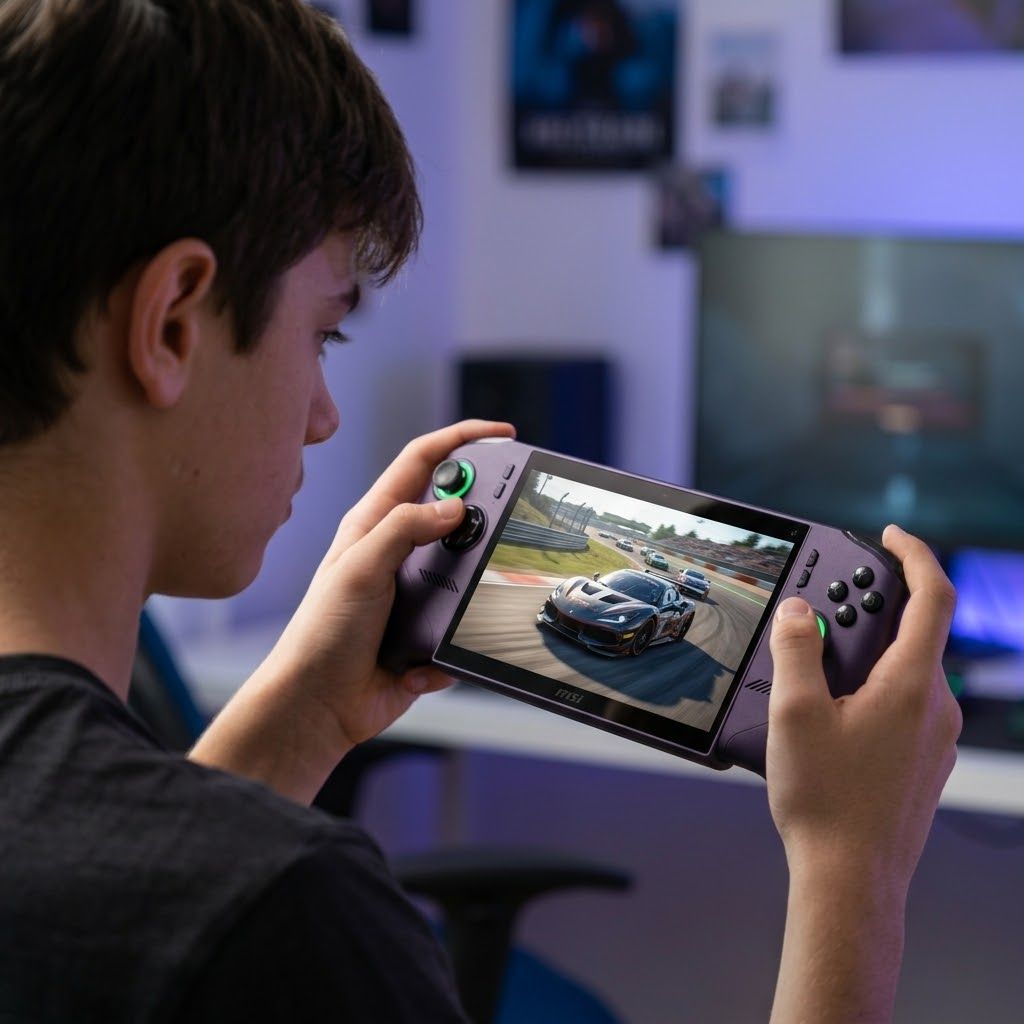
The MSI Claw 8 EX AI+ represents a potentially important turning point for Intel in handheld gaming, and after spending time with the device, I can see why this generation feels different from the company’s earlier attempts to compete in a market that has become increasingly difficult to ignore.
There is something I genuinely love about handheld gaming PCs, and it has very little to do with benchmark scores or how many frames per second a processor can deliver. It is the freedom to step away from my desk, take an entire gaming system into my hands, and play without turning the living room into a small IT project. A desktop gaming PC can be powerful, flexible, and upgradeable, but it still asks me to sit down in front of it, whereas a handheld can come along for the ride, whether I am relaxing on the couch or looking for a quick gaming session before bed.
That is why the original Steam Deck mattered so much, even to people who never bought one. It helped make PC gaming feel like console gaming, and once ASUS, Lenovo, MSI, and other manufacturers joined the market, the idea grew into an entire category of devices trying to solve essentially the same problem: how do you squeeze the flexibility of Windows, the enormous PC gaming library, and enough computing power into something that resembles a gaming laptop after an extreme diet?

The market, however, is still figuring itself out.
Once the initial excitement fades, the picture becomes a little less cinematic. Handheld gaming PCs have not made traditional gaming systems obsolete, and for many people, they remain a complementary device rather than a replacement for a desktop, PlayStation, or Xbox. That distinction matters because it makes the purchase price much more important. When a handheld is something you want rather than something you absolutely need, it has to offer a compelling reason to justify the expense.
That is precisely the challenge facing the MSI Claw 8 EX AI+.
Intel Arc G3 Is Not Intel’s First Attempt, and That Is What Makes It Interesting
Intel’s story in handheld gaming did not begin with the Arc G3 generation. The original MSI Claw arrived in 2024 with a Meteor Lake processor, representing an early attempt by MSI and Intel to challenge a market dominated largely by AMD powered handhelds. The concept was promising, but the first generation struggled with performance and software maturity, leaving Intel with considerable ground to make up.
The subsequent MSI Claw 8 AI+ brought meaningful improvements through Intel’s Lunar Lake platform, demonstrating that the company was capable of producing a much more convincing handheld gaming experience. Now, with the Arc G3 family, Intel is taking a more targeted approach, developing silicon for the specific demands of compact gaming systems rather than simply adapting a general purpose laptop processor to a smaller chassis.
That distinction is important because handheld gaming involves compromises that are easy to underestimate when looking at specifications on paper. Power consumption, heat, sustained performance, and battery life all influence how a game actually feels in your hands, and a processor that performs well in a laptop does not automatically make an equally compelling handheld.
The Arc G3 Extreme configuration in the MSI Claw 8 EX AI+ combines a 14 core CPU, consisting of two performance cores, eight efficiency cores, and four low power efficiency cores, with Intel Arc B390 integrated graphics featuring 12 Xe3 cores, up to 46 TOPS of NPU performance, and fast LPDDR5X memory. The important point is not simply the core count or the headline numbers, but how the platform is designed to balance performance and power consumption in a device that must operate both from a wall outlet and from its internal battery.
MSI Claw 8 EX AI+: A Handheld Built Around Serious Hardware
The MSI Claw 8 EX AI+ is the first MSI handheld to bring Intel’s Arc G3 platform into this particular form factor, and the hardware configuration makes it clear that MSI is not trying to build the smallest or lightest device possible. Instead, the company appears to be prioritizing a combination of performance, connectivity, cooling, and a screen large enough to make PC games comfortable to play.
The eight inch IPS display has a resolution of 1920 by 1200, a variable refresh rate ranging from 48Hz to 120Hz, a rated brightness of 500 nits, and 100 percent sRGB color coverage. The system also offers 32GB of LPDDR5X memory, a 1TB M.2 2280 NVMe SSD in the configuration I am discussing, two Thunderbolt 4 ports, WiFi 7, Bluetooth 6, a microSD Express card reader, and an 80Wh battery, all within a device weighing approximately 785 grams.
Looking at those specifications, my first impression is that MSI has chosen to build a substantial handheld rather than chase the appeal of an ultra compact design. That is not necessarily a bad decision, because portability is about more than reducing a number on a scale. A device can be slightly thicker or heavier yet remain more comfortable to use if its shape, grip, and weight distribution are properly considered.
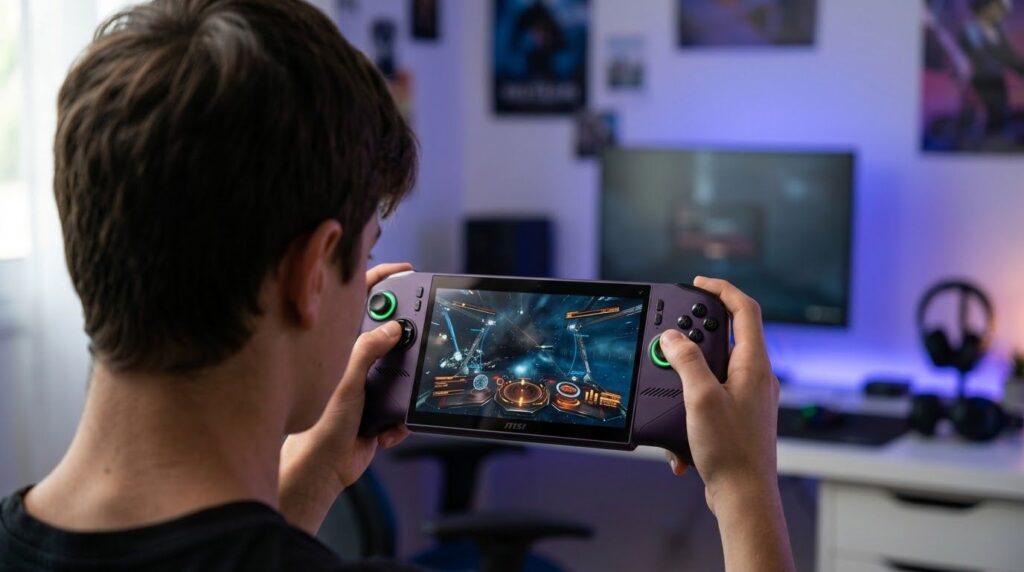
When I first picked up the Claw 8 EX AI+, I immediately noticed its broad, extended grips and the way the body sits in my hands. The overall shape feels closer to holding an Xbox controller than holding a small tablet with controls attached, and that distinction matters more to me than shaving a couple of millimeters off the thickness.
After all, a thin handheld might impress me for the first few minutes, but after an hour of gaming, my hands are no longer interested in the specification sheet. They want to know whether the device remains comfortable.
Designed Around Comfort, Not Just Specifications
The Claw 8 EX AI+ is a large handheld, particularly when compared with the Steam Deck, but I found its grip and weight distribution reassuring during my initial use. The extended handles provide a more substantial place for my fingers to rest, while the controller inspired layout makes the device feel familiar rather than awkward.
MSI has also included Hall Effect analog sticks and triggers, which use magnetic sensing to detect movement and can reduce the wear related problems associated with traditional contact based mechanisms. The controls are complemented by HD haptics, adding tactile feedback during gameplay.
These are the kinds of features that make sense in a handheld designed to be used for extended periods, because the controls are the part of the device I interact with constantly. I did not get the impression that MSI had cut corners in this area, and the overall experience felt thoughtfully designed.
There is still a trade off, of course. At 785 grams, the Claw is carrying a considerable amount of hardware, and although I appreciated its ergonomics, I was always aware that I was holding a fairly substantial piece of electronics. Good grip design can make a heavy device easier to live with, but it cannot make the weight disappear.
The Display Looks Great, but Where Is The OLED?
The eight inch display is one of the easiest parts of the Claw 8 EX AI+ to appreciate. Its 1920 by 1200 resolution provides a sharp image at this size, the 120Hz refresh rate allows compatible games to look fluid, and variable refresh rate technology helps reduce distracting tearing when the frame rate fluctuates.
I also appreciate the additional vertical resolution compared with a conventional 1920 by 1080 display, particularly when Windows interfaces and game menus are involved, because text remains readable without forcing everything to feel cramped on a handheld screen.
The IPS panel is bright, colorful, and capable of delivering an impressive image, but there is an obvious question that becomes difficult to ignore when looking at a premium device like this: why is it not OLED?
OLED would offer deeper blacks and the kind of contrast that can make darker game environments look substantially more convincing. At this price level, asking for that improvement is entirely reasonable, especially when the display is one of the main things separating a premium handheld from a more affordable alternative.
Still, once I started playing, I found myself thinking less about the panel technology and more about how the entire system performed. That is where Intel’s Arc G3 platform became particularly interesting to me, because the Claw began to feel less like a device struggling to catch up with the competition and more like a serious gaming PC that happened to fit in my hands.
What I appreciated was not simply the promise of raw processing power, but the way the overall experience could feel closer to playing on a conventional gaming PC than on a handheld constantly fighting to keep up with the action.
Playing Asphalt 8: When the Technology Disappears
I spent time playing Asphalt 8, and the racing experience brought out a side of me that benchmark charts rarely capture. I found myself getting genuinely excited at the end of races, reacting with the kind of enthusiasm I associate with being a kid again rather than someone sitting down to evaluate a piece of technology.
Once the game was running, the hardware faded into the background, which is exactly what I want from a device like this. I stopped thinking about the fact that I was testing a new processor and started concentrating on the race itself.
For me, that is a more meaningful measure of a gaming device than simply looking at its maximum refresh rate. A display can support 120Hz, but if the game feels inconsistent, input latency becomes distracting, or the experience lacks the responsiveness I expect, the specification loses much of its appeal.
When the controls feel immediate, the image remains fluid, and I forget that I am supposed to be evaluating the hardware, I know that the technology is doing its job.
I would not claim that a single game establishes how the Claw performs across every demanding PC title, and a broader assessment would require testing a much wider range of games at different settings and power limits. Nevertheless, my experience with Asphalt 8 showed me why Intel’s approach is worth paying attention to, particularly when the processor and graphics platform are being used in a system designed around handheld gaming.
Battery Efficiency Could Matter More Than Peak Performance
The part of the Arc G3 story that interests me most is the balance between performance and power consumption. A handheld can deliver impressive performance while connected to a charger, but the experience becomes less convincing if playing away from a power outlet means sacrificing too much of that performance or constantly worrying about the remaining battery percentage.
The 80Wh battery gives the Claw 8 EX AI+ a substantial capacity for a handheld, but capacity alone does not tell us how long the device will last. Actual battery life depends on the game, display brightness, frame rate, power profile, and other settings, so I would not assume that a large battery automatically translates into a full day of gaming.
What matters is how effectively the system manages its available power, allowing the device to preserve a satisfying gaming experience without drawing more energy than necessary. That is a much more practical goal than simply advertising a large battery or chasing maximum performance regardless of the consequences.
This is where I see the potential value of Intel’s approach. If Arc G3 can maintain a responsive experience while adapting power consumption to the demands of the game and whether the device is plugged in, that would be a meaningful advantage for people who bought a handheld specifically to get away from the desk.
The question is not whether the Claw can run at maximum performance all day, because that is an unrealistic expectation for a device of this size. The question is whether it can deliver enough performance, for long enough, to make portable gaming genuinely convenient.
Windows 11 Still Reminds Me That This Is a PC
This is where the dream of a handheld console meets the reality of Windows 11. No matter how capable the Arc G3 platform may be, the Claw remains a Windows computer, and that brings the familiar strengths of PC gaming along with the occasional frustrations of a desktop operating system squeezed into a portable device.
MSI has made an effort to create a more suitable handheld interface through MSI Center M and Xbox Mode, bringing games and relevant settings closer to the kind of experience people expect from a dedicated gaming console. The problem is that moving between interfaces and software layers can still feel more complicated than it should, particularly when several different menus and utilities compete for the user’s attention.
This is one area where I would really like to see the next generation improve. When I pick up a handheld because I want to play for twenty minutes before going to sleep, I do not want to think about desktop menus, driver management, Windows updates, or the different software layers controlling the experience.
I want to turn it on, choose a game, and start playing.
Windows remains a major advantage because it provides access to a broad PC gaming library and familiar desktop applications, but that flexibility does not eliminate the need for a better handheld interface. In fact, the more powerful these devices become, the more important it is for their software to make that power accessible without unnecessary friction.
Connectivity Reminds Me Why I Love PC Gaming
The Claw’s connectivity is another reason I appreciate the PC approach. With two Thunderbolt 4 ports, WiFi 7, Bluetooth 6, a microSD Express card reader, and a headphone jack, the device offers considerable flexibility beyond simply playing games on its built in screen.
I can connect it to a larger display, pair a wireless controller, attach compatible external storage, transfer files, or use it as a compact Windows computer before disconnecting everything and returning to handheld gaming.
That flexibility is one of the strongest arguments for a gaming PC compared with a more closed console ecosystem. A dedicated console may offer a simpler experience, but a handheld PC gives me more freedom to decide how, where, and with which accessories I want to use it.
The challenge is making that flexibility feel effortless rather than complicated, and while MSI has delivered a capable set of connections, the overall Windows experience still has room to become more seamless.
Advanced Hardware Comes at a Premium Price
The biggest obstacle facing the MSI Claw 8 EX AI+ is not necessarily its hardware, but its price.
The combination of Intel’s Arc G3 platform, a large high refresh rate display, generous memory, fast storage, an 80Wh battery, and extensive connectivity makes for a compelling specification sheet. The ergonomics also make a positive impression, and the system has the potential to deliver a strong portable gaming experience.
But once the price enters the territory of gaming laptops, the buying decision becomes considerably more complicated. A laptop can offer a larger display, a physical keyboard, more room for cooling, and potentially different performance options for a similar investment, while a more affordable handheld may provide enough gaming capability for someone who simply wants to play on the couch.
That does not make the Claw a poor product. It means that its value depends heavily on what the buyer prioritizes.
For someone who wants a premium handheld with modern connectivity, a substantial battery, and a platform designed specifically around portable gaming, the Claw 8 EX AI+ makes a much more convincing argument than its predecessors. For someone who measures value primarily by performance per dollar, the price is likely to remain a serious consideration.
At the time of writing, the Amazon listing I am referencing is priced at approximately $2,300, although pricing and availability can change.
Check the MSI Claw 8 EX AI+ price on Amazon
Final Verdict: Intel Has Become a Serious Handheld Contender
For me, Intel Arc G3 represents a meaningful step forward because it reflects a more focused effort to bring processing power, graphics performance, connectivity, and power management together in a handheld gaming system.
The MSI Claw 8 EX AI+ is the clearest expression of that approach I have experienced so far. Its ergonomics, large 120Hz display, substantial battery, modern connectivity, and promising gaming experience combine to create a device that feels considerably more mature than the early Claw concept.
I particularly appreciate that the design does not appear to chase thinness at the expense of comfort, and that the combination of a full Windows environment with extensive connectivity allows the device to function as more than a portable gaming machine.
There are still compromises. I would have liked to see an OLED display at this price, Windows remains more complicated than a dedicated console interface should be, and the weight is something I cannot completely ignore during extended sessions. The asking price also places the Claw in a category where buyers have to think carefully about whether portability is worth the premium.
Even with those reservations, the MSI Claw 8 EX AI+ makes a strong statement about Intel’s ambitions in handheld gaming. It suggests that Intel is no longer content simply to compete with AMD on the same terms, but wants to make a case for its own combination of performance, efficiency, and platform design.
The Claw is not automatically the right choice for every gamer, especially if price is the main consideration. But for people who want a premium handheld PC and are willing to pay for the combination of hardware and portability, it is one of the more interesting devices to watch.
Intel has given the handheld market a reason to take its next move seriously, and that alone makes the MSI Claw 8 EX AI+ worth paying attention to.
Manufacturer: MSI
Processor platform: Intel Arc G3 Extreme
Price referenced: Approximately $2,300 on Amazon at the time of writing, subject to change
Where to buy: Check the MSI Claw 8 EX AI+ on Amazon
Disclosure: This article contains an affiliate link. As an Amazon Associate, TechAndAudio.com may earn from qualifying purchases.