
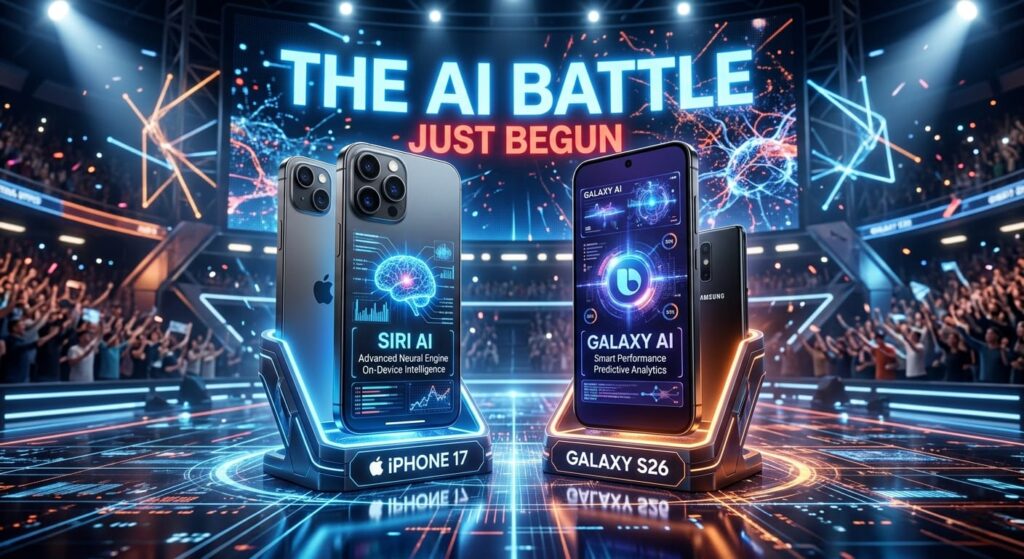
After the iPhone 17 Launch: Is Apple Falling Behind in the AI Race?
Over the past year, the smartphone industry has entered a new phase, one where artificial intelligence is no longer just a feature, but increasingly the core of the user experience.
For years, competition between smartphone makers revolved around cameras, processors, displays, and battery life. Those factors still matter, but the real battleground is shifting rapidly toward AI-powered services that shape how devices interact with users, homes, and digital ecosystems.
In that context, the launch of Apple’s iPhone 17 series generated enormous anticipation. Apple also expanded its Apple Intelligence initiative, promising deeper integration of AI across iOS. Yet the reaction from analysts and technology observers has been mixed.
While the hardware improvements are clear, critics argue that Apple’s AI offering still feels cautious, especially when compared with the aggressive ecosystem strategy now being pushed by Samsung and its Android partners.
So what exactly is happening in the smartphone AI race? What does Samsung currently offer that Apple does not? And how might this affect consumer loyalty in one of the most competitive technology markets in the world?

Where Samsung currently leads
At IFA 2025, one of the world’s largest consumer electronics events, Samsung unveiled a broader AI strategy that goes far beyond smartphones.
The company introduced its AI Home vision along with Vision AI Companion, describing a future where artificial intelligence operates not just on a phone, but across the entire connected home.
In Samsung’s ecosystem, AI is designed to function as a multimodal assistant capable of understanding images, voice commands, and contextual information simultaneously.
A user can speak to a television, ask about what they’re watching, request translations, control smart appliances, or trigger home automation scenarios through the SmartThings platform.
Samsung has also expanded partnerships with major AI companies, including Google and Microsoft, to integrate multiple AI agents and cloud-powered capabilities into its devices. This hybrid approach combines on-device processing with external AI services, creating a flexible environment for experimentation and rapid feature deployment.
What does this mean in practice?
Samsung is not simply embedding AI features into smartphones. Instead, it is building a connected AI ecosystem in which the television can act as a central command hub for the home.
The AI system can analyze what’s happening on the screen, answer contextual questions about the content, translate conversations in real time, and connect with household appliances.
For example, the AI Home platform can help optimize energy consumption by coordinating appliances such as washing machines, refrigerators, and climate systems through SmartThings. The company even introduced incentive programs, like Flex Connect and Samsung Rewards, that encourage users to reduce energy usage.
The result is a vision in which AI becomes a daily household companion rather than a tool used only within a smartphone app.
What Apple introduced with the iPhone 17
Apple’s response comes in the form of Apple Intelligence, a suite of AI capabilities built directly into iOS 26 and optimized for the new A19 processor inside the iPhone 17 lineup.
During the launch event, Apple highlighted several key features. One of the most notable is Live Translation, which enables real-time translation during FaceTime calls. This capability allows users speaking different languages to communicate seamlessly through on-device translation.
Apple also introduced improvements to Visual Intelligence, enabling users to search information directly from images or screenshots. For example, pointing the camera at an object or capturing a screenshot of a product can trigger contextual actions such as searching, identifying items, or extracting information.
The company also emphasized that the A19 chip is designed to support the future evolution of AI features, suggesting that more capabilities will arrive through software updates.
However, many observers noted that much of what Apple presented felt like an expansion of previously announced ideas rather than a dramatic leap forward.
Apple Intelligence was introduced earlier as a concept of “personal AI” focused on privacy, and the new version continues to emphasize on-device processing. While this approach protects user data, it also limits the scope of cloud-based integrations and third-party AI services.
In contrast to Samsung’s holistic AI ecosystem vision, Apple’s implementation still feels primarily device-centric.
The Galaxy S26 Strengthens Samsung’s AI Push
The launch of the Galaxy S26 series in early 2026 further reinforces Samsung’s strategy of turning the smartphone into an “AI phone”. The new devices expand Galaxy AI with features designed to make the phone more proactive, not just responsive. One example is Now Nudge, which analyzes what’s happening on screen and suggests relevant actions, such as opening the calendar during a conversation to schedule a meeting or recommending content to share in a chat.
Samsung also introduced expanded AI creative tools like Photo Assist and Creative Studio, allowing users to perform complex photo edits or generate visual changes using simple text prompts. More broadly, the company is moving toward what it calls agentic AI, where the phone can complete tasks across multiple apps using AI engines such as Google’s Gemini.
In practice, the S26 launch highlights the growing contrast between the two companies’ strategies.
Samsung is pushing aggressively toward a cloud-connected, ecosystem-wide AI experience, while Apple continues to advance Apple Intelligence more cautiously, focusing on privacy and on-device processing.
A closer look at the differences
Natural conversation and AI assistants
Samsung’s Vision AI Companion and its enhanced Bixby assistant enable users to interact conversationally with both smartphones and televisions. Users can ask questions about the program currently playing, search for contextual information, or control SmartThings-enabled devices using natural voice commands.
Apple’s approach with Apple Intelligence remains more controlled and localized. Conversations with AI are largely handled on-device, maintaining privacy but offering fewer integrations with external services.
The result is a system that is secure but less flexible.
Real-time translation and communication
Apple’s Live Translation in FaceTime is a meaningful step forward. By performing translation locally on the device, Apple avoids sending sensitive conversations to external servers.
Samsung, however, has pushed translation further into the broader home environment. Its ecosystem enables real-time speech processing and subtitle translation on televisions as well as smartphones.
In other words, while both companies are advancing translation technology, Samsung emphasizes integration across the household, whereas Apple focuses primarily on communication within its device ecosystem.
Image processing and smart editing
Apple continues to dominate in professional-grade imaging hardware. The iPhone 17 builds on Apple’s strong reputation for camera quality and adds deeper integration with tools such as Final Cut Camera. The expansion of Visual Intelligence also allows users to perform actions directly from images or screenshots, creating powerful workflows for content discovery.
Samsung, meanwhile, focuses more heavily on AI-powered editing tools within its Galaxy AI platform. Features such as smart scene relighting, generative editing, and automated content adjustments aim to simplify creative workflows for everyday users.
Samsung’s strategy is also to expand these tools beyond smartphones and integrate them with TVs and other devices.
The takeaway is clear: Apple still leads in camera hardware and professional imaging quality, but Samsung is rapidly expanding its lead in automated content editing and AI-assisted creativity.
Smart home integration
Samsung’s AI Home strategy, built around SmartThings, is one of the most ambitious attempts to unify consumer electronics into a single AI ecosystem. The system connects televisions, appliances, and mobile devices into coordinated daily scenarios, from scheduling laundry cycles to monitoring food storage in refrigerators.
Apple’s equivalent ecosystem, based on HomeKit, Apple Home, and the Matter standard, is growing but remains more focused on integration with Apple devices such as the Apple TV and HomePod.
Apple’s emphasis on privacy and consistent user experience has produced a stable platform, but its integration with large appliances and broader home automation remains more limited than Samsung’s.
Why Apple appears cautious
Apple’s approach reflects a deliberate strategic choice. The company has built its brand around privacy and user trust, and this philosophy influences how it deploys AI. Many of Apple’s features run locally on the device rather than relying heavily on cloud processing.
This design reduces the risk of data leaks but also slows the rollout of advanced AI services that depend on large-scale cloud computing.
Apple is also known for introducing hardware first and software evolution later. The A19 processor inside the iPhone 17 may be laying the groundwork for future AI features that will appear gradually in software updates.
In short, Apple is moving carefully, possibly too carefully for an industry that is evolving at extraordinary speed.
How the market is reacting
Reactions to the iPhone 17 launch have been mixed. Some analysts praised Apple’s hardware improvements, while others expressed concern about the company’s pace in the AI race. Reports from publications such as Bloomberg and Barron’s suggested that Apple’s cautious approach could eventually challenge its competitive advantage if rivals continue accelerating innovation.
Still, the smartphone market is complex.
Most consumers still prioritize battery life, camera performance, and overall reliability when choosing a device. AI features, while increasingly important, have not yet become the sole deciding factor.
Will users switch to Android?
That question sits at the center of the debate.
Apple users are famously loyal, largely due to the strength of the company’s ecosystem. Services such as iCloud, iMessage, and Apple’s tightly integrated devices create powerful incentives to remain within the platform.
However, surveys indicate that some consumers are becoming more open to switching, especially those interested in foldable phones or advanced AI features not yet available in Apple products.
For now, a large-scale migration to Android seems unlikely. But if Samsung and Google continue expanding practical AI features, like real-time translation, automated editing, and seamless smart-home control, the balance could gradually shift.
A buyer’s dilemma
For anyone considering a smartphone purchase today, the choice has become more nuanced.
Apple offers exceptional hardware quality, a refined user experience, and one of the strongest privacy frameworks in the industry. Its AI strategy is conservative but consistent with its broader philosophy.
Samsung and other Android manufacturers, on the other hand, are moving faster to deliver practical AI features that influence daily life, from smart editing to AI-powered assistants integrated throughout the home.
Consumers must decide whether they prefer stability and privacy or rapid innovation and broader AI functionality.
What Apple may need to do next
To remain competitive in the evolving AI landscape, Apple may eventually need to expand its strategy.
Possible steps include:
- Deeper collaboration with external AI partners
- Greater use of cloud-based AI services alongside on-device processing
- Broader smart-home integration across Apple’s ecosystem
If Apple can combine these elements while maintaining its privacy standards, it could regain momentum in the AI race.
The near-term outlook
Over the next six months, Apple’s sales are unlikely to change dramatically. Customer loyalty remains strong, and incremental software updates will continue improving existing features.
Samsung and Google, however, are expected to push even harder into cloud-powered AI services and ecosystem integrations, potentially delivering experiences that feel more advanced in everyday use.
Looking further ahead, over the next two years, the smartphone market could become more fragmented. Dedicated Apple users will likely remain within the ecosystem, but consumers seeking richer AI experiences may increasingly explore Android alternatives.
The race between privacy-focused AI and ecosystem-driven AI is only beginning.
And the outcome could redefine the next era of smartphones.