
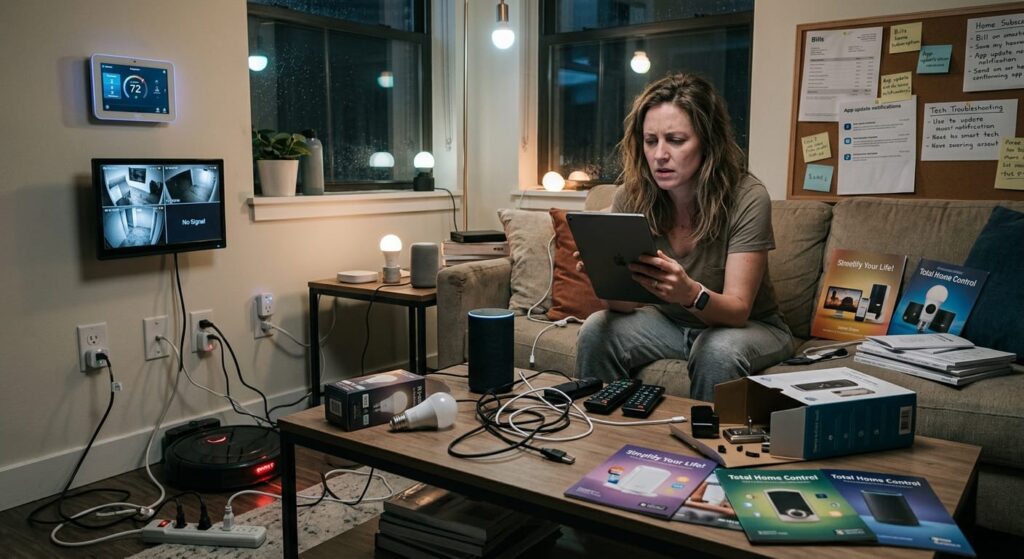
Why Modern Tech Might Be Overpromising.
Imagine walking up to your front door and seeing a sleek smart panel that lets you turn on lights, open blinds, and start the coffee maker. You tap your phone, and in theory the house wakes up. But now ask yourself this: Did the house really get smarter? Or did we just add more gadgets to our lives?
A light switch was invented over a century ago so that with one simple flip you could turn lights on and off. Yet today, some people spend thousands to replicate that exact function with a smart app or voice command. When did convenience become complexity for complexity’s sake?
Welcome to the era of the “smart home”: a buzzword that promises comfort, efficiency, and cutting‑edge living, but in practice often delivers electric gadgets with Wi‑Fi rather than genuinely intelligent living spaces.
What Smart Home Actually Means And What It Doesn’t
At its core, a smart home is supposed to be an ecosystem of devices connected via the internet that you can control remotely: lighting, thermostat, security, entertainment, and more from a phone or voice assistant. In the ideal vision, these systems work seamlessly, learn your patterns, and make decisions for you.
But there’s a big difference between connected devices and an intelligent home ecosystem. Most smart systems today still require manual setup, separate apps, individual accounts, and constant updates just to function. That’s convenience, but only if it works reliably.
According to smart home experts, the term smart home covers everything from a single voice‑enabled speaker to a fully automated climate, lighting, security, and energy platform. That’s because the definition is very broad, making it harder to measure what smart really means in practice.
Smart Devices vs. Smart Homes: The Real Difference
Here’s a reality check:
- Installing a smart bulb that changes color via app doesn’t make your home smarter than a chic lamp with a remote.
- Having a smart thermostat that learns your schedule is certainly more useful than opening a window, but it still reacts to data rather than anticipates intelligently.
- A connected smart lock sounds futuristic until it fails to unlock during a power or Wi‑Fi outage.
In other words: You can have smart devices without having a smart home. This is where many people get confused.
Take smart lighting as an example: some systems promise energy savings and automation, but they come with higher upfront costs than traditional bulbs, complex integrations, and compatibility issues across brands and protocols like Zigbee, Z‑Wave, or Wi‑Fi.
My Dimmer Switch
Even if you spend on smart bulbs everywhere, that doesn’t necessarily improve your everyday life, especially if they don’t work when a guest flips the old switch or your internet goes down.
The Costs You Don’t Always See
One of the most common myths is that smart homes are cost savers. In reality, that depends on how they’re used.
A full smart home setup can easily run thousands of dollars in devices, hubs, sensors, and professional installation. Adding smart locks, cameras, switches, and climate controls can significantly raise the price tag compared with traditional systems.
Even after installation, there’s often ongoing maintenance and subscriptions: cloud storage for camera footage, advanced thermostat features, or security services. Devices also need power and standby energy just to stay connected.
some energy experts estimate that always‑on smart gadgets can account for up to 25% of a household’s standby energy use, especially when dozens are connected.
The Spruce
So while a thermostat might theoretically save on heating and cooling by optimizing schedules, the cumulative load of dozens of smart devices can cancel out some of those savings. That’s not smart. It’s just networked consumption.
Complexity, Connectivity and the Illusion of Control
Smart homes are literally only as strong as their weakest connection.
A network outage, power flicker, or cloud service glitch can leave smart lights off, locks unresponsive, or thermostats in limbo.
Many users report frustrating experiences: devices failing to reconnect automatically, smart switches reverting to manual mode, or systems requiring constant app interaction just to stay functional.
In one striking example shared in the The Guardian news, homeowners found themselves unable to flush toilets, unlock doors, or even exit garages during outages because their smart systems either failed or were too reliant on cloud connectivity.
This reveals a deeper truth: a truly smart home should be able to function even when the internet doesn’t. But most current systems don’t.
Security and Privacy: The Dark Side of Smart
Almost every smart device collects data about your routines, habits, presence patterns, and preferences. While that data enables automation, it also creates privacy risks. Studies show that smart home tech can expose vulnerabilities in authentication, data confidentiality, and unauthorized access if not properly secured.
Router breaches, hacked cameras, and voice assistant exploits aren’t rare headlines; they’re real threats users must actively guard against. Many early IoT‑connected devices lacked robust security standards, and the pace of manufacturer updates doesn’t always keep up with emerging threats.
This isn’t just theory. Many consumers now cite privacy concerns and fear of data misuse as primary reasons they slow down or avoid smart home adoption.
When Smart Tech Truly Helps (and When It Doesn’t)
It’s not all doom and gloom. Some smart systems genuinely add value:
- Smart thermostats can optimize HVAC use and reduce waste.
- Water leak sensors can prevent expensive home damage before it happens.
- Smart smoke and CO detectors can notify you remotely in emergencies.
- Security systems with remote monitoring add peace of mind that simple locks can’t.
That’s real value, but note the distinction:
These systems enhance safety and efficiency, not merely novelty or remote control.
Forum discussions from homeowners highlight that successful smart integration tends to follow a principle: solve a real problem, then automate it. Simply slapping gadgets everywhere often leads to frustration rather than convenience.
For example, people regret investing heavily in smart bulbs because they require constant network presence and often revert to dumb behavior when switched manually. But smart switches and sensors that actually reduce effort or risk tend to be appreciated longer.
So Is a Smart Home Really Smart?
The answer is nuanced:
Not necessarily. A home flooded with connected gadgets is not automatically better than one with targeted, thoughtful automation. Smart tech is a valuable tool when it simplifies real problems, not when it introduces complexity without payoff.
True intelligence in a home comes from integration and context, not just remote control or flashy features. In many cases, people are better served by focusing on systems that provide tangible benefits like security, safety, energy management, rather than technology for technology’s sake.
The Takeaway: Intent Over Hype
Smart home technology is undeniably impressive, and for many, it does enhance daily life. But the industry’s marketing often oversells what smart really means: not a self‑thinking house, but a collection of connected devices that still depend on networks, updates, and sometimes, your patience.
Before turning every switch into a smartphone app or voice trigger, ask yourself:
- Does this solve a real problem?
- Will it still work if the internet goes down?
- Am I paying more for convenience than value?
Because in the end, a smart home should feel effortless and reliable, but not fragile and overpriced.