
Panasonic Skyworth Discovery happened when I investigated a Panasonic television together with Panasonic representatives at IFA Berlin 2026 and what we found inside surprised even them. The discovery revealed that Skyworth’s role in Panasonic’s European television business goes much deeper than simply manufacturing TVs in the background
When I arrived at Panasonic’s television presentation at IFA 2026 in Berlin, I was initially told that I could not enter, despite identifying myself as press, because the space was primarily being used for meetings with dealers and Panasonic had organized separate days for the press. I decided to return on the next day, insist, and eventually was allowed inside, something that turned out to be quite fortunate because what began as a visit to see Panasonic’s new European television lineup quickly turned into a much more interesting conversation about what is actually happening behind the Panasonic name.

The space itself was relatively small and unlike the large consumer oriented television areas that usually dominate IFA, it felt much more like a business meeting room, with Panasonic representatives speaking to retailers about the company’s 2026 television range and the future of the business in Europe. I was particularly interested in that future because earlier this year Panasonic announced a comprehensive partnership with Shenzhen Skyworth Display Technology and its group companies, a move that fundamentally changed the way the company operates its European television business.
But I did not expect the most interesting part of the story to come from inside the television itself.
We began discussing the transition from the old Panasonic organization to the new structure involving Skyworth, and I asked a question that seemed simple but has become increasingly difficult to answer in the modern television industry, namely, who is actually manufacturing the television that carries the Panasonic logo?

I had previously used AIDA64, a hardware and system information application, on the Dreame S100 television which I have reviewed here, where it had identified Skyworth as the manufacturer, so I showed the Panasonic representative what I had found and suggested that we try the same approach on one of Panasonic’s televisions. He was familiar with AIDA64, but, interestingly, he had never thought about using it in this particular way on a television, so we went through the process together.
What we found was one of those small details that suddenly makes a much larger business story tangible, because deep inside the television’s system information, Skyworth was still identified as the manufacturer.

The reaction of the Panasonic representative was almost as interesting to me as the information itself, because this was not something he had previously checked, and it illustrated in a very direct way something that is otherwise easy to describe only in corporate language.
From the outside, this is a Panasonic television
The logo on the front says Panasonic, the product is presented to consumers as a Panasonic television, Panasonic continues to promote its picture processing technologies and its engineering expertise, and the company remains responsible for important aspects of the product.
But when you go deeper into the machine, you can find Skyworth. That distinction is at the heart of Panasonic’s transformation in Europe.

The hardware connection
What we discovered was not limited to the Skyworth name. A closer look at the hardware revealed similarities in the chipset, memory, and other internal components as well. In particular, some of the hardware appears to closely resemble components used in another television manufactured by Skyworth for different brand, which I reviewed recently. Interestingly, this includes hardware found in the Dreame S100 TV which I reviewed recently, with several components appearing remarkably similar to those inside the specific Panasonic television we examined.
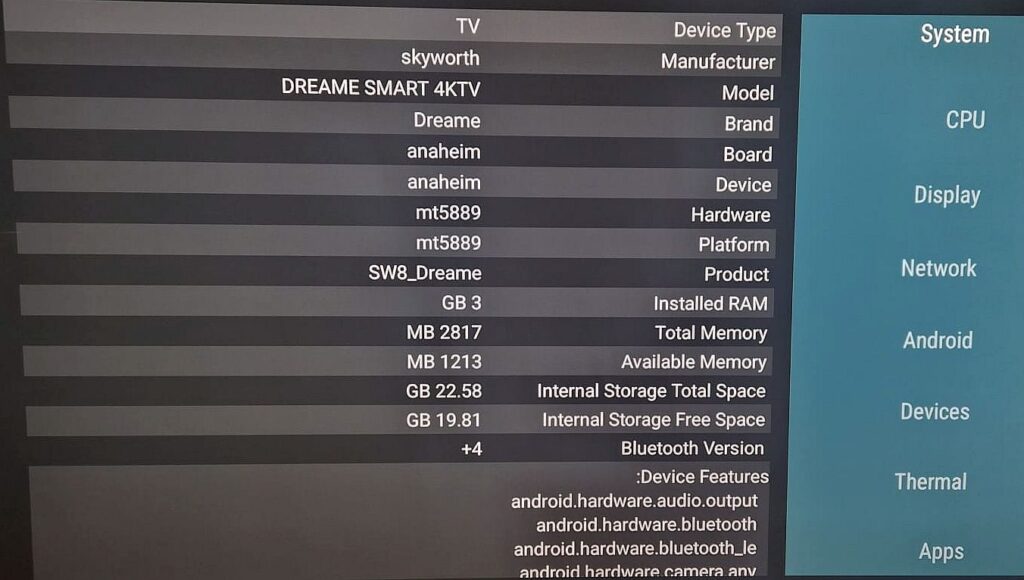
While these similarities alone do not establish that the devices share an identical internal platform, they do raise intriguing questions about the extent to which different brands may be relying on the same underlying hardware and manufacturing ecosystem.
From the outside, this is a Panasonic television.
The logo on the front says Panasonic, the product is presented to consumers as a Panasonic television, Panasonic continues to promote its picture processing technologies and its engineering expertise and the company remains responsible for important aspects of the product.
But when you go deeper into the machine, you can find Skyworth. That distinction is at the heart of Panasonic’s transformation in Europe.
The change behind the Panasonic logo
In February 2026, Panasonic announced its comprehensive business partnership with Shenzhen Skyworth Display Technology and its group companies, describing the arrangement as a regional partnership designed to combine Panasonic’s technical expertise and quality standards with Skyworth’s manufacturing scale, development capabilities and speed.
The new structure became effective in Europe on April 1, 2026, with Skyworth’s side taking responsibility for important commercial functions including sales, marketing and logistics, while Panasonic retained technical expertise and quality assurance, and the two companies continued to work together on the development of Panasonic’s complete TV portfolio.
On paper, this is a fairly straightforward corporate arrangement, but standing inside Panasonic’s IFA space and talking to an employee who had spent almost 16 years working for the company made the change feel very different.
For that employee, the transition is not simply a matter of Panasonic signing a partnership agreement with another manufacturer. He has spent a large part of his professional life working under the Panasonic name, and moving into a Skyworth related organization represents a significant personal change as well as a commercial one.
At the same time, he described the transition as something that was good for the business. His explanation was that the previous Panasonic structure involved a much longer and more complicated decision making process, particularly around research and development and product decisions, whereas the new organization is designed to operate considerably faster and with lower costs.
Under the Japanese structure, decisions had to reach consensus, with everyone agreeing before anything could move forward. Here, it is much faster, one person makes the decision, and we move.
That is an important part of understanding why Panasonic has chosen this direction, because Skyworth is not simply being brought in to manufacture televisions more cheaply. It is becoming part of a business model designed to make the entire operation more efficient, from manufacturing and logistics to sales and decision making.
And that is where the distinction between a Panasonic television and a Skyworth manufactured television becomes much more complicated than simply asking which company built it.
Panasonic is still involved, but the boundaries are changing
It would be wrong to conclude from the Skyworth identification inside the television that Panasonic has simply stopped making televisions and is now putting its logo on generic products.
Panasonic’s 2026 European range includes the Z95B and Z90B OLED models, together with QD Mini LED, QLED and LED televisions, and the company continues to promote technologies that are very much part of its own identity, including its picture processing, calibration expertise, the Primary RGB Tandem Panel and ThermalFlow cooling system on selected OLED models.
Panasonic also says that its partnership with Skyworth includes full joint development of its top end OLED models, which means that the relationship is not simply one in which Skyworth builds a television that Panasonic has designed independently.
The reality is more complicated, and probably more representative of where the television industry as a whole is heading, because a modern television can involve several companies at different stages of its development, with one company controlling the brand and product direction, another providing manufacturing capacity, another supplying the operating system, and other companies contributing panels, processors, software and components.
The consumer sees one product, but the product itself can be the result of an international network of companies.
There is even evidence in Panasonic’s own documentation
The connection between Panasonic and Skyworth is not limited to what I was told in Berlin or what can be inferred from the structure of the partnership.
Panasonic’s European television documentation currently identifies itself as “SWMEU GmbH”, while its licensing documentation states that Panasonic authorizes Skyworth to use the Panasonic trademark across a large part of Europe, making clear that Panasonic remains the owner of the Panasonic trademark while Skyworth uses it under license in the authorized territory.
Panasonic’s European television documentation also identifies Shenzhen Skyworth Display Technologies as the supplier or data holder for a number of 2026 Panasonic television models under the EU Data Act documentation, providing considerably more concrete evidence of the role Skyworth now plays in the European television operation.
This is why I think the question is no longer simply whether Panasonic televisions are made by Panasonic, because the answer depends on what exactly we mean by “made”.
Panasonic owns the brand, continues to play a significant role in picture technology and product expertise, yet Skyworth has become deeply involved in manufacturing and the commercial infrastructure surrounding the European television business.
When me and the Panasonic representatives looked inside the television itself, using AIDA 64 app which can be downloaded from the google appstore, Skyworth was identified as the manufacturer.
Then there was the Metz detail
There was another detail from my conversations with Panasonic that made the transition even more interesting, because I was told that some Panasonic televisions still carry markings on the rear referring to Metz, a television brand that is also part of the Skyworth manufacturing ecosystem.
At first glance, seeing the name Metz on the back of a Panasonic television sounds almost impossible to explain, but the reason, according to what I was told, is connected to the practical and regulatory difficulties involved in changing product labeling while manufacturing structures are being transferred between organizations.
The transition between companies does not happen overnight, and sometimes the history of the product remains literally printed on the product itself.
The operating system tells another part of the story
The software side of the transition provides another example of how complicated the new structure has become.
Google TV is currently used as a transitional solution, with the intention of returning to Fire TV for the following generation. This may sound like a relatively minor product decision, but it demonstrates how many different elements have to come together to create a modern television, and how changes in manufacturing and business structures can affect things that consumers might otherwise assume are entirely controlled by the brand printed on the front.
Sony is going through something similar, but in a different way
This is also why Sony’s agreement with TCL is relevant to the Panasonic story, although the two arrangements should not be treated as identical.
In March 2026, Sony and TCL signed definitive agreements to establish BRAVIA Inc., with TCL holding 51 percent and Sony holding 49 percent, and the new company expected to take over Sony’s home entertainment business, including product development, design, manufacturing, sales, logistics and customer service.
Panasonic has not created an equivalent 51/49 joint venture for its European television business, but the broader direction is similar, with a historic Japanese television brand retaining its technological identity and brand while relying increasingly on a Chinese manufacturer for the industrial scale and commercial infrastructure needed to compete.
That is the larger change taking place in the television industry.
For decades, the idea of a television manufacturer was relatively easy to understand. Japanese companies designed and manufactured televisions through their own industrial ecosystems, sold them under their own brands and controlled most of the process from development to distribution.
That model has gradually become much harder to sustain.
Chinese manufacturers such as TCL, Hisense and Skyworth have built enormous manufacturing capacity, sophisticated supply chains and increasingly competitive display and software technologies, while the economics of television manufacturing have become more demanding for the traditional Japanese brands.
The result is a new model in which the value of a brand does not necessarily depend on that brand owning every part of the manufacturing process.
So what is a Panasonic television now?
After spending time inside Panasonic’s restricted IFA Berlin 2026 space and more importantly, after having the opportunity to investigate the television together with Panasonic representatives themselves, I think this is the question that matters more than simply asking whether Skyworth makes Panasonic televisions.
The answer is that Panasonic televisions are still Panasonic products, but the meaning of that statement has changed.
Panasonic remains responsible for the brand, contributes technological expertise, continues to define important aspects of the product and remains deeply involved in the development of its premium televisions.
At the same time, Skyworth is no longer merely an invisible factory somewhere in the background. It has become an important part of the manufacturing, commercial and logistical structure behind Panasonic’s European television business, and in some cases its identity can be found inside the television itself.
That is what made the experience at IFA so interesting to me.
I went into Panasonic’s restricted space expecting to see the company’s newest televisions and to hear about its latest OLED and Mini LED technologies, but the most revealing discovery came when we stopped looking at the Panasonic logo and started looking inside the television.
There, the distinction between the Japanese brand and the Chinese manufacturer became much harder to define.
- On the front, it says Panasonic.
- Inside, it can say Skyworth.
And on some models, I was told, even the label on the back can still carry a trace of another brand.
The television industry is changing in a way that is not always visible to the consumer standing in front of a store shelf, but once you look closely, the old boundaries between brand, manufacturer, technology company and owner of the business begin to disappear.
Panasonic has not disappeared from the television business.
What has disappeared, or is at least rapidly disappearing, is the old idea that the name on the front of the television necessarily tells you who built the television behind it.