
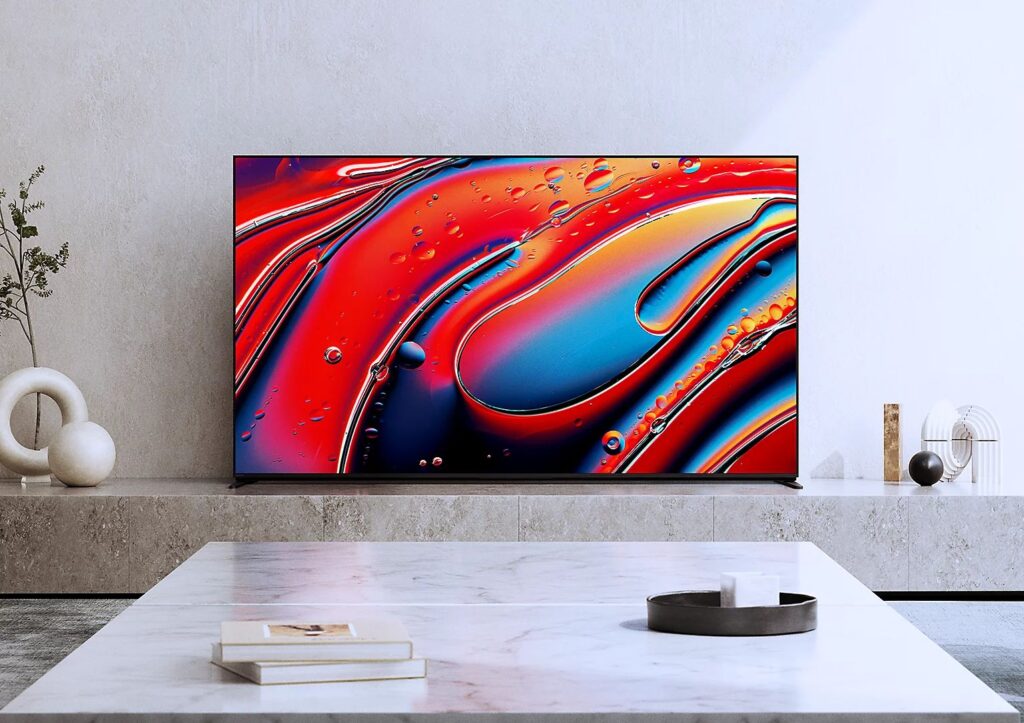
Are you with the feeling of walking into a car showroom and right in the middle sits the manufacturer’s flagship supercar? The one that instantly makes you reconsider your budget and wonder whether you should stretch beyond the mid-range model you originally planned to buy?
If that thought has ever crossed your mind, you’re not alone. There are many reasons people choose the most premium version of a consumer product. Some may do it for status, but most simply appreciate the exceptional quality that usually comes with a flagship product.
The Premium TV Market
The premium TV market, defined as televisions priced above $1,500, is expected to grow steadily over the next eight years at an average annual rate of about 6.8%. This growth is driven by advances in display technology, rising disposable income among consumers, and the increasing desire to enhance the home viewing experience.
The result is a rapidly expanding market, with more households adopting high-end models and manufacturers investing heavily in research and development to deliver the next wave of technological breakthroughs.
Competition between OLED and Mini LED display technologies has intensified in recent years. Manufacturers now offer premium models in both categories, fully aware that each technology comes with its own advantages and limitations.
As if the launch of the BRAVIA 9 hadn’t already caught the market off guard, Sony recently announced another major development. The company revealed that it has developed a new display system featuring a high-density RGB LED backlight, capable of independently controlling the three primary colors, even in very large displays. In this system, each LED emits light independently, potentially enabling LED-based TVs to achieve true black levels comparable to OLED.
Since reviewing premium flagship models from leading manufacturers has become something of an annual tradition for me, I requested the BRAVIA 9 in what has become the most popular TV size in recent years: 75 inches.
My goal was simple: find out whether Mini LED technology can truly claim the top spot.
BRAVIA 9
The BRAVIA 9, officially named K-75XR90, is Sony’s flagship television. It uses a Mini LED panel, positioned above the BRAVIA 8 OLED series in Sony’s lineup.
This announcement surprised the market and was seen by many as a strategic shift. Until recently, Sony’s flagship had been the A95L, which uses OLED technology.
Sony explained the change by pointing to its development of extremely small LED controllers that allow improved contrast while providing more precise control over local dimming zones. Sony claimed these improvements reduce the traditional advantages OLED once held.
It should be noted that the BRAVIA 9 is also available in 65-inch and 85-inch versions. The number of local dimming zones varies depending on the screen size, meaning contrast performance may differ slightly between models.
Installation
The TV was installed in my living room,a well-lit space with a large south-facing window. This placement allowed me to evaluate how the Mini LED panel handles bright sunlight in a typical sun-filled Israeli living room.
Design
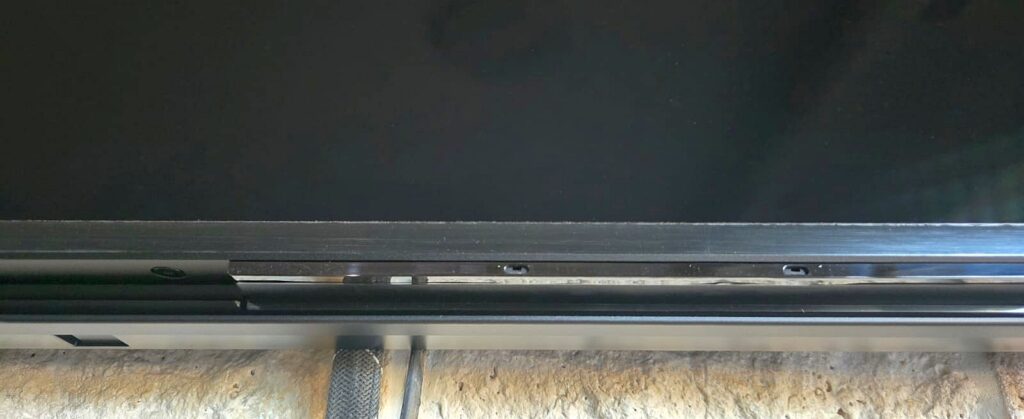
The BRAVIA 9 shares several design elements with Sony’s previous flagship models but introduces a few notable changes. While it becomes thicker toward the center, the edges measure 2.3 cm (0.9 inches).
That’s significantly thicker than many competing premium TVs, which often range between 6 mm and 10 mm. However, when viewed from the front, the thickness is hardly noticeable.
Another unique detail: Sony doesn’t place its brand name on the front of the display.
Stand Design
The metal stand consists of two legs that can be configured in four different positions: Narrow or wide placement, and low vs high position.
In the low position, the TV sits very close to the surface, vs the high position, there is enough space to place a soundbar underneath without blocking the screen.
Rear Panel
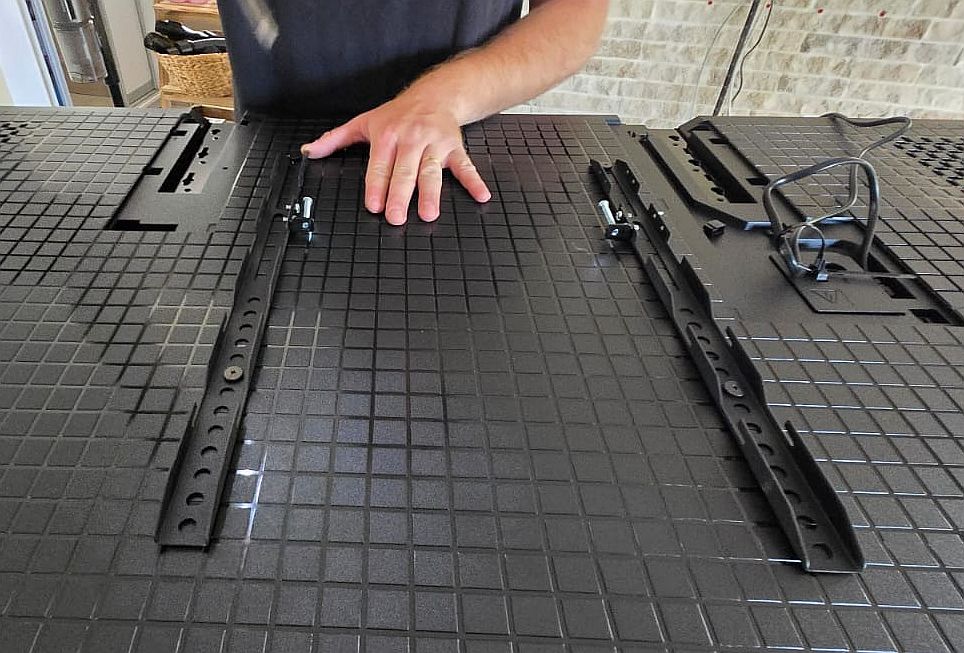
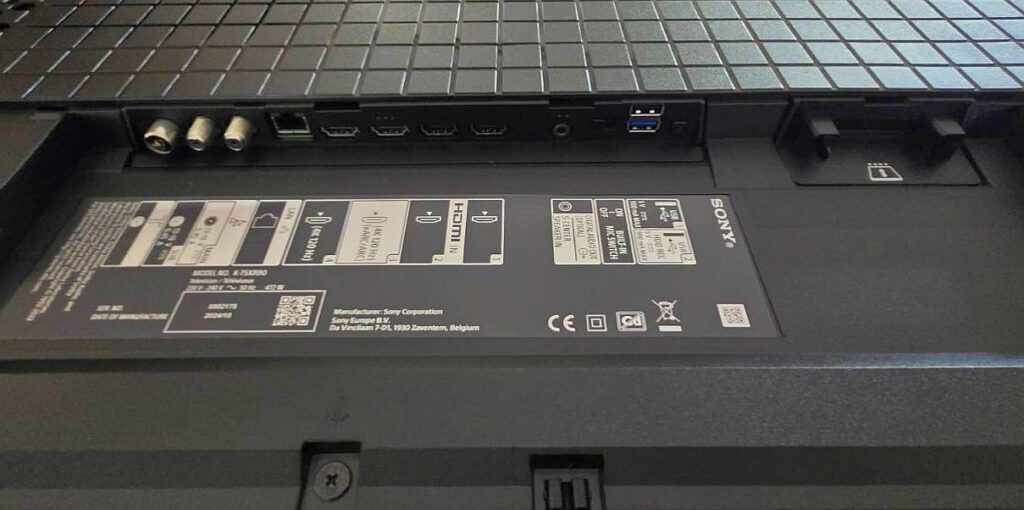
The back of the TV is made almost entirely of plastic. The connection ports are located near the left edge, about 14 cm from the side, making them relatively easy to access even if the TV is mounted close to a wall. Because of this layout, you don’t necessarily need a full-motion wall mount to reach the connections.
The BRAVIA 9 supports VESA 300×300 wall mounting, however, Sony places the VESA screws in the lower third of the TV, unlike many other manufacturers that position them in the center. If you’re replacing another TV and plan to reuse the same wall mount position, you may need to drill new holes to achieve the correct viewing height.
Dimensions
The 75-inch BRAVIA 9 weighs about 42 kg (92 lbs),so it’s certainly not lightweight. it’s width is 167 cm (65.7 inches), and height: 95 cm (37.4 inches).
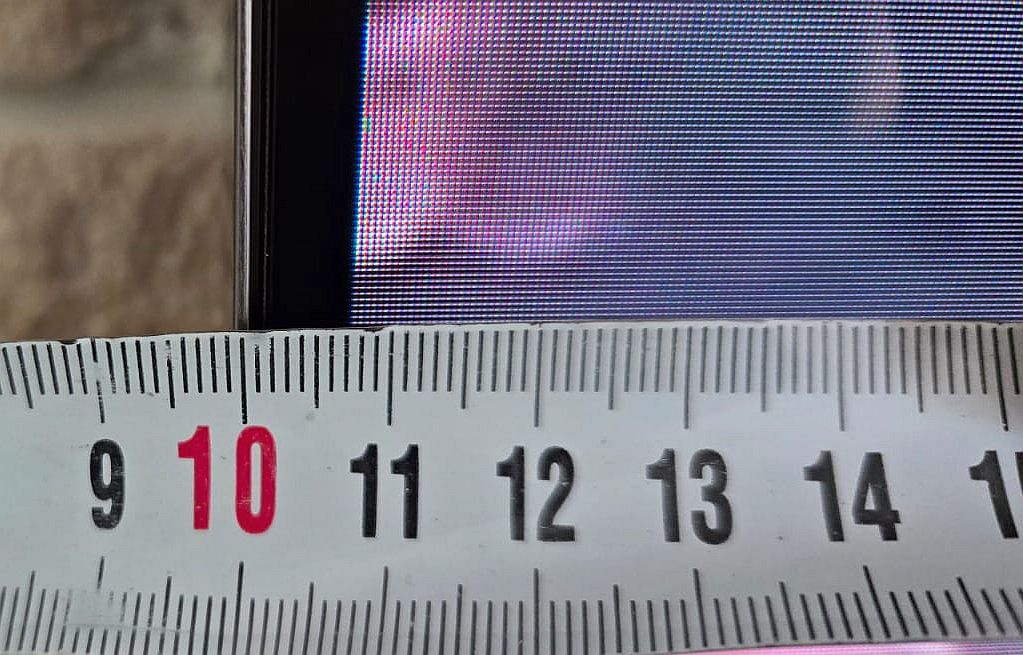
The bezel around the image measures about 7 mm on the sides and top. While the screen edges are slim, the chassis becomes thicker toward the lower half, reaching about 4.5 cm.
Specifications
The BRAVIA 9 has a Mini LED panel with 4K (3840×2160) Resolution at 120Hz, it supports HDR Dolby Vision, HDR10 and HLG. Audio formats include Dolby Atmos and IMAX Enhanced. Maximum color depth is 10-bit / DCI-P3, and streaming is available both in Chromcast and Air 2.
Initial Setup
The initial setup process using Google TV feels remarkably similar to setting up an Android smartphone and is highly intuitive. This year the Bravia 9 interface looks even more polished and includes several Sony-specific screens not found on other Google TV televisions.
The first startup screen appears in local language and walks you through the process step by step, including connecting to Google’s app store. The system then automatically scans and identifies available broadcast channels.
Sony also takes audio setup seriously. During installation, the TV performs an acoustic calibration using the microphone built into the remote control, playing a series of tones similar to the calibration routines used in AV receivers.
Connectivity
The TV’s power connection is located on the right side, separate from the other ports positioned on the left. As a surprise, the power cable is not detachable but permanently attached to the TV.
Wired Connections includes 4 HDMI ports (HDCP 2.3), One side-facing and three downward-facing. Only two HDMI ports (3 and 4) support HDMI 2.1 and 4K/120Hz. There is also one optical audio output.
Support for ALLM (Auto Low Latency Mode) and VRR (Variable Refresh Rate) is available only on HDMI 3 and 4. HDMI 3 supports eARC.
In addition, there are 2 USB ports, one supporting USB 2.0, and the other USB 3.0.
The RF antenna input has built-in DVB-T2 tuner. The ethernet port supports up to 100 Mb/s.
Wireless Connectivity
Wi-Fi support includes 2.4, 5, and 6 GHz, while bluetooth 5.3 for headphones and remote connectivity. Both the TV and remote include built-in microphones for Google Assistant, which can be disabled via a physical switch on the back of the TV.
Audio System
Since Sony’s Acoustic Surface Actuator technology can only be used with OLED panels, such as the A80L, Sony developed a different solution for the Mini LED BRAVIA 9. The TV uses a 2.2.2 speaker configuration with a total output of 70 watts, including:
- 2 × 5W tweeters mounted in the panel frame
- 2 × 10W mid-range speakers
- 2 × 10W subwoofers
- 2 × 10W beam tweeters that direct sound upward toward the ceiling, creating a passive Dolby Atmos effect
Unlike most competitors, Sony allows the TV’s speakers to function as a center channel speaker when paired with a Sony soundbar. This is performed via the S-CENTER SPEAKER IN input located on the rear panel. Dialogue in movies can then originate directly from the screen itself, improving realism.
Google TV
The BRAVIA 9 runs Google TV version 12, which remains one of the most user-friendly smart TV interfaces available. Google TV provides personalized content recommendations and allows multiple users to sign in with their own Google accounts.
The home screen prominently displays content suggestions based on previous viewing habits and installed streaming services.
Interestingly, Google TV also recommends content from services you haven’t subscribed to. For example, the BRAVIA 9 suggested titles from Amazon Prime Video even though I had not opened the app or created an account.
Some apps, like Netflix, YouTube, and Amazon Prime Video, cannot be fully removed from the system, only updated or disabled.
One of Google TV’s biggest advantages is the vast selection of apps available in Google Play, far exceeding what closed systems like Samsung’s Tizen, LG’s webOS, or Hisense’s VIDAA offer.
It’s also possible to install apps not listed in the Play Store. Due to this flexibility, storage capacity matters. While older Sony models like the A90J included 16 GB of storage, the BRAVIA 9 comes with 32 GB, matching the capacity of the A80L.
Streaming apps themselves take up little space, but their cached data can become massive. Apps like YouTube and Kodi quickly created large data libraries during my testing.
Streaming Performance
Streaming media from other computers on the network can be done using a DLNA server such as Serviio, or by sharing a network folder and accessing it through apps like VLC or Kodi.
I tested playback using VLC installed directly on the TV, avoiding the need for an external media streamer.
VLC ran flawlessly on the BRAVIA 9, even with uncompressed 4K REMUX files, with full support for DTS audio formats including DTS-MA, Dolby TrueHD, lossless DTS formats.
This is worth highlighting because Samsung TVs do not support DTS audio, and many LG models lack support for certain lossless formats like DTS:X, TrueHD, or DTS-MA 7.1.
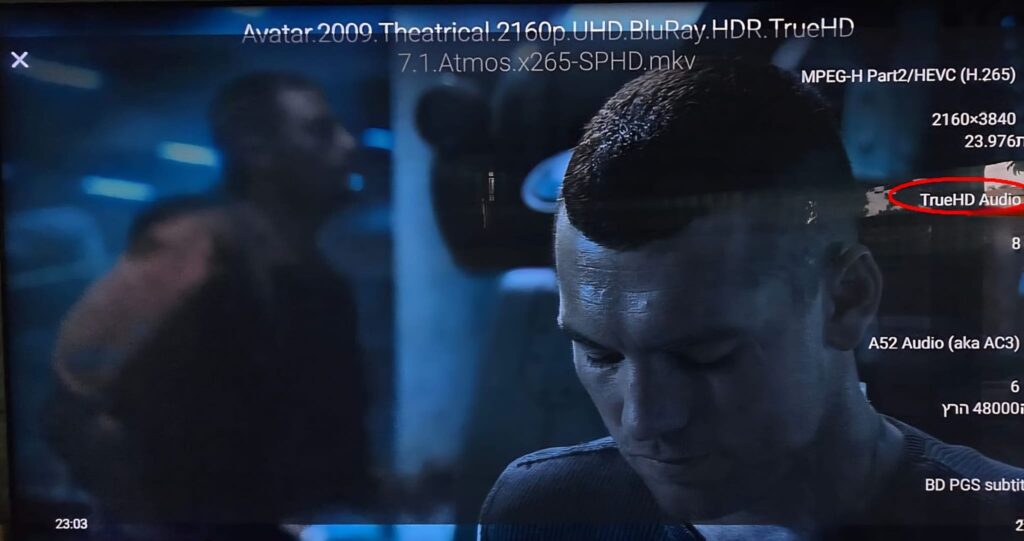
The BRAVIA 9 handled all of them without issue, eliminating the need for an external streaming device.
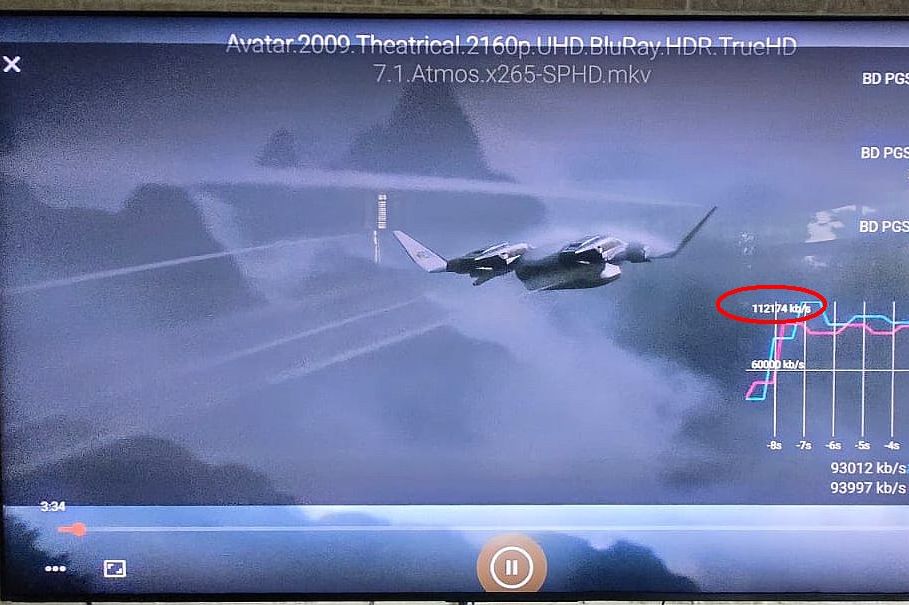
Data rates reached 100,000 kb/s over wired Ethernet with perfectly smooth playback.
Gaming
As expected, Sony provides full compatibility with the PlayStation 5. With two HDMI 2.1 ports supporting 4K/120Hz, along with VRR and ALLM, the TV is well suited for console gaming.
However, Sony focuses primarily on console support and therefore does not support 144Hz refresh rates or PC-centric technologies like G-SYNC.
Remote Controls
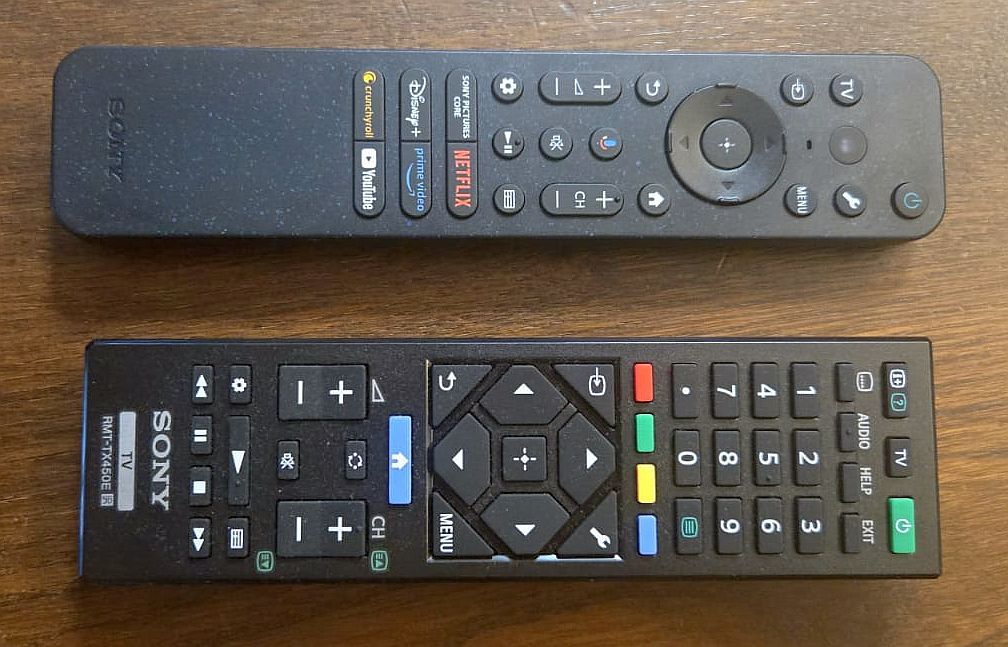
Sony provides two remotes with the BRAVIA 9:
- Slim brushed-plastic remote with backlighting and very small buttons. It looks premium but I found it less comfortable to use.
- A larger remote with big, soft buttons and numeric keys. It’s easier to use but it lacks backlighting.
Both remotes include a dedicated Google Assistant voice button.
Pixel Performance
To examine the pixel behavior of the BRAVIA 9, I used an electronic microscope with up to 1600× magnification. The pixels dim to complete darkness, although the dimming occurs in groups rather than on an individual pixel level.
Video Experience
If there is one area where Sony TVs consistently shine, it’s picture quality. Sony’s XR Processor handles all image processing, and once again the results are exceptional.
Colors appear accurate, natural, and carefully calibrated. The XR Triluminos Pro technology expands color reproduction while preserving fine details in complex textures.
Sony’s cognitive processor analyzes images similarly to how the human brain focuses on specific visual elements. The screen is divided into multiple zones, identifying the focal point of each scene and optimizing contrast and brightness accordingly.
SInce the BRAVIA 9 supports HDR10, HLG, and Dolby Vision, every piece of HDR content I tested looked stunning. Even with the TV placed near a sun-filled south-facing window, the image remained bright and vibrant.
Sony also uses a special anti-reflection coating that diffuses incoming light, significantly reducing indirect reflections. Direct reflections, like a ceiling light, can still be seen, but their intensity is greatly reduced.
In dark scenes, reflections can occasionally produce a faint rainbow effect, but because the screen is so bright, it’s rarely noticeable.
I opened my movie watching experience with Anora, the six-Oscar-winning film. Its shifting visual style provided an excellent showcase for the BRAVIA 9’s HDR contrast.
Next came Captain America: Brave New World. During the scene where Harrison Ford transforms into the Red Hulk, the HDR effect and explosive contrast were especially striking. Combined with the powerful built-in sound system, the experience was remarkably immersive.
Finally, I closed with The Legend of Tarzan, starring Alexander Skarsgård and Margot Robbie. The jungle environments, gorilla battles, and fast-moving action scenes demonstrated how clean and artifact-free the BRAVIA 9’s image remains—even during rapid motion.
Final Verdict
Sony has made a bold strategic move by placing a Mini LED TV at the top of its lineup for the first time.
The BRAVIA 9 delivers exceptional picture and sound quality. Thanks to its Mini LED panel and massive number of local dimming zones, the TV produces deep blacks and an almost infinite contrast ratio.
Its multi-directional speaker system creates an enveloping soundstage, while HDR and Dolby Vision support. Combined with Sony’s powerful image processor, it provides an excellent upscaling across all resolutions.
Include also wide color reproduction, extremely high brightness, and smooth motion handling, and you have a truly premium television.
Gamers will appreciate 4K at 120Hz with VRR and ALLM, and the Google TV interface offers one of the most versatile smart platforms available.
If you’re looking for Sony’s best television available in sizes up to 85 inches, the Sony BRAVIA 9 will elevate your home viewing experience to a remarkably high level.