

For decades, the dream of the ultimate home theater experience revolved around front projection: large screens, cinematic immersion, and a viewing experience that televisions simply could not match in sheer scale. But in recent years, a powerful shift has begun to reshape that equation.
The rise of giant television displays measuring 98 inches, 100 inches, and now well beyond, has introduced a new competitor to the traditional projection-based home theater. And no company is pushing this shift more aggressively than TCL.
Now, with its display technology being showcased around the 2026 Winter Olympics in Milan–Cortina, TCL is signaling that the era of truly massive consumer displays is not just coming. It is already here.
The Olympic stage is simply the latest platform for a strategy that TCL has been pursuing for years: normalize gigantic screens and make them accessible to mainstream consumers.
And if the company’s recent moves are any indication, this strategy is beginning to work.
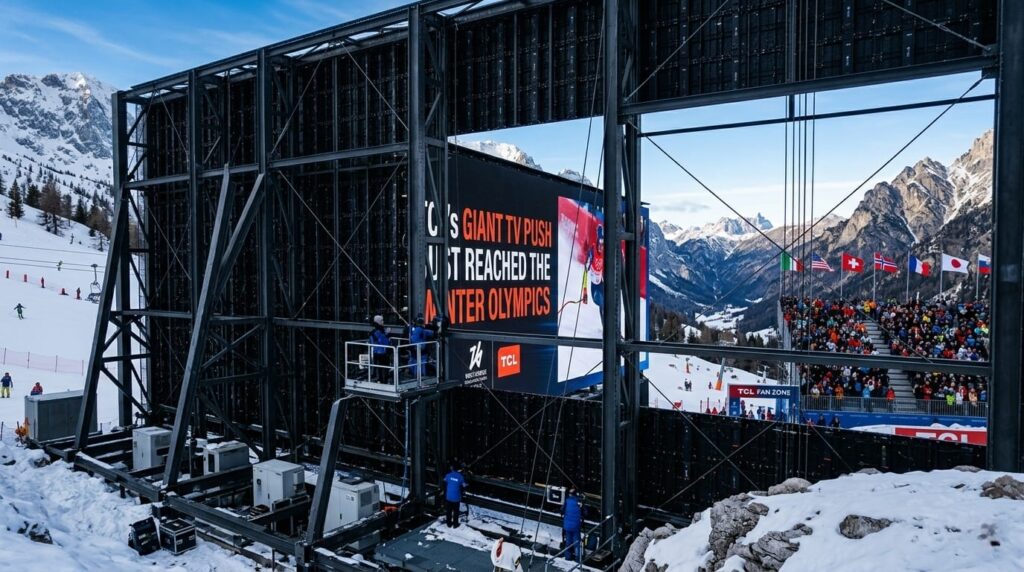
The Olympics as a Showcase for the Future of Displays
Global sporting events have long served as testing grounds for cutting-edge display technology. From the introduction of HD broadcasts to the rise of 4K and HDR, major international events have historically accelerated consumer adoption of new visual standards.
TCL is now leveraging that same dynamic.
Through its display manufacturing arm, TCL CSOT, the company is showcasing advanced display technologies in connection with the Milano-Cortina 2026 Winter Olympics. These demonstrations focus heavily on large-format displays, high brightness panels, and next-generation screen technologies designed for both public viewing spaces and premium home environments.
In other words, TCL is using one of the most visible global platforms available to demonstrate a simple message:
Big screens are the future of home entertainment.
But the company’s ambition goes even further.
The Giant TV Arms Race
Just a few years ago, televisions larger than 85 inches were rare luxury items. Today, however, the landscape is changing rapidly.
The 98-inch category, once considered extreme, is quickly becoming a new benchmark for premium living rooms and home theater spaces. TCL has been one of the companies pushing hardest in this direction.
The company has already made 98-inch televisions significantly more accessible than many competitors, with prices that have dropped dramatically over the past few years. But TCL has not stopped there.
Recently, the company unveiled 115-inch consumer televisions, pushing the boundaries of what was previously considered feasible for a home display.
Beyond that, TCL has also demonstrated even larger MicroLED and prototype displays, signaling that the company sees virtually no upper limit to how large televisions can become.
This aggressive push toward giant displays aligns closely with the broader industry trend toward Mini-LED and high-brightness LCD technologies, which scale particularly well to very large panel sizes.
And TCL happens to be one of the biggest players in that space.
Why Bigger TVs Are Becoming Possible
Several technological shifts have converged to enable the rise of giant televisions.
First is Mini-LED backlighting, a technology that dramatically increases the number of local dimming zones behind an LCD panel. This allows TVs to achieve significantly better contrast and brightness compared to traditional LED-backlit displays.
Second is improvements in manufacturing efficiency. Large LCD panels are now easier and cheaper to produce than they were just a few years ago. TCL’s display manufacturing infrastructure, through TCL CSOT, has given the company a significant advantage in scaling production for oversized panels.
Third is HDR performance, which is becoming a major differentiator between televisions and projection systems. And this is where the comparison becomes particularly interesting.
HDR: The Brightness Advantage of Giant TVs
High Dynamic Range (HDR) content has become a central part of modern video production.
Streaming services, Ultra HD Blu-ray discs, and next-generation gaming systems all rely heavily on HDR to deliver images with greater contrast, deeper blacks, and dramatically brighter highlights. To reproduce HDR properly, displays must reach high levels of brightness.
Modern premium televisions, particularly Mini-LED models, can reach peak brightness levels of 2,000 to 4,000 nits, and some flagship displays are pushing even higher.
That level of brightness allows televisions to deliver extremely vivid HDR highlights: reflections on water, sunlight glinting off metal, or bright explosions in action scenes.
Projectors, by contrast, operate under very different constraints.
Projection systems measure brightness in lumens, not nits, and even high-end home theater projectors typically produce far lower peak brightness when translated to screen luminance.
In practical terms, many home theater projection setups deliver between 100 and 300 nits on the screen, depending on the projector, screen size, and room conditions.
That does not mean projection cannot produce a stunning cinematic image, because it absolutely can.
But when it comes to pure HDR impact, large televisions have a clear advantage.
This is one of the reasons companies like TCL are so confident in pushing giant displays into spaces traditionally dominated by projection systems.
The Projection Advantage Still Exists
Of course, televisions, even giant ones, do not completely replace projection.
In fact, projection systems still offer several advantages that remain difficult for televisions to replicate.
The most obvious is extreme screen size.
While TVs are now reaching 100 inches and beyond, projection systems can easily scale to 130, 150, or even 160 inches and larger, creating a level of immersion that remains unmatched.
Projection systems also support acoustically transparent screens, allowing speakers to be placed directly behind the image, just like in a commercial cinema. This enables a perfectly aligned front soundstage, something televisions cannot replicate.
Another advantage is cinema-style aspect ratios, such as 21:9, which allow films to fill ultra-wide screens without the black bars typically seen on 16:9 televisions.
These factors ensure that projection continues to play a critical role in dedicated home theater environments.
But for many consumers, the convenience and performance advantages of large televisions are becoming increasingly attractive.
The Simplicity Factor
Another key advantage of televisions is simplicity.
A large TV requires very little setup: mount it on a wall, connect your sources, and it is ready to go. Projection systems, by contrast, often require more planning. Screen installation, projector placement, room light control, and calibration all play a role in achieving optimal performance.
For enthusiasts, this process can be part of the fun. But for many consumers, the appeal of a single large display that delivers excellent image quality with minimal setup is hard to ignore.
TCL clearly understands this dynamic. By pushing giant televisions deeper into the mainstream market, the company is effectively offering an alternative vision of the home theater experience.
TCL’s Momentum in the Global TV Market
TCL’s aggressive display strategy is not happening in isolation. The company has been rapidly gaining ground in the global television market, challenging long-established industry leaders.
In fact, as discussed in a previous analysis on this site, TCL recently surpassed Samsung in global TV shipments during December, marking a significant milestone in the shifting balance of power in the television industry.
This momentum reflects the following factors: aggressive pricing, strong Mini-LED innovation, large-scale manufacturing capabilities and a willingness to push unconventional screen sizes.
The company’s giant TV strategy fits perfectly within that broader expansion.
The Sony Connection
Another intriguing development is TCL’s evolving relationship with Sony. The two companies have recently announced a strategic partnership related to television and audio technologies, a move that could reshape aspects of the premium TV ecosystem.
Sony has long been associated with premium image processing and high-end display engineering, while TCL brings enormous manufacturing scale and panel production capabilities.
If these strengths begin to converge more closely, the implications for the television market could be significant.
The Future of the Giant Screen
For years, the assumption was simple:
If you wanted a truly massive image, you needed a projector, but that assumption is now being challenged
The rapid rise of 98-inch, 100-inch, and now 115-inch televisions suggests that the boundary between televisions and projection systems is beginning to blur.
Companies like TCL are accelerating that shift with aggressive pricing, new display technologies, and bold marketing strategies, including highly visible showcases like the upcoming Winter Olympics.
But the story is not about replacing projection.
Instead, the industry appears to be entering a new phase where two different approaches to the giant-screen experience coexist:
- televisions offering extreme brightness, HDR performance, and simplicity
- projection systems delivering unmatched scale and cinematic flexibility.
For home theater enthusiasts, that competition is ultimately good news, because whether the image comes from a giant television or a powerful projector, one thing is certain:
The future of home entertainment is going to be very, very big.