
There are moments at trade shows like IFA when you can tell something has changed before you even walk through the doors. This year in Berlin, I had one of those moments while looking at the IFA 2026 floor plan and the layout of the exhibition halls. It was hard to miss that the familiar landscape of the television industry had shifted. TCL had taken over a massive space in Hall 21, filling it with almost everything you could imagine surrounding the modern home entertainment experience, from enormous televisions and Mini LED displays to RGB Mini LED, soundbars, speakers, artificial intelligence and a growing range of connected products.
At the same time, manufacturers that once felt almost inseparable from the IFA television experience looked very different this year. Samsung and Sony are still present at the show, but neither has the kind of television presence we have come to associate with them in previous years, while LG continues to operate a significant home entertainment booth, even as it finds itself responding to reports and rumors that it could be acquired by Hisense.

Once you walk through the show and try to understand where the television market is heading, it becomes difficult not to notice the contrast between those changing positions and the enormous footprint TCL has created for itself.
To me, that is the real story of TCL at IFA this year.
It is not simply that TCL’s televisions have become bigger. The company itself is taking up a much bigger space in the television industry.
The X11L Is More Than Just a Huge TV
Inside TCL’s booth, it was almost impossible not to stop and look at the televisions, and not only because their screen sizes have reached almost absurd proportions. What stood out more was the feeling that TCL is no longer satisfied with simply offering another Mini LED television at an attractive price.
Instead, the company is building a clear hierarchy across its display lineup, with SQD Mini LED positioned at the top while it continues to push the development of RGB Mini LED into new territory.
After walking through the different displays and demonstrations, it was clear to me that the X11L is the television most likely to be remembered from this year’s show. The 98 inch version displayed at IFA is an SQD Mini LED television with up to 20,736 local dimming zones and peak HDR brightness of up to 10,000 nits. TCL is combining that performance with CSOT’s WHVA 2.0 panel technology, developed by CSOT, the display manufacturing company that is part of the TCL Group, creating what the company presents as the high end of its Mini LED technology. I reviewed the C7L, which is actually two tiers below it in the lineup.
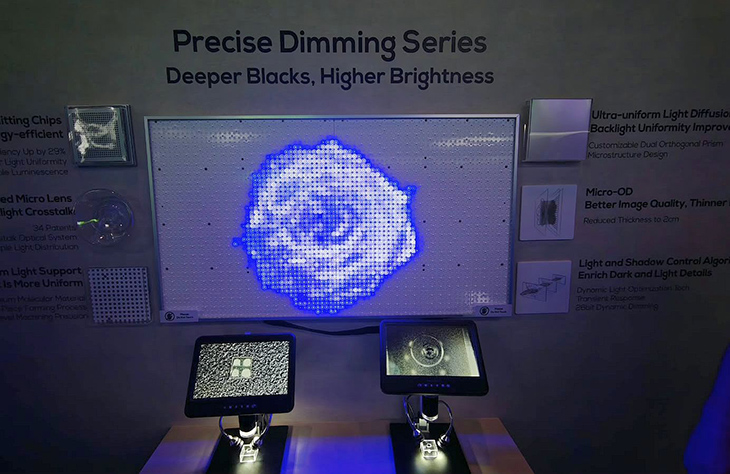
The design is remarkably thin as well, measuring around 2 centimeters, while an audio system developed in collaboration with Bang & Olufsen adds another layer of luxury to the overall package.
The specifications are certainly impressive, but what interested me more was what TCL is actually trying to achieve with them.
The basic idea behind Mini LED is relatively simple. Instead of illuminating the entire screen evenly, the television uses a backlight divided into zones that can be controlled independently. The more zones there are, and the more precisely they can be controlled, the better the television can illuminate a small, bright object against a dark background without simultaneously brightening everything around it.
The X11L, however, is not simply a collection of thousands of LEDs sitting behind the screen. Underneath that backlight is CSOT’s WHVA panel technology, which means TCL controls a significant portion of the display supply chain behind its televisions. That gives the company a very different position from television manufacturers such as Sony, which sources its OLED panels from LG Display and is therefore dependent on an external panel supplier for a critical part of its technology.
That matters because TCL is increasingly competing on more than price. With products like the X11L, the company is making a clear statement that its televisions are capable of competing at the very top of the market.
Then Comes RGB Mini LED
If SQD Mini LED represents TCL’s attempt to take traditional Mini LED technology further, RGB Mini LED takes a fundamentally different approach to how the television’s backlight is built.
Rather than relying on a white light source and then using additional layers to handle color, TCL’s RGB Mini LED technology uses red, green and blue light sources in the backlight itself. This means the television can potentially control not only how much light reaches a particular area of the screen, but also the color composition of that light.
On paper, that creates the potential for a wider color gamut and much more precise control over both color and brightness.
The RM9L is the most prominent example of this approach at IFA.
As TCL’s flagship RGB Mini LED series, the RM9L is being presented in 85, 98 and 115 inch sizes. The 115 inch version features 16,848 local dimming zones and brightness of up to 9,000 nits, along with coverage of the full BT.2020 color space according to TCL’s specifications.
This is where it is important to look beyond the numbers, because TCL is effectively presenting two different approaches to pushing LCD technology toward the high end of the market. On one side, there is SQD Mini LED, with the X11L sitting at the top of that hierarchy. On the other, there is RGB Mini LED, which takes direct control over color in the backlight a step further.
This does not necessarily look like a battle between two competing technologies. Instead, TCL appears to be developing several technological paths at the same time, exploring just how far each one can be pushed.
What makes this particularly interesting is that the technology is no longer limited to enormous flagship televisions. The RM7L series, which will also be sold in Israel under the Q7D name, brings RGB Mini LED to 65, 75, 85 and 98 inch sizes. These models offer brightness of up to 2,000 nits, up to 100 percent coverage of the BT.2020 color space and refresh rates of up to 144Hz, along with VRR and advanced gaming features.
The series also runs on Google TV and includes a 2.1 channel audio system from ONKYO. TCL says the RGB Mini LED lineup is positioned below its SQD Mini LED models, and that positioning was also apparent from my experience with the displays at the show.
The Story Goes Beyond Televisions
Walking through TCL’s IFA 2026 exhibition space makes it clear that audio is an important part of the company’s strategy. As televisions continue to become thinner, there is an obvious physical limitation when it comes to fitting speakers large enough to produce sound that can match the scale of a 98 or 115 inch display.
That is why TCL is also introducing a new generation of soundbars, ranging from entry level models to more serious home theater systems featuring Dolby Atmos, DTS:X and wireless rear speakers.
The model that caught my attention was the Q95K.
This is TCL’s new flagship soundbar, featuring an 11.1.4 channel configuration, 22 drivers, a wireless subwoofer and rear speakers. For me, however, the more interesting part is how TCL wants the television and soundbar to work together.
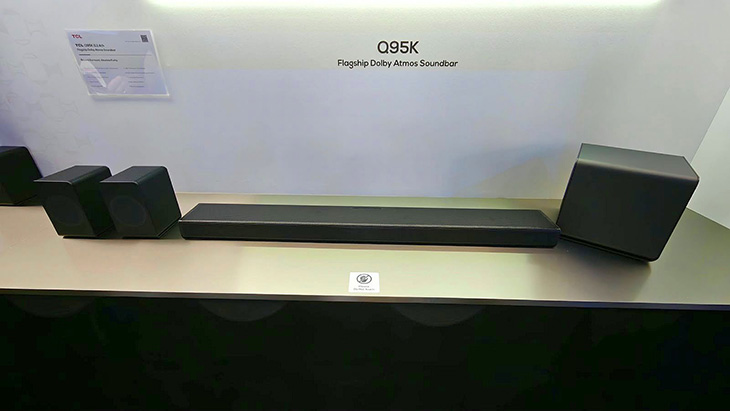
TCL’s Tutti Choral technology allows the television’s built in speakers and the soundbar to contribute together to the overall soundstage, rather than simply shutting off the television speakers when an external audio system is connected. The concept is similar to Samsung’s Q-Symphony and LG’s WOW Orchestra, where the television and external audio system work together instead of operating as completely separate sound sources.
TCL is also continuing its collaboration with Bang & Olufsen across the new soundbar lineup. The bigger picture is that TCL is no longer presenting the television as a standalone product. Instead, it is increasingly positioning the TV as the center of a complete home entertainment system.
The company also showed standalone speakers and subwoofers that can connect wirelessly to its televisions, adding more power and creating a more immersive surround sound experience, in a concept that is broadly similar to the Trio system Sony recently introduced.
Gemini Becomes Part of the Experience
Artificial intelligence has become another layer of TCL’s home entertainment strategy. The company’s message at IFA this year is “AI Inspired Life,” and TCL is attempting to connect the television, smart home, mobile devices and other products under a single AI driven ecosystem.
On the television side, one of the most notable developments is the integration of Gemini into Google TV. Instead of having to search for a program using an exact title, viewers will be able to interact with the television in a more natural way, ask an initial question and then continue with follow up questions based on the response.
The system can provide content recommendations and allow users to control certain television functions using natural language, making the television feel less like a traditional interface and more like an interactive assistant.
According to TCL, these capabilities are expected to reach Israel during the first quarter of 2027.
The Bigger Picture
After spending time walking through IFA 2026, I came away with a much clearer sense of who is genuinely investing in showing where the future of the industry could go and who is simply maintaining a presence at the show.
TCL is clearly here to demonstrate where it wants to go, and that distinction matters.
The company is talking about Mini LED, RGB Mini LED and CSOT display technology, while at the same time putting artificial intelligence and Google TV at the center of the entertainment experience. It is also expanding into premium audio through its collaboration with Bang & Olufsen and building a broader entertainment ecosystem in which all of these technologies are designed to work together.
It is still too early to say whether all of these technologies will fundamentally change the television market, and it would certainly be a mistake to judge a television’s real world performance solely by its number of dimming zones or the peak brightness it can achieve under laboratory conditions.
After spending time inside TCL’s booth at IFA, however, it is becoming increasingly difficult to see the company simply as the manufacturer of large, affordable televisions. TCL has become something considerably more ambitious.
The interesting question now is no longer whether TCL has become a serious player in the television industry, because that has already happened. The more interesting question is just how much further the company can go.
If what I saw in Berlin is any indication, TCL is no longer waiting for someone to make room for it.
It is simply taking the space.