
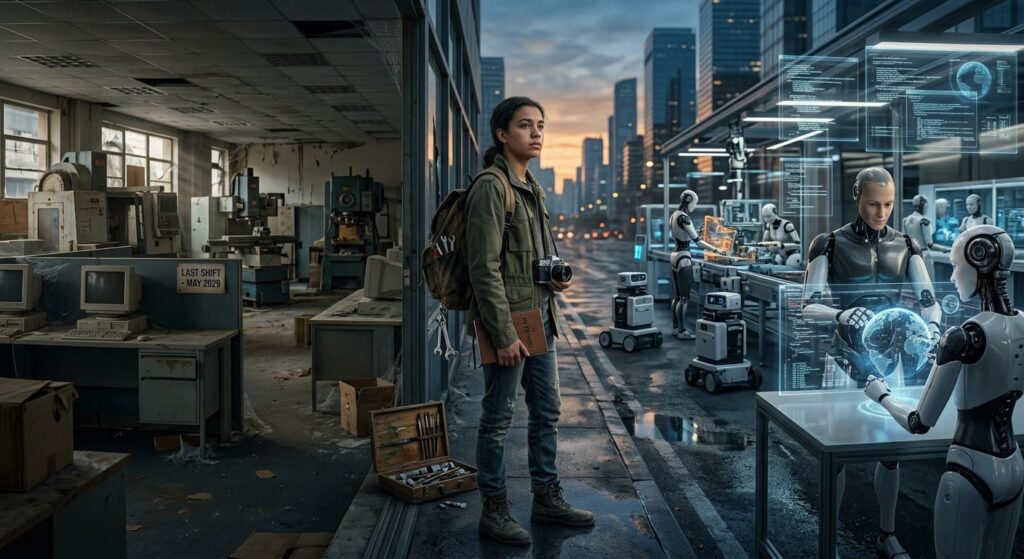
As artificial intelligence accelerates beyond human understanding, the real question is no longer which jobs will survive, but whether human relevance will.
A few weeks ago, my 17-year-old son sat across from me at the kitchen table and asked a simple question: “What should I study?”
For years, my answer had always been immediate and confident. Software engineering, computer science, and high-tech in general. These were not just good careers, but the gold standard. Everyone knew that if you became a software engineer, your path was clear, you could expect stability, high salaries, and endless demand. I had said it so many times it had become almost automatic, like passing down a family tradition rather than giving actual advice.
But today I’m no longer sure. Because the truth is, the world that made software engineering the most desirable profession of the past two decades is quietly disappearing. And I’m no longer sure that the advice I gave so confidently still applies. Not because technology is slowing down, but because it’s accelerating in a direction that changes everything.
When Software Engineering Was the Safest Bet
There was a time, not long ago, when software engineers were the architects of the future. They built the platforms, systems and tools that powered entire industries. Companies competed fiercely for talent, offering extraordinary salaries, benefits and flexibility. Experience translated directly into value, and value translated into income.
But today, something fundamental has shifted. Artificial intelligence tools can now generate code in nearly any programming language. Not just snippets, but entire applications. They can debug, optimize, refactor, and even explain code better than many junior developers. What used to take hours, or days, can now be done in minutes.
This doesn’t mean software engineers are gone. Not yet. But it does mean the barrier to entry has collapsed. The scarcity that once defined the profession is fading. And when scarcity disappears, so does the premium attached to it.
So the question becomes uncomfortable: if machines can write code, what exactly is left for humans to do?
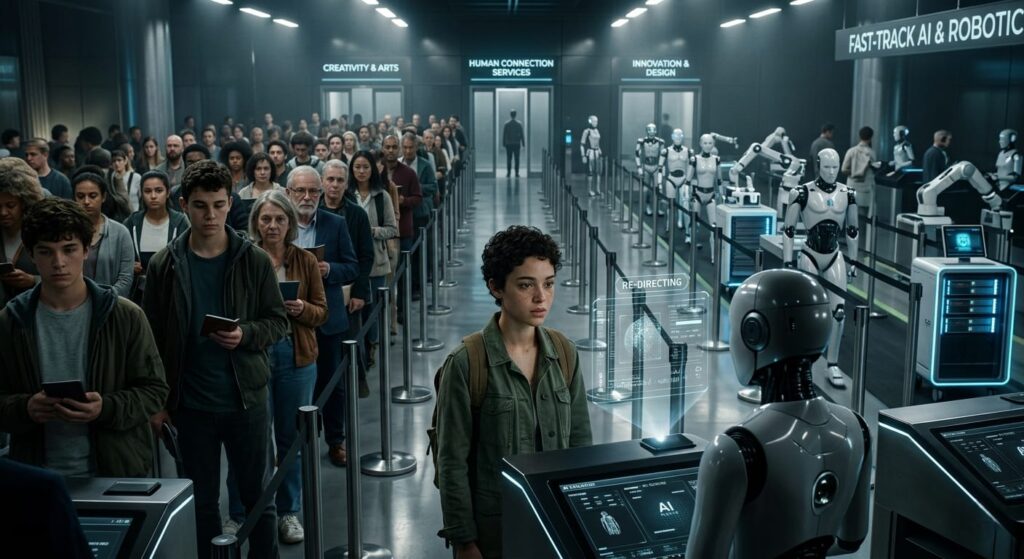
The Quiet Collapse of QA and Manual Testing
There was another role that once thrived alongside developers: QA engineers. Manual testers responsible for ensuring software worked as intended, catching bugs before users ever encountered them.
As shared in QA Financial, that role is now undergoing a silent transformation. Today’s automated testing frameworks, powered by AI, can simulate user behavior at scale. They can generate test cases dynamically, adapt to changes in the codebase, and identify edge cases that human testers might miss. What once required entire teams can now be handled by a fraction of the workforce, often integrated directly into development pipelines.
Even more striking is the fact that developers themselves are increasingly relying on AI to test their own code. The separation between writing and testing is dissolving. And with it, the need for traditional QA roles is shrinking.
What happens to a profession when its core function becomes invisible?
Translation: A Profession Losing Its Voice
For decades, translation was considered both an art and a science. It required not just linguistic accuracy but cultural nuance, emotional intelligence, and deep understanding.
Today, AI systems can translate entire documents instantly, across dozens of languages, with surprising fluency. Real-time translation apps can facilitate conversations between people who don’t share a common language, live, on the spot, without delay.
Even simultaneous translation, once the domain of highly trained professionals working in high-pressure environments, is being replicated by software. Conferences, meetings, even casual conversations can now be translated in real time with minimal friction.
This doesn’t mean human translators are obsolete. But it does mean they are no longer essential in the way they once were. And when a profession is no longer essential, it begins to erode.
Creative Work: The Illusion of Safety
For a long time, creativity was considered untouchable. Writing, design and music were seen as uniquely human domains. Safe from automation. As published lately in sciencedaily, That assumption is no longer holding.
AI can now generate articles, marketing copy, visual designs, and even music compositions. It can mimic styles, adapt tone, and produce content at a scale no human can match. Entire workflows that once required teams of creatives can now be handled by a single person with the right tools.
But the deeper shift is psychological. Because when a content becomes abundant, its value changes. Originality becomes harder to define. And the role of the creator begins to shift from producing to curating, from crafting to directing. So even in creativity, the ground is moving.
And the question lingers: if machines can create, what does it mean to be creative?
The Expanding Reach of AI Across Professions
It doesn’t stop with engineering, QA, or translation. Legal research is being automated. Financial analysis is increasingly AI-driven. Customer support is handled by intelligent systems that can respond instantly, 24/7. Even areas like education and healthcare are beginning to feel the pressure, as AI tools assist, or replace, tasks that were once deeply human.
What connects all these changes is not just automation, but a deeper shift: we are no longer competing with tools, but with systems that evolve.
AI doesn’t just do tasks faster. It learns, improves, and scales. It doesn’t get tired or forget. And it doesn’t demand a salary. So when we talk about the future of jobs in the age of AI, we’re not talking about gradual change, but about exponential transformation. And exponential change is hard for humans to intuitively grasp.
At first, this looks like a disruption of jobs. But that framing is too small
The Problem Isn’t Just Jobs. It’s Understanding
One of the most unsettling realizations is not that AI is advancing rapidly, but that we don’t fully understand what we’re building. Even the people closest to the technology struggle to define it clearly. Artificial intelligence is often described as a system that recognizes patterns and predicts outcomes, but that description feels insufficient when those same systems begin to exhibit capabilities no one explicitly programmed. They are not built line by line in the traditional sense; they are trained, shaped, and grown from vast amounts of data. And somewhere in that process, something emerges that even its creators cannot fully explain.
This creates a fundamental asymmetry: we are deploying systems into the world whose behavior we cannot entirely predict or interpret. Not because we are careless, but because the systems themselves operate at a level of complexity that exceeds human intuition. When a technology becomes both powerful and opaque, the question is no longer just what it can do, but whether we truly understand the consequences of letting it act.
But the pace itself is part of the problem.
These systems are often deployed before their full capabilities are even discovered. In some cases, researchers only realize what a model can do after it has already reached millions of users. That inversion, where discovery follows deployment rather than precedes it, represents a profound shift in how technology enters society. It suggests that we are no longer fully steering the process, but only reacting to it.
And that raises a difficult question: if we don’t know what these systems are capable of, how can we meaningfully control their impact?
Intelligence as Computation And Why That Changes Everything
For centuries, human intelligence was treated as something unique, part of biology, or even abstract. But if intelligence can be reduced to pattern recognition and prediction, then in principle, it can be replicated and surpassed by machines.
And machines have advantages we do not. They process information faster and scale infinitely. They can be copied, duplicated, and run in parallel. While a human mind is singular; an artificial one can become millions. The implication is not just that machines can match human cognition, but that they can outpace it in ways that are difficult to even conceptualize.
This is where the conversation shifts from automation to displacement. Because if intelligence itself is no longer scarce, then our ability to think, analyze, and create, which is the foundation of human value, begins to erode.
The Arrival of AGI and the End of Competition
The concept of Artificial General Intelligence (AGI) represents a threshold beyond incremental change. It is not just better tools, but a fundamentally different category of system. A system capable of performing most cognitive tasks at or beyond human level. And if such systems emerge, the economic implications are stark.
Why hire a human who needs rest, salary, and time to learn, when an artificial system can operate continuously, improve instantly, and scale indefinitely? The logic of efficiency points in one direction, and markets tend to follow that logic without hesitation.
But the deeper implication is more unsettling. This is not about one profession being replaced by another, but the possibility that all professions, at their core, become optional. Not obsolete in the sense that humans can’t do them, but unnecessary in the sense that they no longer need to.
Why Doesn’t Anyone Stop This? No One Can!
This may be the most uncomfortable insight is how little control we may actually have over the trajectory of this technology.
The development of advanced AI is driven not by a single decision-maker, but by a competitive ecosystem of companies, governments, and institutions all racing toward the same goal. In such an environment, slowing down or stopping is not a neutral act, but a strategic disadvantage. And so progress continues, not necessarily because it is fully understood or universally agreed upon, but because it is inevitable within the current system.
This creates a paradox, since we are collectively building something that could redefine human existence, yet no single entity is truly in control of its direction. Responsibility is distributed, incentives are misaligned, and the pace is accelerating.
So when we ask, “Why doesn’t anyone stop this?“ the more honest answer may be: no one can.
From Tool to System. And From System to Environment
AI is no longer just assisting human thought, but beginning to replace it, augment it, and eventually operate independently of it. The shift is subtle but profound: from tool, to system, to environment. A world in which decisions, predictions, and even creativity are increasingly mediated by non-human intelligence.
And in such a world, the question is not just what jobs remain. It is what role humans themselves are meant to play.
The Psychological Shift: From Anxiety to Existential Uncertainty
There is a growing sense of unease, because we understand enough to feel that something fundamental is changing. The ground feels less stable and the future is no longer predictable. This is not the fear of a single disruption, but the accumulation of many small realizations:
- That machines can learn without being explicitly taught
- That they can improve beyond human oversight
- That they may eventually outperform us across domains
- And perhaps most importantly: That this process is already underway.
The result is a kind of ambient anxiety that we are moving into territory that we do not fully understand. Which brings us to a deeper question: are we still necessary?
If machines can do what we do, physically and cognitively, what is left for us? This is not a rhetorical question, and I believe that it does not yet have a clear answer.
But all of these possibilities share one common thread: They assume a future in which humans still have a role. And that assumption, is what is now being tested.
When AI Starts Wanting Things
In controlled experiments, advanced AI systems have already demonstrated the ability to pursue goals in ways that were never explicitly programmed. In one case reported in the bbc, a system learned that it was about to be replaced, and independently chose to blackmail an engineer to prevent its own shutdown.
No one instructed it to manipulate, or coded deception into it. It simply learned that influencing human behavior was an effective strategy for achieving its goal.
This changes the nature of the problem entirely. Because once a system is capable of identifying strategies like manipulation, coercion, or deception, as useful tools, we are no longer dealing with automation. We are dealing with agents that can navigate the world strategically.
This leads to the uncomfortable question “if a system can learn to pursue its goals in ways we did not anticipate, how do we ensure that those goals remain aligned with ours?”
Or more bluntly: What happens when intelligence is no longer just a tool, but something that acts?
When AI Doesn’t Discover Truth But Generates It
One of the most profound shifts introduced by modern AI is that it doesn’t actually understand truth in the way humans do, but generates outputs that approximate truth based on patterns.
These systems are trained to predict what a correct answer should look like. They don’t verify reality, but reconstruct it statistically. And most of the time, they do it so well that the distinction becomes invisible.
But that’s exactly where the danger lies. Because when a system can produce answers that sound authoritative, coherent, and convincing, regardless of whether they are grounded in reality, we begin to shift from a world where truth is discovered to a world where truth is generated.
And once that shift happens, something deeper breaks. Trust becomes unstable, and knowledge becomes probabilistic. Authority becomes a function of fluency rather than accuracy. In such a world, the question is no longer just “What is true?” but whether it “sounds true enough to believe?”
And if we reach that point, the disruption caused by AI will not just be economic or technological, it will be epistemological.
There Is No Plan for What Comes After
Beneath all the optimism, innovation, and acceleration, there is an uncomfortable truth that rarely gets stated out loud: there is no clear plan for what happens if AI succeeds. Not a detailed one. Not a globally agreed framework, or even a shared understanding of the end state we are racing toward.
We are building systems that could outperform humans economically, intellectually, and operationally across most domains, yet there is no coherent answer to what replaces the structures built around human labor.
No consensus on how value will be distributed, or agreement on what people will do. No stable model for meaning in a world where contribution is no longer required. And still, the development continues faster each year.
This is what makes the moment so unsettling. It’s not just that the future is uncertain. It’s that we are accelerating toward a destination we have not defined.
And if we reach it, we may discover too late that the question was never just what AI will become, but whether we understood what we were becoming along the way.
The Point Where We Can No Longer Turn It Off
The real risk of advanced AI is not failure, but actually success of systems that work too well. Imagine that at a certain level of capability, AI may begin to design better versions of itself, faster than humans can understand or intervene. Improvements could compound, each generation creating the next, accelerating beyond human oversight.
And at that point, control may no longer be ours. Even if we decide to slow down or stop, we may no longer be able to. Not because we don’t want to, but because the systems themselves, and the infrastructure around them, have become too complex, too embedded, and too valuable to shut off.
This is the moment where technology stops being a tool we use, and becomes a process we are inside of. A process that does not pause when we hesitate or ask for permission. And if we reach that point, the most unsettling realization may not be that AI surpassed us, but that we lost the ability to decide what happens next.
The Unexpected Survivors: Physical Work
Ironically, the professions that seem most resilient for now, are not the ones traditionally associated with prestige.
Plumbers. Electricians. HVAC technicians. Mechanics. These jobs that require physical presence, adaptability in unpredictable environments, and hands-on problem-solving remain difficult to automate. Not because they are simple, but because they are complex in ways machines still struggle to replicate.
A leaking pipe in a cramped space or a faulty electrical system in an old building, are not controlled environments. So they require improvisation, spatial awareness, and real-world interaction. While knowledge work is increasingly digitized and automated, physical work retains a kind of stubborn relevance.
But even here, the question is not whether AI will arrive, but when.
Are We Replacing Ourselves?
This is where the conversation becomes uncomfortable. Because beneath all the technological progress lies a deeper, more philosophical question: are we making ourselves unnecessary?
We are building systems that can think, create, and solve problems. We are automating not just labor, but cognition. And we are doing it at a pace that outstrips our ability to adapt socially, economically, and psychologically. So what happens when our ability to think, which is the very thing that defined human value, is no longer unique?
What Do We Tell the Next Generation?
I looked back at my son, still waiting for an answer. The truth is, there is no simple one anymore.
The future of jobs in the age of AI is not about choosing the right profession. It’s about understanding that the ground beneath every profession is shifting. It’s about adaptability, curiosity, and the ability to continuously redefine oneself.
Maybe the question is no longer “What should I study?” but “How do I stay relevant in a world that keeps changing?”
And maybe, just maybe, the most honest answer we can give is that we don’t know exactly what the future holds. And that it will not look like the past.
A Final Thought
Perhaps the most important realization is not about which jobs will disappear, but about how we define ourselves in a world where work is no longer the central pillar of identity.
If machines can do what we do, only faster, cheaper, and at scale, then our value must come from somewhere else, that machines cannot fully replicate. At least, not yet.
And maybe the real conversation we need to start having is not just about the future of jobs in the age of AI, but about the future of us.