
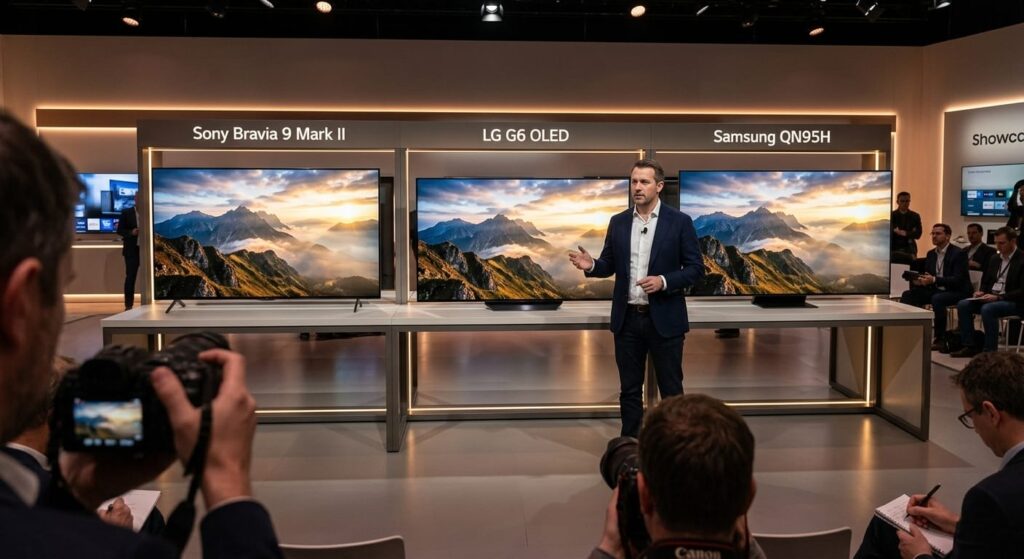
TV Shootout Ethics reveals the hidden world of private television comparison rooms, where perception, persuasion, and performance quietly collide behind closed doors.
There is a ritual that happens at almost every major television launch event. It usually arrives after the presentations are over and the executives have explained the technology. The discussion about AI processing, HDR performance, Mini LED backlights, OLED evolution, and whatever new acronym the industry has decided was also over.
The moment comes when someone quietly says: “Let’s go to the demo room”. A door opens and a small group of journalists, retailers, influencers, and industry guests are guided into another space with several televisions. Not just this company’s televisions, but also everyone else’s televisions.
For years, I have found these rooms more fascinating than the launches themselves, because the moment you walk inside, something interesting happens. You stop looking at televisions, and start looking at human psychology. More than once, I have walked into a demo room convinced I knew which television would impress me most, only to leave questioning whether I had been evaluating image quality or simply reacting to the way the comparison had been constructed.
What struck me over the years is that most people walk into these rooms believing they are there to evaluate televisions. In reality, they are often evaluating differences. That sounds like the same thing, but it isn’t. Human perception is comparative by nature. We rarely judge a display in isolation. We judge it against whatever is sitting next to it. The moment two televisions are placed side by side, the exercise stops being purely about picture quality and starts becoming an exercise in relative perception.
The Room Behind the Headlines
Most consumers never see these demonstrations. They only see the headlines afterward: “The brightest TV ever made”, or “the most accurate display we’ve ever tested”.
But long before those headlines appear, somebody has already decided what the audience will see. The lighting is carefully controlled, seating positions are deliberate and even content has been selected with extraordinary care.
Nothing is random, and that is where TV Shootout Ethics begins. Not with the televisions themselves, but with the realization that every comparison starts with choices. Someone selected the clips, chose the environment and decided which strengths deserved attention.
The comparison may be completely honest, and the differences may be entirely real, yet honesty and persuasion are not mutually exclusive. In fact, the most effective demonstrations often combine both. This is where TV Shootout Ethics becomes complicated. The challenge is not determining whether the differences are real, but understanding how those differences are being presented and interpreted.
The Most Powerful Comparisons Are Often the Ones That Feel Objective
One of the reasons these demonstrations are so effective is because they appear objective. After all, what could be more convincing than placing two televisions side by side? The audience can see the difference with their own eyes. Instead of marketing slogans, advertisements or technical specifications, you just see two screens displaying the same content.
And yet appearances can be deceptive, because modern televisions are incredibly sensitive to context. A small change in ambient lighting can alter perceived contrast, and a slight adjustment to tone mapping can influence HDR highlights.
Different calibration targets can affect color accuracy. Viewing angle, room brightness, source material, panel warm-up time, and processing behavior can all change how a television appears during a demonstration.
That doesn’t mean the comparison is invalid, but simply that it isn’t as simple as it first appears. The room itself becomes part of the result, and once you understand that, every TV comparison starts to look a little different.
TV Shootout Ethics Is Really About Control
The question that interests me most is not whether manufacturers manipulate these demonstrations. In most cases, I don’t believe they do. Then again, perhaps that is exactly what every attendee tells himself after sitting through a particularly impressive demonstration. The more interesting question is who controls the variables.
Imagine a car manufacturer inviting journalists to compare vehicles. The company selects the track, chooses the route, determines the weather conditions and provides the vehicles. So it actually controls the presentation, and then asks everyone to decide which car performed best. The results might still be meaningful, but nobody would confuse the exercise with an independent evaluation.
Television demonstrations occupy a similar space. The manufacturer often controls the environment, content, explanation and narrative. And while that doesn’t automatically invalidate the experience, it does create an unavoidable asymmetry.
One side designed the experiment and the other side simply participates in it. That imbalance does not automatically make the outcome wrong, but it does mean the audience is being asked to trust the referee, the rulebook and the result at the same time.
There is also a question that rarely gets asked. When a manufacturer purchases a competitor’s television and places it inside a private comparison room, who is representing the competing product? The company being compared is not present, has no visibility into the setup and no opportunity to challenge the methodology. That absence does not prove anything improper occurred, but it highlights how unusual these demonstrations would seem in many other industries.
Why European Regulators Care About Comparative Demonstrations
These questions are not merely philosophical. They sit at the heart of how comparative marketing is treated in parts of the world, particularly within the European Union. Under EU rules governing comparative advertising, companies are generally permitted to compare their products against competitors, but those comparisons must be verifiable, objective, and not misleading.
The principle is straightforward: consumers should be able to distinguish between evidence and persuasion. That sounds obvious until you sit in a dark room watching three flagship televisions side by side and realize how difficult it can be to separate the product from the presentation. A side-by-side demonstration may feel self-evident in the room, but once the manufacturer controls the content, calibration, lighting, and presentation, the line between objective evaluation and marketing narrative can become difficult to define.
That does not mean such demonstrations are deceptive; many showcase genuine engineering advantages. It does mean, however, that regulators increasingly recognize a simple reality: the more influence a company has over the conditions of a comparison, the greater the responsibility to ensure that comparison can withstand independent scrutiny.
The broader issue behind TV Shootout Ethics is transparency, because transparency is what allows consumers to distinguish between a demonstration and an evaluation. Most manufacturers are perfectly entitled to showcase their strengths, but consumers also deserve enough information to understand how those strengths are being demonstrated.
It’s More Interesting When Nobody Is Lying
This is where the discussion becomes genuinely fascinating, because TV Shootout Ethics is not really about deception. Deception is easy.
The more difficult question is what happens when a company genuinely believes its television is better. What happens when the engineers are sincere and the advantages are real? When the product actually performs exceptionally well? The answer is that ethical questions still remain, because every demonstration is also an act of framing.
The most interesting thing about TV shootout rooms is that they rarely need to be dishonest. Their real power comes from deciding what deserves to be seen.
A television might genuinely excel in shadow detail, another might excel in brightness and a third in color volume. The decision about which scenes to display inevitably shapes the conclusion, and once you recognize that, you begin to realize that comparison rooms are not simply showing performance. They are defining performance.
What Other Industries Have Already Learned
Interestingly, this debate is not unique to consumer electronics. Medicine confronted similar questions decades ago. Modern pharmaceutical research relies on peer review, transparency requirements, statistical analysis, and independently verifiable methodologies because researchers understand something fundamental:
The more control someone has over an experiment, the more transparency becomes necessary. The reason is simple. Transparency is not designed for situations where everyone is acting in bad faith. It exists because even well-intentioned people can unintentionally shape outcomes. The same principle appears throughout science, finance, academic research and journalism.
Transparency is required because good intentions alone are not enough. Even honest people can create biased environments without realizing it. Behavioral economists have spent years studying how framing influences decision-making.
Researchers such as Daniel Kahneman demonstrated that human beings rarely evaluate information in isolation. We evaluate it relative to context. If you change the frame, so perception may also change. Change the comparison and conclusions often change with it.
Economists and ethicists often describe situations like this as information asymmetry. One side simply knows far more about the conditions of the comparison than the other. The larger that gap becomes, the more important transparency becomes.
Television manufacturers understand this instinctively, and this is why the comparison itself becomes part of the product.
Why Recording Is Sometimes Restricted
One detail that often attracts attention during private demonstrations is the restriction on photography and video recording. There are legitimate reasons for this:
- Pre-production firmware may be unfinished.
- Legal concerns may exist.
- Competitive sensitivities may be involved.
- Prototype hardware may not yet represent final retail products.
All of those explanations are reasonable, yet restrictions also create another consequence.
They limit external verification.
The moment footage leaves the room, independent analysis becomes possible. Interestingly, this is also the moment manufacturers lose something valuable: control of the narrative. Professional calibrators can examine the setup, competing manufacturers can evaluate the methodology and enthusiasts can scrutinize individual frames. Suddenly the conversation shifts from presentation to evidence. And evidence tends to be less controllable than perception.
The Psychology Nobody Talks About
Understanding TV Shootout Ethics requires understanding perception. Perhaps the most remarkable aspect of these comparison rooms is that they work because human beings naturally trust what they can see with their own eyes. If one television looks better than another, we instinctively believe we have discovered truth.
But comparison and truth are not always the same thing. A television viewed alone may appear extraordinary. But place it next to a brighter display and it suddenly appears dim. Place it next to a less accurate display and it suddenly appears exceptional.
The comparison changes the perception, not the television itself. This is one reason comparison rooms have become so powerful. Manufacturers are no longer competing solely through engineering. They are competing through interpretation. The battle is increasingly about defining what consumers should notice.
TV Shootout Ethics Beyond the Demo Room
The irony is that nobody actually watches television inside a launch event. Consumers watch television in living rooms, bedrooms and family rooms over months and years. Across thousands of hours of content.
So the television that wins a controlled demonstration may still be the best television, or may not. Because ownership reveals things no demonstration ever can. How stable the software remains six months later, whether the operating system becomes frustrating over time, or how the television handles thousands of hours of real content rather than a handful of carefully selected clips. Not even the TV longevity. These are questions that simply cannot be answered inside a demo room.
While a demo room can reveal strengths, it cannot reveal an entire ownership experience, and perhaps expecting it to do so is where consumers make their biggest mistake.
The Question Nobody Asks
There is another question that rarely gets discussed: what if the television that wins the comparison is not necessarily the television you would choose to live with? Launch events reward immediate impact. A brighter highlight, deeper black level and more dramatic demonstration.
But living with a television is different. Ownership is measured in thousands of hours, not thirty-second demo clips. The television that impresses you most in a dark demo room may not be the one you enjoy most six months later. And that raises an uncomfortable possibility: perhaps some demonstrations are optimizing for visibility rather than ownership.
TV Shootout Ethics and the Future of Trust
At its core, TV Shootout Ethics is a debate about trust. Not trust in any single manufacturer, but trust in the process itself. How much confidence should consumers place in comparisons created by the very companies being compared? After years of attending launch events, private demonstrations, and industry showcases, I have come to appreciate these rooms for what they are: not laboratories or courtrooms. Not objective arbiters of truth.
They are carefully constructed environments designed to communicate a message. Sometimes that message is accurate, but sometimes it’s persuasive. Usually it is both, and that is why TV Shootout Ethics matters.
Not because comparison rooms are inherently deceptive. I’m not implying that manufacturers should stop comparing products. Not even that consumers should distrust everything they see. Understanding how perception is shaped has become almost as important as understanding the technology itself.
Every comparison room eventually teaches the same lesson that technology companies no longer compete only on engineering. They compete on interpretation and the battle is no longer simply over who builds the best television. This battle is increasingly over who gets to define what best means.
And perhaps that is the most revealing thing these rooms unintentionally expose. Not how televisions compete, but how modern companies compete for belief itself. Because once you notice how carefully every comparison is constructed, you leave with a very different question:
Were you evaluating the television, or simply the version of it someone wanted you to see?