
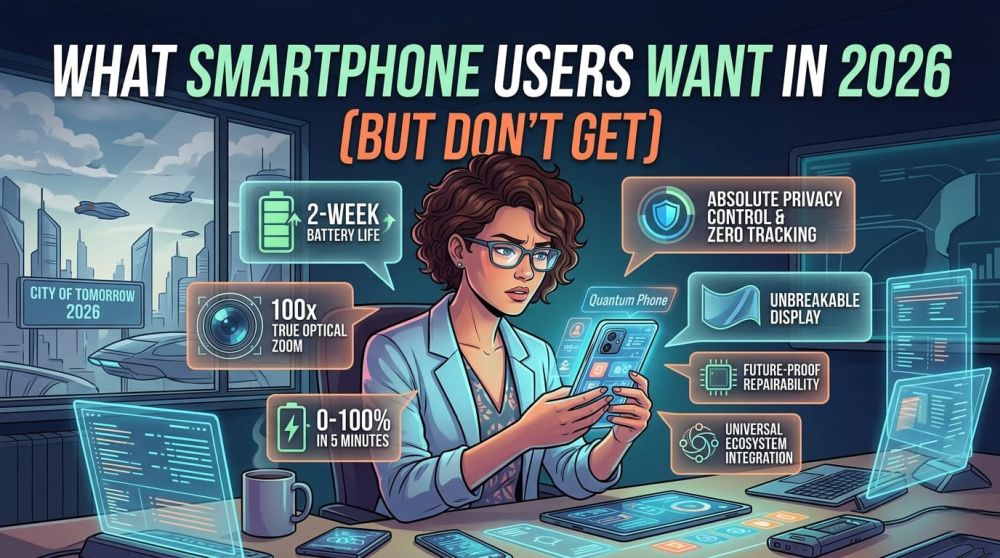
In this article, I’m attemptingת cautiously, to step into the shoes of smartphone users around the world. I don’t claim to represent anyone but myself, yet based on years of hands-on experience with a wide variety of smartphones, I aim to provide a subjective perspective that strives to be as objective as possible. My goal is to highlight the real pain points and frustrations that everyday users face, from Android to iPhone, and to explore what people genuinely wish their devices could do better.
Introduction
Despite massive innovation in hardware and features, smartphone users around the world still report recurring frustrations, from software fragmentation to hardware limitations. By analyzing discussions across major global forums, support communities, and my reviewer colleagues, I would like to identify the genuine pain points that both Android and iPhone owners share, and imagine what the ultimate smartphone of 2026 should look like.
Fragmented Software Updates and Longevity Anxiety
One of the most persistent frustrations among smartphone users today, especially within the Android ecosystem, revolves around software update commitments. In the past, Android devices typically received only 2–3 major OS upgrades and a few years of security patches, leading owners to feel their devices became outdated quickly compared to expectations.
Samsung has taken a much more aggressive stance in recent years. Starting with its Galaxy S24 lineup, announced in 2024, Samsung publicly committed to providing up to seven major Android updates and seven years of security updates for its most premium flagships, a level of support that aligns it with Google’s own Pixel series and even matches Apple’s multi‑year support model. However, Samsung’s update structure is not uniform across all models.
While top‑tier devices like the Galaxy S24, S25 and the latest Galaxy Z foldables are indeed slated to receive this extended support, many mid‑range A‑series phones receive fewer years of OS updates, usually 4–6, despite still benefiting from improved security patch timelines. Some older devices that pre‑date this policy are already reaching end‑of‑life and losing security updates.
Even within the enthusiast community, there is debate about how these promises are interpreted, for example, whether “7 generations of Android updates” strictly means seven distinct Android versions or something slightly different in practice.
Pre‑Installed Bloatware and Unwanted Apps
Another persistent Android complaint, especially on OEM devices like Samsung, Xiaomi and others, is what we consider as bloatware: apps that come pre‑installed and often cannot be removed.
Users express frustration on forums that these apps take storage, slow down performance, and cannot be fully uninstalled. Here are some real examples from common device ecosystems:
In Samsung Galaxy series phones
Many Samsung phones ship with a combination of Samsung’s own apps plus third‑party apps that cannot be completely uninstalled. Examples often include:
- Samsung Health which can be useful if you have Galaxy Watch, but may not be used by the average user.
- Galaxy Store, the Samsung’s own app marketplace, in addition to the Google Play Store
- LinkedIn. One may ask “Why is LinkedIn installed on my phone when I never signed up for it?”
- Microsoft Outlook
- OneDrive
- Microsoft Office / Word / Excel / PowerPoint
Some of these apps can be disabled, but they often can’t be removed entirely without root access or specialist tools. Users frequently report that apps like Outlook or LinkedIn are unwanted if they never signed up for those services in the first place, yet they still appear on their new phones.
Xiaomi, Redmi and POCO devices
Xiaomi’s MIUI often comes with a mix of system apps and localized promotional or brand‑specific apps, such as the Mi Browser, Mi Video, Mi Remote, GetApps (Xiaomi’s app store), Themes, Security/Optimizer apps with ads and Occasionally region‑specific partner apps like shopping, games, etc.
These apps tend to be more aggressive about showing recommendations and sometimes even push ads, which exacerbates the sense that the phone is crowded with unnecessary software.
Why Can’t Users Remove These Apps?
There are a few technical and business reasons for that:
- Manufacturer Agreements and Carrier Branding: Manufacturers sometimes bundle partner apps as part of revenue or promotional deals.
- Carriers may require certain apps to remain installed on devices sold through their network.
- Integration Into the System: Some pre‑installed apps are tied into the system UI or services. For example, Samsung Health might be integrated into Samsung’s widget ecosystem and therefore not allowed to be removed entirely.
Similarly, “security center” or “optimizer” apps on Xiaomi phones are part of the MIUI experience and thus are considered system apps.
Secured Data
Another topic that increasingly concerns smartphone users is data security and the ability of authorities or external actors to access information stored on a phone.
Over the years, a widely discussed perception has emerged among security researchers and technology journalists: Android devices tend to be easier to access using forensic tools compared to iPhones.
Law-enforcement agencies around the world frequently rely on specialized digital forensic companies such as Cellebrite or GrayKey to extract data from smartphones during investigations. While these tools evolve constantly, reports and independent analyses have repeatedly suggested that many Android devices are significantly easier to unlock or extract data from compared to Apple’s iPhones.
Apple’s security architecture places strong emphasis on hardware-level encryption, secure enclaves, and tightly controlled operating system access, making full device extraction extremely difficult in many scenarios.
In fact, there have been public cases in which forensic companies struggled to bypass security protections on certain iPhone models. For example, several reports have highlighted situations where Cellebrite was unable to unlock specific iPhone devices, illustrating how robust Apple’s security architecture can be under certain conditions.
Android manufacturers have made attempts to address this challenge. Samsung, for instance, developed its Knox security platform, which adds a hardware-based security layer designed to protect sensitive data and create isolated environments within the phone.
However, critics often argue that Knox does not fully solve the broader issue. Because Android is deployed across many hardware platforms and vendors, security implementations can vary widely. In some cases, relatively simple forensic tools or vulnerabilities may still allow access to device data.
For many users, this raises an uncomfortable question:
Is their personal data truly safe if their device is lost, stolen, or seized?
Looking toward the ideal smartphone of 2026, users increasingly want Android security protections that match the robustness of Apple’s ecosystem. This would include:
- Stronger hardware-level encryption
- Tighter OS-level security controls
- Improved resistance to forensic extraction tools
- Unified security standards across Android manufacturers
In other words, users want the flexibility of Android without sacrificing the level of data protection many associate with the iPhone.
User Experience Assumptions
Manufacturers may assume that all users want a full suite of features., but in reality, many users prefer choice over assumption. Others prefer the CLEAN android install.
These complaints show up again and again on forums and device‑specific discussions.
Why This Matters to Users
Pre‑installed bloatware affects users in several real ways:
- Storage Consumption: Apps take up space on the phone, and on lower‑capacity devices this can be a noticeable percentage of internal storage.
- Background Processes: Even if they don’t run constantly, apps often register for background events that can impact performance and battery life.
- Cluttered UI: Extra apps crowd the app drawer and home screens, making organization less intuitive.
- Ads and Recommendations: In ecosystems like MIUI, some pre‑installed system apps push ads or suggestions, which many users find intrusive.
What Users Really Want
- The ability to remove any unwanted app completely, and not just disable it
- A clean user experience out of the box with minimal bloatware
- Optional prompts offering to install extra apps, but only if the user chooses
- Less intrusive recommendations or ad placements
Many users explicitly state preferences like:
“Just give me a clean phone with only Google and OEM essentials, and I’ll add what I want.”
“If I want LinkedIn, I’ll install it. Don’t pre‑install it for me.”
A Stronger Vision for the Ultimate Smartphone OS
If we imagine the perfect smartphone experience in 2026, addressing the bloatware problem would be a major feature:
- Minimum Pre‑Installed Software: Only core system apps plus genuine essentials, such as phone dialer, messaging, camera.
- User‑Controlled App Installation: Offer optional app suggestions at first launch, but only as opt‑in.
- Clean Uninstallability: Every app, including manufacturer apps, should be fully removable without hacks.
- Ad‑Free System UI: System recommendations should not show ads unless explicitly enabled.
Battery Life and Power Management
Battery life remains one of the most persistent frustrations for smartphone users, even as processors become more efficient and software optimization improves.
Modern smartphones are more powerful than ever. High-refresh-rate displays, advanced AI processing, 5G connectivity, and increasingly complex camera systems all demand significant amounts of energy.
As a result, many users feel that battery technology has not advanced at the same pace as other smartphone components. While processors and cameras receive major upgrades every year, battery capacity often changes very little across generations.
Samsung’s flagship Galaxy series provides a good example of this trend. Over multiple device generations, battery capacities have remained largely similar, with only minor adjustments. Even in the most recent Galaxy S26 series lineup, battery capacities remain in roughly the same range as previous models.
This incremental approach frustrates users who expect more dramatic improvements in real-world endurance.
Removal of Legacy Features
One of the most emotional debates in the smartphone world revolves around the removal of features that many users still value.
Over the past decade, manufacturers have steadily eliminated several once-common hardware capabilities in pursuit of thinner designs, water resistance, and simplified internal layouts.
Among the most frequently mentioned features are:
- The 3.5mm headphone jack
- Expandable storage via microSD cards
- Removable batteries
Each of these features provided meaningful flexibility for users, and their disappearance continues to spark discussion across smartphone communities.
The Disappearance of the Headphone Jack
For many years, the headphone jack was a universal audio connection supported by virtually every device.
Its removal forced users to adopt alternative solutions such as bluetooth wireless headphones and USB-C audio dongles. While wireless audio has improved dramatically, some users still prefer wired headphones due to zero latency, consistent audio quality, no battery requirements and no radiation.
Today, users who want to connect traditional wired headphones must often purchase USB-C adapters, which adds cost and inconvenience.
Expandable Storage: A Lost Advantage
Another major change is the gradual disappearance of microSD card slots. In earlier smartphone generations, users could easily expand storage by purchasing an affordable microSD card. This provided tremendous flexibility, especially for storing large photo libraries, videos, or offline media.
Today, most flagship phones rely exclusively on internal storage tiers. This has created a new economic reality for consumers. Upgrading from a 128GB phone to a 512GB or 1TB version can add hundreds of dollars to the purchase price, even though the underlying storage hardware itself costs far less.
Many users feel that expandable storage once provided a more affordable and consumer-friendly alternative.
The End of the Removable Battery
Perhaps the most controversial loss is the removable battery. In earlier smartphone generations, users could quickly swap a depleted battery for a fully charged one or replace an aging battery themselves at minimal cost. Today’s smartphones typically use sealed battery designs.
While this allows for slimmer devices and improved water resistance, it also means that battery replacement is now a more complicated and expensive process.
In many cases, replacing a smartphone battery through official service channels can cost a substantial portion of the phone’s value. For older devices, the cost may approach one-third to one-half of the phone’s resale value, making replacement less attractive.
Samsung itself once offered removable batteries in its flagship devices. The Galaxy S5, released in 2014, is widely considered the last Galaxy S flagship with a removable battery before the company transitioned to sealed designs starting with the Galaxy S6.
For users who value repairability and long-term device ownership, this change remains controversial.
Conclusion
Even in 2026, when smartphones are more powerful than ever, users still face recurring frustrations. From inconsistent software updates to battery concerns, security worries, and the gradual removal of once-useful features.
What many users want is not just faster processors or higher megapixel cameras.
They want thoughtful improvements that address everyday usability.
The ultimate smartphone of the future may not simply be the most powerful device on the market. Instead, it would combine:
- security and reliability associated with the iPhone
- Flexibility and customization of Android
- Meaningful battery improvements
- The return of previously omitted features
- Cleaner software experiences
- Greater user control over hardware and software features.
In other words, the best smartphone of the future may not belong to one ecosystem alone, but rather represent a balance between performance, privacy, longevity, and user freedom.