
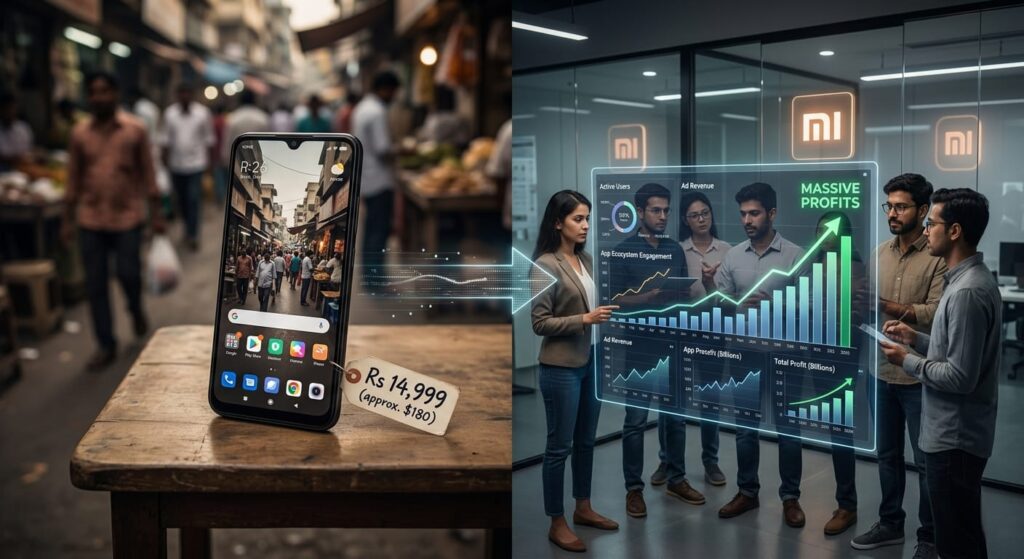
Alex turns the Xiaomi phone in his hand one more time, and it feels like a flagship. The screen is sharp, the build is solid and the specs check out. And yet, it’s cheaper than the Samsung flagship next to it.
He doesn’t say it out loud, but asking himself: “What am I missing?”
To answer that, you don’t look at the phone, but at Xiaomi recently published financial report.
The first thing that jumps out is scale is “Revenue 227,249.4… increase of 38.2%“, which means that this isn’t a company standing still. Revenue is growing, and not quietly.
But the number on its own doesn’t tell Alex how that growth is built, only that it exists, and that it’s significant.
Then comes something sharper: “Profit for the period 22,765.9… increase of 146.3%“, which means that profit is growing faster than revenue. That’s not a detail. It’s a shift, not explained here, or broken down, but clearly happening.
For Alex, it means one simple thing: this isn’t a company discounting itself into trouble.
He looks back at the phone, because at the end of the day, that’s what he’s buying. And Xiaomi is very clear about how many of those it sells: “Smartphone shipments reached 84.2 million units“. That’s scale. Global scale.
But right next to that, the tone changes: “The gross profit margin from our smartphones decreased from 13.5% in the first half of 2024 to 12.0% in the first half of 2025. It’s a small drop, 1.5 percentage points, but it’s in the direction that matters.
Margins are going down, and Xiaomi doesn’t leave much room for interpretation elsewhere: “margin… decreased… mainly due to the increased competition“. And competition is not abstract here, but shows up directly in the numbers.
So Alex now understands something he didn’t see on the price tag: the lower price isn’t random. It lives inside a competitive environment that pushes margins down.
But the story doesn’t stop with the phone, because Xiaomi doesn’t.
Somewhere else in the report, the numbers look different: “IoT… gross margin increased from 20.8% to 23.9%“. Here, margins are going up, with no explanation attached in this line, just the fact itself. And alongside that: “Cost… increased by 43.3%… primarily due to increased sales”. The costs are rising, but so are sales, meaning this is expansion, and not contraction.
For Alex, who only came to buy a phone, this starts to feel bigger than a single device.
And then there’s the part he never sees. “The gross profit margin of our internet services reached 76.1%“. It doesn’t need decoration, since no segment in the report comes close to that level of margin. The report doesn’t explain it here. It just sits there, quiet, and very different from hardware.
And then the report shifts again with the following: “Revenue… smart EV… RMB39.8 billion“. These Electric vehicles are not a concept or a plan, but actual revenue.
So now the structure becomes visible:
- Smartphones → lower margin
- IoT devices → mid-level, improving margin
- Internet services → very high margin
- smart EV → growing business
Although not stated as a strategy in one sentence, the numbers start to line up.
At this point, Alex might think he understands the company. Phones, IoT devices, services. For Alex, that changes the framing completely, because he is not just buying a device, but entering an eco-system that continues after the purchase.
And not just that, all of this sits on a geographic foundation: “Mainland China 68.4%… Rest of the world 31.6%”. This means that most of the business is still in China. For Xiaomi the rest of the world exists, but it’s smaller.
Final Thought. The Quiet Tradeoff
Alex, standing in the U.S., is part of that 33%. He puts the Xiaomi phone down, and then picks it up again, because now the question has changed.
It’s no longer: “Why is this phone cheaper?” Because now the price doesn’t feel suspicious. It feels… structured.
Because what the report shows, without ever saying it directly,is this:
 The phone is not the end of the transaction
It is the beginning of a relationship. And that relationship, somewhere else in the report, is where the margins are. And suddenly, that price tag doesn’t feel random anymore. It feels… explained.