
From Fear to Clarity: What Hearing Aids Really Did to Me and My Music Experience
This article is the third in a series focusing on the diagnosis of hearing loss, available treatment options, and the added value for people who enjoy listening to music. The first article, deals with diagnosis, and the second article, covers treatment methods, and another on Tinnitus.
Since hearing loss typically does not occur suddenly, those affected often begin to notice it only after a significant decline that impacts their quality of life. Unlike in the past, when hearing aids were bulky and merely amplified all surrounding sounds, today’s hearing aids are extremely compact and packed with advanced technologies, to the point where even tech-savvy users may be surprised.
Although my own hearing loss is not severe enough to require a hearing aid, I asked Audio Medic for the opportunity to try one in order to evaluate its added value. I am writing this review after extended use, allowing me to assess its benefits in everyday life, as well as during music listening in an opera house, a concert hall, and at home.
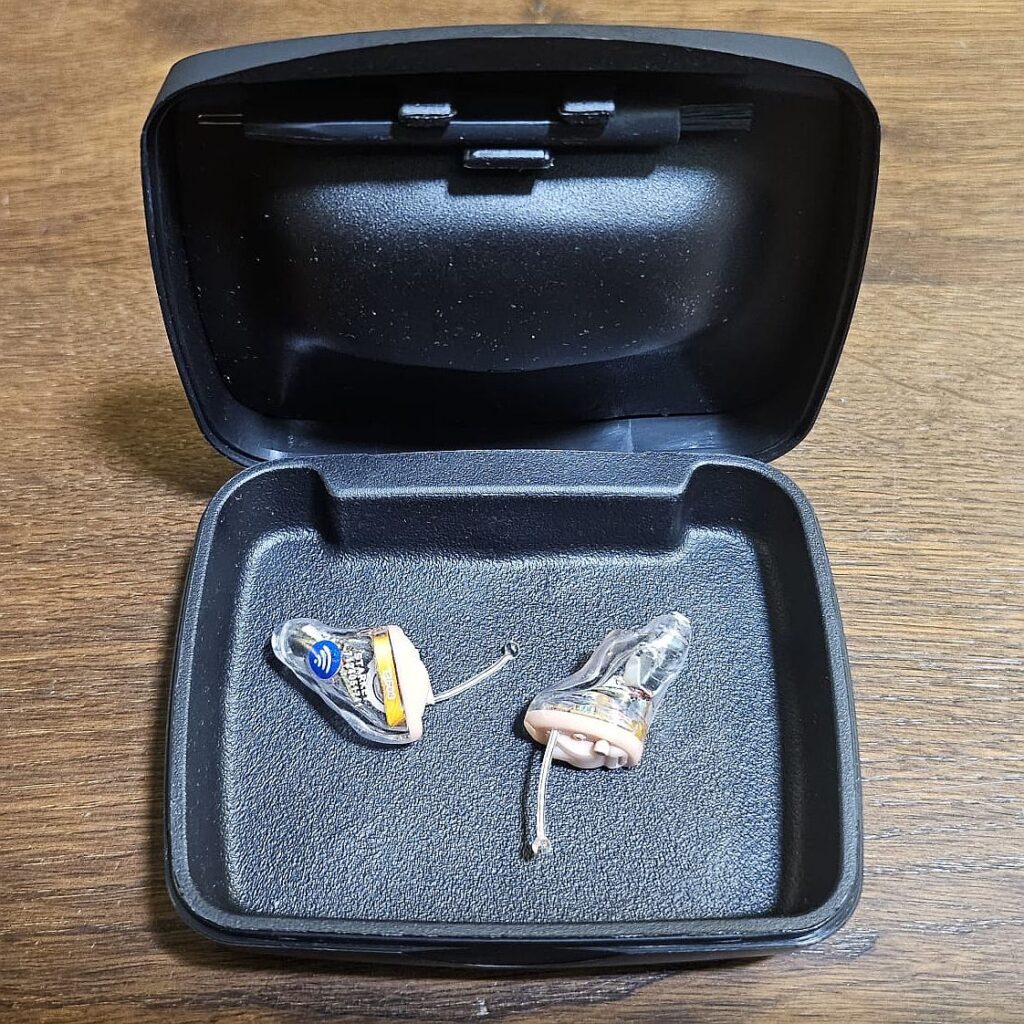
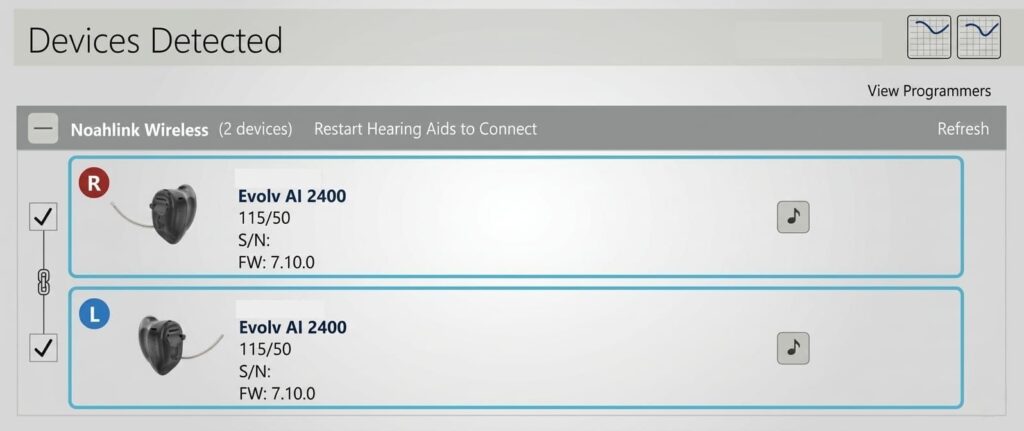
For this purpose, Audio Medic ordered for me an advanced model from Starkey, the Evolv AI 2400, in a CIC (Completely-in-Canal) configuration, meaning it sits entirely inside the ear canal. The order is placed through an online system shared by multiple hearing aid manufacturers. During the ordering process, the device color is customized to match the user’s skin tone.
Diseño
If you order a CIC (Completely-in-Canal) hearing aid, its external dimensions are fully customized based on an impression taken from your ear canal. Since ear canals vary from person to person, each device is uniquely tailored.
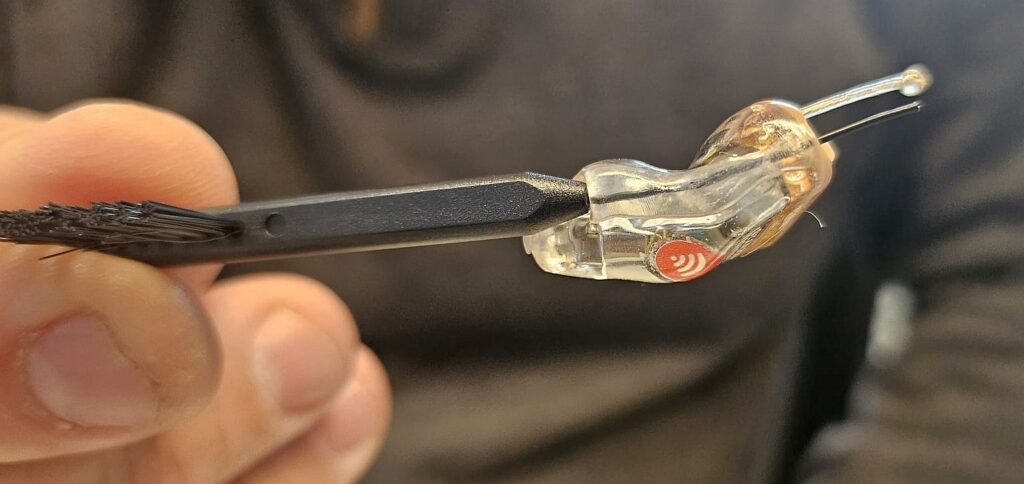
The design of the Evolv AI 2400 is particularly striking because it is completely transparent, allowing you to see all of its internal components through the plastic shell. To differentiate between the earpieces, each one is permanently marked: right in red, left in azul. The outward-facing tip is colored to match the user’s skin tone for discretion and includes several important components:
- A built-in touch sensor on each earpiece allows instant switching between audio programs
- A slightly raised button on each earpiece: pressing the right increases volume, while pressing the left decreases it
- A short antenna on each earpiece serves two purposes: easy removal from the ear and Bluetooth connectivity with your smartphone
Personalization
The initial experience of wearing the Evolv AI 2400 was unusual, as it was the first time a device designed to remain inside my ear canal was inserted. As mentioned, the body of the device is molded precisely to match the outer ear canal of the user, so in this case, it fit my ear perfectly.
The Evolv AI 2400 was ordered in a configuration that is not fully sealed. Instead, it includes an internal vent channel running through its length, allowing sound waves to pass naturally into the ear. This enables the ear to hear frequencies that do not require amplification, in a natural way. This feature is particularly suitable for individuals whose hearing loss affects only specific frequency ranges.
In such cases, the audiologist configures the hearing aid to amplify only certain frequency ranges. Remember that the Evolv AI 2400 includes 24 audio channels, unlike other devices that typically offer 6 or 12 channels. This high number of channels allows precise selection of which frequencies are amplified and which remain natural.
If you choose to use a 24-channel hearing aid, this must already be planned during your hearing test. I mention this because standard hearing tests (such as those often performed through public healthcare systems) typically measure fewer frequencies. To fully utilize the 24 channels of the Evolv AI 2400, you should ensure that your hearing test evaluates at least 24 distinct frequencies.

Dividing the frequency range into a large number of channels allows each channel to be analyzed and processed independently. This is very similar to an equalizer: the more bands it has, the more precisely you can target narrow frequency ranges and adjust them individually. This enables highly accurate correction tailored to the user’s hearing profile. In addition, the device’s sound profiles can be controlled via a dedicated app.
The Evolv AI 2400 requires extensive programming and fine-tuning by an audiologist, meaning it is not an off-the-shelf product that you simply order and wear. One of the methods it uses to improve hearing is frequency shifting. For example, if a person has significant hearing loss in the higher frequencies, instead of amplifying them excessively, the device shifts those sounds to nearby frequencies that the user can hear better.
However, frequency shifting has a downside: it compresses the original sound. Therefore, users who prefer to hear frequencies as they naturally are may choose to avoid this feature.
Programming of the Evolv AI 2400 is performed directly from a computer via Bluetooth. Since most hearing aids require such adjustments, this typically involves meeting an audiologist in person. However, the Evolv AI 2400 uniquely allows full remote adjustments while the patient is at home. Through a video call and the mobile app, the audiologist can connect to the hearing aid in real time and make programming changes without requiring an in-person visit.
Tinnitus Management
Tinnitus is defined as hearing a sound that does not come from an external source, meaning others cannot hear it. It is often described as ringing, although some people experience it as buzzing. Surveys estimate that between 10% and 25% of adults suffer from tinnitus.
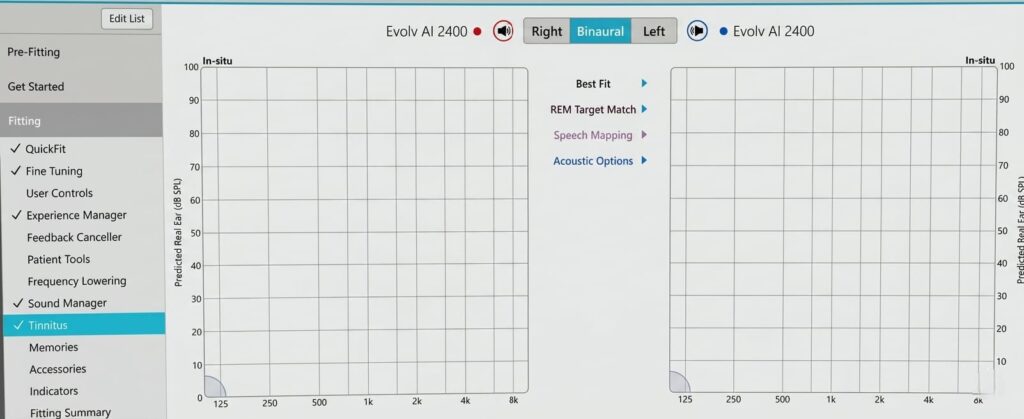
The causes are not entirely clear, but it is often associated with hearing loss. Since this condition can also affect mood, sleep, and concentration, it can be managed using a hearing aid. The principle is simple: the device generates a sound that masks the tinnitus frequency, thereby reducing its impact on the user. For more information read here my complete article on Tinnitus.
T-Coil
Some hearing aids also allow direct connection to central sound systems in venues such as theaters and concert halls. The advantage is that instead of the hearing aid’s microphone picking up both the performance and background noise, it can connect directly to the venue’s sound system, eliminating ambient noise.
This direct connection works with a T-Coil (telecoil) built into the hearing aid, which creates an electromagnetic field that connects to induction loop systems installed in the venue. These systems are also found in public places such as banks, where a designated station, often marked with a “T” symbol, allows automatic connection when approached.
It is important to note that the T-Coil takes up space, which is why it is typically not included in CIC hearing aids due to their compact size within the ear canal.
Gradual Amplification
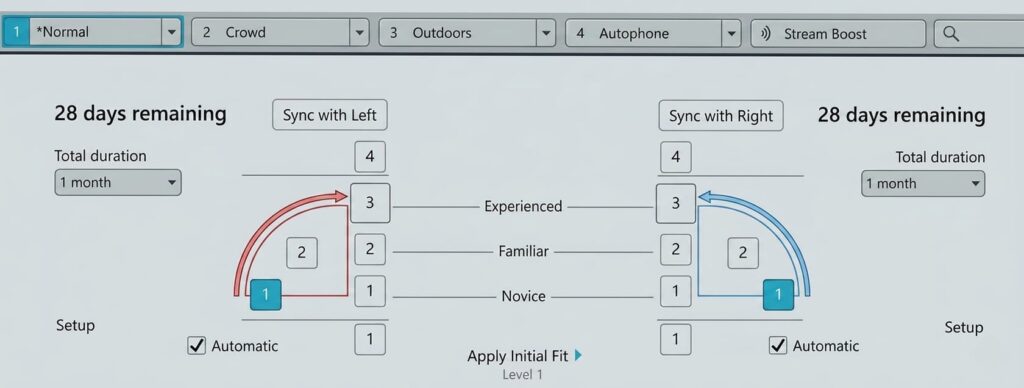
Because many people adapt over time to gradual hearing loss, an immediate jump to full amplification can feel overwhelming. The device may initially seem too loud.
For this reason, hearing aids like the Evolv AI 2400 can be programmed to increase volume gradually, typically in stages every two weeks. This allows both the ear and the brain to adjust comfortably to the new sound levels until the desired level is reached.
Experiencia de usuario
My experience relates specifically to a CIC device (completely inside the ear), which may differ from behind-the-ear models. Since the device sits entirely inside the ear, it requires an initial adjustment period.
I found the technology very impressive, since it can distinguish between background noise and speech, enhancing clarity. Another thing I noticed is that the device also amplifies my own voice, which caused me to speak more quietly than usual.
In terms of maintenance, aside from replacing the batteries approximately every 10 days, there is very little upkeep required. Thanks to Bluetooth connectivity, the device also eliminates the need for separate headphones or a headset, as it automatically functions as earbuds for phone calls, music listening, and video playback on a smartphone.
The added value of a hearing aid for music listening is a more complex topic. If your hearing loss is minimal and does not justify using a hearing aid, its benefit will be limited to correcting specific frequency ranges. However, if you suffer from significant hearing loss, you may be missing entire portions of the frequency spectrum, as well as balance between frequencies. In such cases, a hearing aid can provide substantial added value by restoring much of the listening experience.
Stay healthy!
Thanks to Audio Medic for their cooperation in creating this series of articles.