
Why Home Theater Sound Quality Gets Sacrificed for Design
This article is part of an ongoing series sectioned Beyond The Gear, exploring the deeper world of high-end audio and home theater. While some articles focus on maximizing performance in dedicated cinema rooms, others examine broader topics such as music reproduction, source quality, human hearing perception, acoustic psychology, and the often-overlooked differences in how people actually experience sound. Among the additional articles in this series, readers can also find:
- The Most Expensive Home Theater Mistakes to Avoid
- Soundbar vs Surround Sound: Which Is Best for You?
- Why We Turn Music Up – Even When It’s Already Loud?
- Music Isn’t Just Sound. It Affects Brain and Body. Learn How!
- Do Audiophiles Really Hear Better, or Just Think They Do?
- Audiophile vs. Music Lover: Who Actually Enjoys Music More?
- Toxic Headphones? Separating Fact from Fear
- From Needle to Cloud: How the Way We Listen to Music Changed and What We Lost Along the Way
The following article discusses how design decisions directly impact real-world home theater performance.
There is a growing trend in modern home theater design that almost nobody wants to discuss openly, especially installers.
Clients invest tens or even hundreds of thousands of dollars into luxury theater rooms. They purchase high-end projectors, flagship AV processors, premium amplifiers, advanced room correction systems, acoustic treatments, custom cabinetry, motorized seating, and elaborate lighting designs. Yet in many of these rooms, the actual home theater sound quality ends up compromised before the first movie even starts.
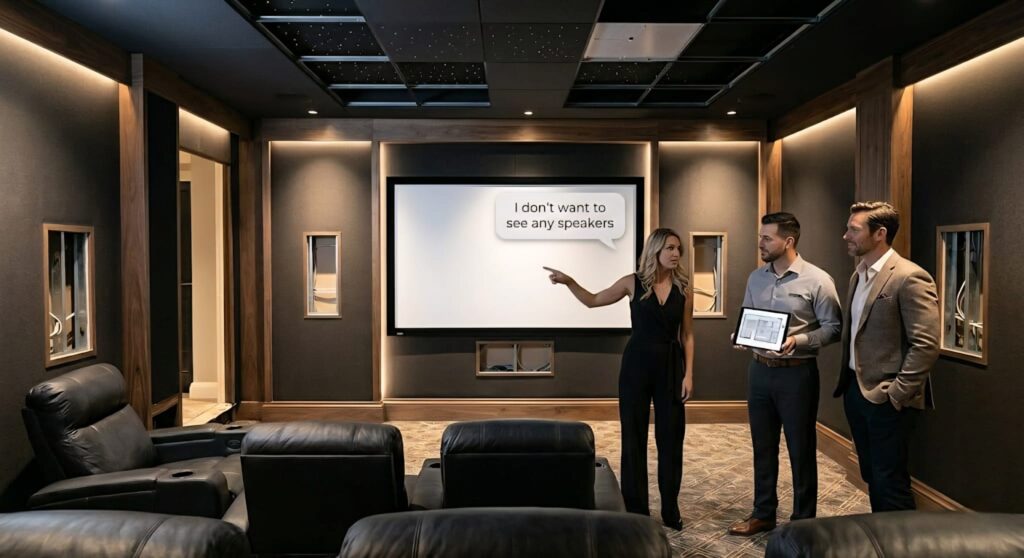
Why? Because aesthetics increasingly dictate speaker design and placement decisions. And in many cases, the installer’s primary mission quietly shifts from maximizing performance to keeping everyone in the household happy. That often means making the speakers disappear.
The Industry’s Obsession With Invisible Audio
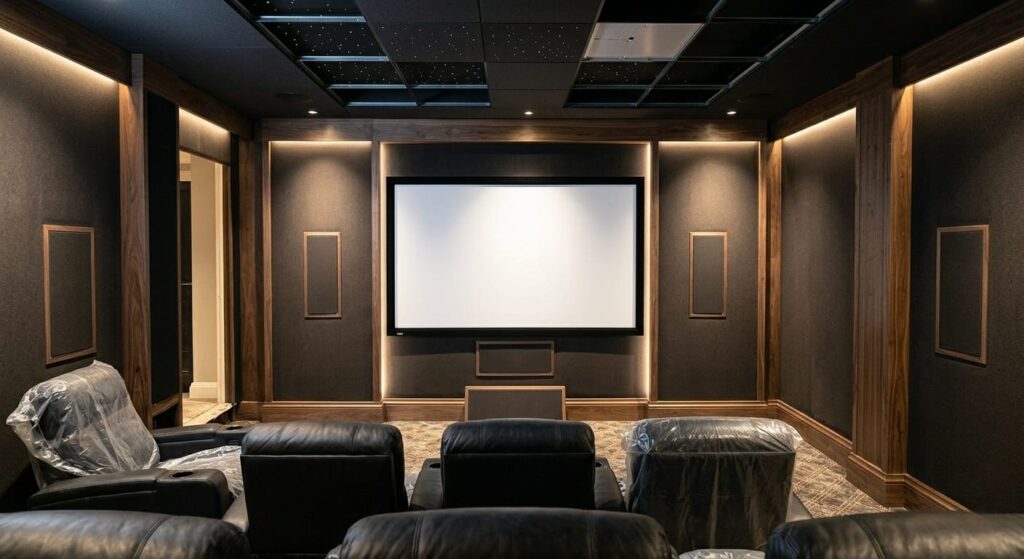
Particularly in North America, where wood-frame construction dominates residential homes, many homeowners are tempted by the idea of fully concealed speaker systems.
The appeal is understandable: It serves clean architectural lines, minimal visual clutter and results in designer-friendly rooms. But it also addresses the wife-acceptance-factor (WAF) considerations, for multi-purpose living spaces.
As a result, in-wall speakers have become the default recommendation in countless installations. Unfortunately, what is often marketed as premium architectural audio, can introduce major compromises in home theater sound quality. And many homeowners only realize this after the installation is complete.
The Acoustic Reality of In-Wall Speakers
Let’s be clear: there are excellent in-wall speakers on the market. Some high-end models can deliver impressive performance when properly installed. But from a purely acoustic standpoint, in-wall speakers frequently operate with built-in disadvantages compared to properly designed freestanding speakers, especially floorstanding models.
That’s not marketing hype, but physics.
1. Limited Cabinet Volume
Most in-wall speakers either operate without a true back box, rely on the wall cavity itself, or use small sealed enclosures. This creates an immediate limitation.
Speaker cabinet volume plays a major role in bass extension, midbass authority, dynamic impact, tonal fullness and overall scale. A small enclosure simply cannot move air like a large cabinet can.
Even when manufacturers include acoustic back boxes, the resulting internal volume often resembles that of a compact bookshelf speaker rather than a true full-range floorstander.
The result? A sound signature that is often leaner, thinner, less authoritative and less physically engaging. Especially in the crucial midbass region.
The Midbass Problem Nobody Talks About
This is one of the most overlooked issues in modern theater installations. When in-wall speakers struggle with cabinet volume and driver size limitations, installers often compensate by adding powerful subwoofers. And yes, subwoofers absolutely help, but they primarily reinforce the lowest frequencies, and not fully restore the missing chest impact, upper bass warmth, lower midrange body, or dynamic punch that larger speakers naturally produce.
This creates a common listening experience where the deep bass is present, but the sound lacks fullness and physicality. The system may measure flat on paper while still sounding emotionally lightweight in practice.
Many enthusiasts describe this as sterile, clinical, dry, or overly processed.
The Wall Cavity Is Not a Proper Speaker Cabinet
Another issue rarely discussed honestly is inconsistency. When speakers are mounted inside wall cavities, each cavity can behave differently acoustically. Even small variations matter: stud spacing, insulation density, cavity depth, wiring paths, nearby HVAC ducts, wood resonance and drywall rigidity.
In many installations, every speaker effectively operates inside a slightly different acoustic chamber, and that can lead to tonal inconsistencies, uneven bass behavior, imaging issues and phase irregularities. Ironically, the room correction software then attempts to fix problems introduced by the installation itself.
By contrast, properly engineered freestanding speakers are designed as complete acoustic systems which provide controlled cabinet design, optimized internal damping, engineered bracing, predictable resonance behavior and matched performance between channels. That consistency matters enormously in a theater environment.
The Hidden Cost of Chasing Aesthetics
This is where the conversation becomes uncomfortable, because many installers understand these compromises perfectly well, but they also understand something else:
- The homeowner wants invisible speakers.
- The designer wants clean walls.
- The spouse may strongly oppose large visible speakers.
- And the installer wants the project approved.
So the industry often arrives at a compromise solution which bundles expensive electronics, premium room treatments, luxury finishes, hidden speakers and ultimately compromised home theater sound quality.
The tragedy is not that in-wall speakers exist, it’s that many homeowners are never fully informed about the trade-offs.
“But My In-Wall System Sounds Great”
And sometimes it absolutely does, because context matters. Compared to TV speakers, soundbars, lifestyle systems, or entry-level home theater packages, a properly installed in-wall system can sound phenomenal.
But that is not the same as saying it represents the highest performance possible for the investment, and that distinction matters, especially when discussing serious dedicated theaters.
The Visual Argument Is Legitimate
To be fair, aesthetics are not trivial, since a home theater is still part of a home, and not everyone wants giant speakers dominating the room visually. Also, not every space can accommodate deep cabinets, and not every family wants a room that looks like a commercial cinema. These are valid concerns.
The problem begins when aesthetics become the primary design driver while acoustic performance becomes secondary. Because at that point, the room may look extraordinary while underperforming sonically relative to its budget.
The Solution Most People Overlook
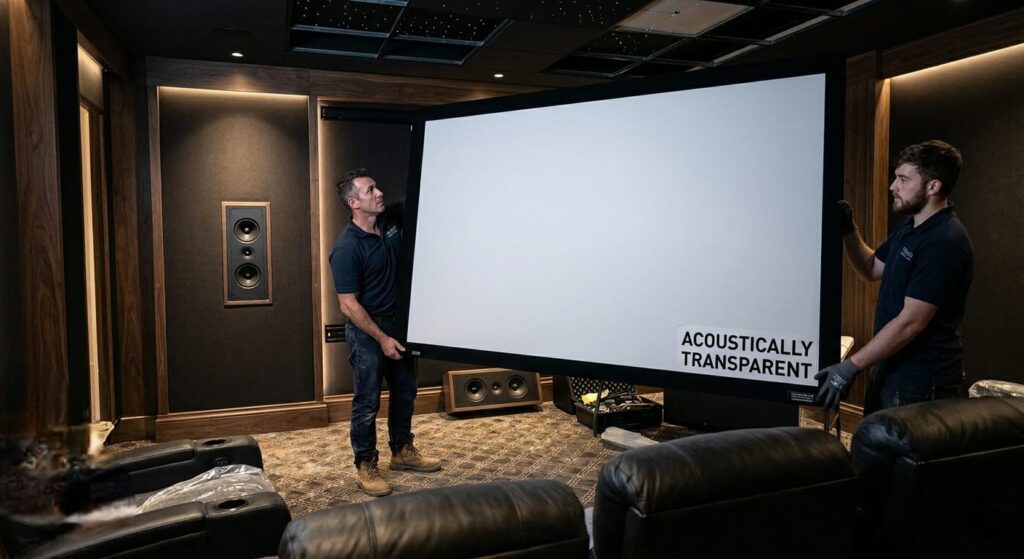
Ironically, the best compromise has existed for decades. It’s called Acoustically Transparent Projection Screens. In serious high-performance theaters, the front floorstanding speakers are often hidden behind an acoustically transparent screen.
This approach solves multiple problems simultaneously:
- The speakers disappear visually
- Large speakers become possible
- Proper speaker placement becomes easier
- The soundstage aligns with the image
- Dynamics improve dramatically
- Midbass authority returns
- Dialogue localization becomes more realistic
This is how commercial cinemas operate for a reason.
And in many cases, it delivers far superior home theater sound quality compared to shallow in-wall systems.
The Most Frustrating Trend Of All
And then there is perhaps the most frustrating trend of all: the installation that comes this close to greatness, only to compromise at the very last second.
Some installers go through the expense and complexity of building a full acoustically transparent projection screen setup, creating the ideal opportunity to place properly sized full-range speakers behind the screen… and then still install shallow in-wall speakers inside the front wall.
It is the acoustic equivalent of reaching the gates of the promised land and choosing not to enter. At that point, the room has already sacrificed depth, construction budget, and design flexibility to accommodate a false wall and an AT screen, yet the system still inherits many of the same limitations of architectural speakers: restricted cabinet volume, reduced midbass authority, smaller drivers, and compromised dynamics. The entire purpose of an acoustically transparent screen is to free the system from the visual constraints that forced those compromises in the first place. When installers still default to in-wall speakers behind an AT screen, you have to ask: was the room designed for performance… or simply for appearance disguised as performance?
Yes, You Lose Some Room Depth
There is a trade-off, because to place large speakers behind an acoustically transparent screen, the room typically requires a false wall, a front stage area, or a dedicated speaker cavity.
That consumes room depth, and as a result the theater becomes slightly shorter. But if the room is long enough to begin with, the acoustic benefits can be enormous. Many enthusiasts who upgrade from in-wall front stages to full-size speakers behind AT screens describe the difference as transformative. Suddenly yo experience larger scale, greater immersion, fuller dynamics, deeper emotional engagement and more cinematic realism.
The Real Question Homeowners Should Ask
Instead of asking: How can we hide the speakers? perhaps the better question is How do we balance aesthetics and performance intelligently? Because true high-end theater design is not about eliminating speakers visually at all costs, but about prioritizing the experience.
And ultimately, sound is half the cinematic experience and arguably more.
What Experienced Installers Quietly Know
Many seasoned installers eventually reach the same conclusion: The rooms that impress clients the most long-term are usually not the ones with the cleanest walls, but those that sound effortless.
Rooms where dialogue has body, explosions carry weight, music breathes naturally and the system feels alive even at moderate volume. That usually requires larger enclosures, better speaker placement, controlled acoustics and fewer compromises dictated purely by interior design.
Final Thoughts
This article is not an attack on in-wall speakers, nor is it a claim that every visible speaker system is automatically superior. There are exceptional architectural audio systems on the market, and also terrible floorstanding speakers.
But the industry increasingly avoids discussing a simple reality that many luxury home theaters are visually optimized first and acoustically optimized second. And for enthusiasts chasing true home theater sound quality, that distinction matters more than most people realize.
Before investing heavily into processors, amplifiers, projectors, and acoustic treatments, homeowners should ask one critical question: Are we building a room that looks like a great theater…or one that actually sounds like one?