
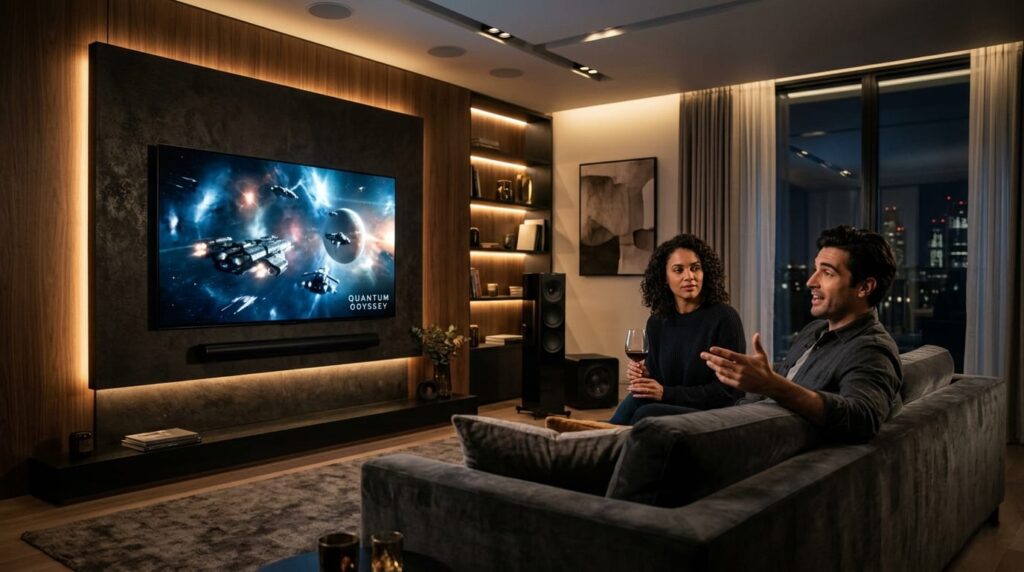
The complete buying guide for choosing the right home theater audio setup for your room, lifestyle and budget.
Almost everyone reaches a time of upgrading their TV setup. You buy a beautiful new OLED television, dim the lights and launch your favorite movie on Netflix, Disney+, or Blu-ray. The picture looks incredible: cinematic, sharp, immersive. But then the sound starts, and it is thin, flat and dissapointing.
Then you realize that modern TVs may look spectacular, but their built-in speakers rarely match the visual experience. And that’s when the internal debate begins.
Do you buy a sleek soundbar and keep life simple? Or dive into the complicated world of AV receivers, surround speakers, subwoofers, ceiling speakers, calibration microphones, speaker cables, and acoustic tuning?
And if you’re married or living with a partner, there’s usually another voice entering the conversation almost immediately: “Do we really need all these speakers in the living room?” Named also the Wife Acceptance Factor (WAF).
I know this conversation very well because I’ve lived on both sides of it. I’ve owned premium soundbars and full surround sound systems. I’ve also spent evenings enjoying the simplicity of a clean minimalist setup, and experienced the breathtaking immersion of a properly calibrated home theater with dedicated speakers all around the room.
And honestly? Both approaches can be fantastic, depending on who you are, how you live, and what kind of experience you actually want. The problem is that many people buy the wrong solution for their lifestyle. Some spend thousands on complicated surround systems they barely use, while others settle for a cheap soundbar when they truly wanted a cinematic experience. Many focus only on marketing terms like Dolby Atmos without understanding what those features actually mean in real life.
So before you spend your money, it’s worth asking a more important question: What kind of viewer are you?
The Appeal of the Soundbar: Why So Many People Choose Simplicity
The reason soundbars exploded in popularity over the past decade, is because it solves a real problem: People want better sound without turning their living room into a recording studio. A modern soundbar is elegant, compact, easy to install, and far less intimidating than a traditional surround setup. In many cases, installation takes less than ten minutes: one HDMI cable and one power cable. Done.
That simplicity matters more than enthusiasts sometimes admit. Most people do not want to research amplifier impedance, speaker sensitivity, room correction software, or ideal speaker placement angles. They simply want movies and dialogue to sound better than the weak speakers built into modern ultra-thin TVs.
And the truth is, even a mid-range soundbar can dramatically improve the experience. Dialogue becomes clearer, explosions gain weight, music sounds fuller and sports broadcasts feel more alive. Suddenly you stop increasing the volume every five minutes just to understand what actors are saying.
But the biggest advantage of a soundbar is aesthetics and not just convenience. A traditional surround system changes the visual identity of a room: Floorstanding speakers dominate walls, wires need to be hidden, rear speakers occupy space and large subwoofers sit in corners.
A soundbar, by comparison, almost disappears, and if we’re being completely honest, this is often where the negotiation with your spouse begins and ends. Your partner may fully support upgrading the entertainment experience, until a giant speaker tower suddenly appear in the living room.
I’ve personally seen countless situations where someone dreamed about building the ultimate home theater, only to realize their family wanted the living room to remain a living room, not a miniature cinema complex.
That’s exactly where premium soundbars became incredibly smart products: they offer a compromise between performance and lifestyle. You still get immersive audio, bass and surround simulation. But you avoid most of the complexity and visual clutter, and for many people, that balance is perfect.
A Soundbar Still Isn’t True Surround Sound
Because no matter how advanced soundbars become, physics still matters. A traditional surround system with separate speakers positioned around the room will almost always outperform a soundbar in terms of immersion, soundstage, power, separation, and realism. And once you experience a properly configured surround system, it becomes very difficult to forget it.
The first time you hear rain falling above you through ceiling speakers, a helicopter genuinely sounds like it’s moving across your room, or when bass shakes the floor beneath your seat during an action scene. All these scenes make you understand why home theater enthusiasts become obsessed.
A soundbar can simulate much of this experience surprisingly well, especially modern Dolby Atmos models that bounce sound off walls and ceilings. But simulation and physical speaker placement are not the same thing. Dedicated speakers create a wider soundstage because they physically exist in different locations around you, front speakers can be positioned far apart, rear speakers actually sit behind you and subwoofers move significantly more air because they contain larger drivers and dedicated amplification.
The difference becomes especially obvious in larger rooms. A soundbar may sound impressive in a bedroom or apartment living room. But in a large open-plan space with high ceilings, a traditional surround system simply has more authority and scale. This is also why home theater enthusiasts rarely choose soundbars.
If you truly love music, detail, dynamics, and accurate imaging, a traditional speaker still dominate over a soundbar. There’s more space for drivers, more power delivery, better stereo separation, and far greater upgrade flexibility.
At the same time, surround systems come with genuine downsides that enthusiasts sometimes underestimate. Their setup can become exhausting: Running speaker wires across rooms is not fun, calibrating systems properly takes time and choosing compatible speakers requires research. Also, receivers have menus that feel designed by engineers for other engineers.
And then there’s the cost. Not just the equipment itself, but also the hidden costs of speaker stands, mounts,cables, acoustic treatment, installationand even furniture rearrangement. Suddenly the simple idea of building a home theater becomes a serious project.
That’s why there’s no universal winner here. The better choice depends entirely on your priorities.
Why Room Layout Matters More Than Most People Realize
One of the biggest mistakes people make when choosing between a soundbar and a traditional surround sound system is focusing entirely on the product itself while ignoring the room it’s going into.
Your room is part of the sound system. A premium Dolby Atmos soundbar may sound incredible in one living room and disappointing in another simply because Atmos effects often rely on sound bouncing off walls and ceilings. If your ceiling is extremely high, angled, heavily textured, or connected to a large open-plan space, the immersive height effects may become much less convincing.
Traditional surround systems are also heavily influenced by room shape, but they’re generally more adaptable because speakers can be physically positioned exactly where they’re needed. This is why rectangular rooms tend to work best for full surround systems. Speaker placement becomes more symmetrical, rear channels are easier to position correctly, and the soundstage feels more cohesive.
Meanwhile, soundbars are often ideal for apartments, smaller family rooms, bedrooms, or modern open living spaces where running cables across the room simply isn’t practical.
The reality is that room acoustics can affect your experience just as much as the sound system itself. Even an expensive setup can sound mediocre in a poor acoustic environment, while a well-matched system in the right room can feel spectacular.
Dialogue Clarity
Most people think they want more powerful sound, but what they actually want is clearer dialogue. This is one of the biggest reasons soundbars became so successful in the first place. Modern movies and streaming shows often have aggressive dynamic range, meaning explosions become incredibly loud while conversations sound frustratingly quiet.
A good soundbar can solve this problem surprisingly well, as it may include dedicated dialogue enhancement modes, vocal boosting technologies, night listening modes, and AI-powered voice separation systems that make speech easier to understand without constantly adjusting the volume.
For families watching content late at night, this becomes incredibly valuable. You can reduce bass intensity and loud action peaks while still hearing conversations clearly. Traditional surround systems can absolutely deliver superior dialogue clarity too, especially with a high-quality dedicated center speaker, but achieving that performance often requires proper calibration, positioning, and tuning.
This is where soundbars quietly win for many casual viewers: they’re optimized to sound good immediately with minimal effort.
You’ll Regret Cheap Soundbars
Some people buy very cheap soundbars expecting a cinematic experience… and end up disappointed. Ultra-budget soundbars often deliver only a modest improvement over built-in TV speakers. Yes, they may get louder, but also lack real bass depth, channel separation, dynamic range, and immersion.
That disappointment creates a misconception that soundbars are overrated, when in reality they simply purchased a product that wasn’t designed to deliver a true home theater experience.
This is why expectations matter so much. If your goal is simply improving dialogue and making casual TV watching more enjoyable, an entry-level soundbar may be perfectly fine. But if you expect room-filling Dolby Atmos immersion, impactful bass, realistic surround effects, and cinematic scale, you generally need to move into mid-range or premium territory.
Ironically, this is where many people discover that once when comparing high prices of soundbars, traditional surround systems begin offering significantly better performance for similar money. That crossover point is where the real decision becomes difficult.
Soundbar Dolby Atmos Isn’t Always the Real Experience
Many consumers assume that if a soundbar supports Dolby Atmos, they’re automatically getting true cinematic 3D surround sound, and that’s not always the case.
Some soundbars include dedicated upward-firing or side-firing drivers that physically bounce sound off the ceiling and walls to create height and spatial effects. Others simulate Atmos entirely through digital processing without having actual dedicated height speakers.
And while virtual Atmos processing can still sound immersive, it usually doesn’t create the same convincing overhead effects as real upward-firing drivers. This becomes especially important when comparing products in stores or online because two soundbars may both advertise Dolby Atmos support while delivering dramatically different levels of immersion.
That’s why it’s worth looking deeper than marketing terms. Check how many actual channels the soundbar has, whether it includes dedicated height drivers, and whether the system supports expandable rear speakers for a more complete Atmos experience.
For movie lovers, those details make a very noticeable difference.
So Who Should Buy a Soundbar?
After years of testing both approaches, I’ve come to a simple conclusion: Soundbars are ideal for people who value convenience, clean aesthetics, and simplicity more than chasing absolute audio perfection. If your room is small or medium-sized, a good soundbar can provide an outstanding result.
Also, if you mainly watch streaming content, sports, YouTube, and casual movies, a soundbar is often more than enough. If your partner strongly dislikes visible speakers in the living room, a soundbar may save your relationship. If you rent an apartment and don’t want installation headaches, a soundbar makes perfect sense. And if you simply want an easy plug-and-play solution that dramatically improves TV audio without becoming a hobby, a soundbar is probably the smartest decision.
In fact, I often tell people something surprising: A premium soundbar setup is usually better than a badly configured surround system. A poorly placed 5.1 system with weak calibration, bad wiring, and cheap speakers can sound disappointing. Meanwhile, modern premium soundbars are heavily optimized, intelligently tuned, and designed to sound impressive immediately.
And Who Should Build a Full Surround System?
If movies are a passion rather than background entertainment, surround sound changes everything. This is especially true if you have a dedicated room or a room layout that supports proper speaker placement.
A surround system makes sense for people who:
- Watch a lot of films in dark-room conditions
- Care deeply about immersion
- Want the most realistic Atmos experience possible
- Listen to high-quality music regularly
- Enjoy upgrading components over time
- Have room for speakers and wiring
- Don’t mind learning technical details
The biggest advantage of traditional systems is their long-term flexibility. With a soundbar, you’re largely locked into one ecosystem, so if you dislike the sound signature, you have to replace the entire unit.
With a surround setup, you can upgrade piece by piece: better subwoofer, center channel or ceiling speakers, and even a new receiver. All upgraded seperately. That modularity is one of the reasons enthusiasts stay loyal to traditional systems for decades.
Before You Buy a Soundbar, Ask Yourself These Questions
One of the biggest mistakes buyers make is focusing on brand names before understanding their own needs.
The first thing you should consider is room size. A compact soundbar may work beautifully in a small apartment but feel weak in a large open living room. Bigger spaces require larger drivers, more power, and often dedicated subwoofers.
Your TV size also matters more than people realize. A tiny soundbar under an 85-inch television looks visually awkward and often sounds underpowered relative to the scale of the screen. Ideally, the soundbar should visually complement the television rather than disappear beneath it.
You also need to think carefully about connectivity. This is where terms like HDMI ARC and eARC become important. Modern TVs with eARC support can pass high-quality Dolby Atmos audio properly to compatible soundbars, but older televisions may only support optical connections or compressed formats.
Many buyers purchase advanced Atmos soundbars without realizing their TV cannot fully support the format.
Another major question is whether you want expandability. Some soundbars are all-in-one products, while others allow wireless rear speakers and external subwoofers to be added later. Personally, I think that flexibility matters, since many people initially believe they only want a simple setup, but once they experience better audio, they often want more immersion later.
It’s also critical to understand audio codecs. If you mainly watch modern streaming content and blockbuster films, Dolby Atmos support is valuable. But if most of your viewing consists of news, sitcoms, or older TV content, Atmos may matter far less than good dialogue clarity and tonal balance.
Soundbar Compatibility
If you decided to choose the soundbar option, there’s one thing ou shouldn’t neglect: the importance of ecosystem compatibility. And honestly, in 2026, this has become one of the smartest buying decisions you can make.
If you already own a relatively modern TV from the last few years and decided a soundbar is the right solution for your home, there’s a very strong argument for buying a soundbar from the same manufacturer as your television.
Not because other brands necessarily sound worse, but because modern TVs and soundbars are now designed to communicate with each other in surprisingly sophisticated ways.
Samsung calls this feature Q-Symphony, LG calls it WOW Orchestra, and Sony uses a technology called Acoustic Center Sync. These systems allow the TV’s internal speakers and the soundbar to work together simultaneously instead of disabling the TV speakers entirely.
At first glance, this may sound like pure marketing, but when implemented properly, it genuinely improves the experience. One of the biggest limitations of a soundbar is front soundstage width and height. By combining the television’s built-in speakers with the soundbar itself, manufacturers can create a larger and more immersive sound field. Samsung specifically describes Q-Symphony as synchronizing the TV speakers with the soundbar for a more immersive surround effect rather than muting the television speakers completely.
And this is where the ecosystem advantage becomes very real. When you pair a Samsung TV with a Samsung soundbar, or an LG TV with an LG soundbar, the communication between devices is smoother and more deeply integrated. Volume synchronization works more reliably. Power on/off behavior feels seamless. Audio modes communicate properly. In many cases, you barely even think about the soundbar because everything behaves like a single unified system.
Sony takes a slightly different approach with Acoustic Center Sync, where compatible BRAVIA TVs can effectively turn the television itself into part of the center channel alongside the soundbar.
This integration also simplifies everyday usability, something reviewers often overlook but families notice immediately. Using one remote for everything becomes easier, input switching behaves more consistently, and HDMI-CEC communication is usually more stable when both products belong to the same ecosystem.
Users regularly report fewer synchronization and handshake issues when staying within the same brand family.
But perhaps the most important advantage today involves wireless Dolby Atmos. Many recent premium Samsung TVs and soundbars now support wireless Dolby Atmos transmission over Wi-Fi, allowing Atmos audio to pass from the TV to the soundbar without requiring an HDMI eARC cable at all. However, this feature is typically restricted to matching ecosystems. In practice, that means Samsung’s wireless Atmos features work properly only with compatible Samsung soundbars and TVs.
That may not matter to everyone, but for people trying to create a clean minimalist setup without visible cables, it becomes a major advantage. Of course, none of this means you must buy the same-brand soundbar. A Sonos soundbar connected to an LG or Sony TV can still sound incredible, may even outperform the manufacturer’s own audio products.
But if your priorities include convenience, stability, wireless functionality, cleaner integration, simplified control, and maximizing all the smart audio features your TV manufacturer built into the ecosystem, staying within the same brand family is often the smartest and least frustrating decision you can make.
So don’t just buy hardware, consider the platform ecosystem you’ll still enjoy using several years from now.
The Most Important Truth Nobody Tells You
Here’s the part many people rarely say clearly enough: There is no perfect setup, only the right one for your life. Some people genuinely do not need a complicated surround system, and a quality soundbar will make them incredibly happy for years.
Others will never feel satisfied until they hear dedicated surround speakers, dual subwoofers, and a calibrated Atmos ceiling setup. I believe that neither side is wrong. What matters is aligning expectations with reality.
If you expect a $300 soundbar to replicate a professionally designed home theater, your disappointment might be inevitable. But if you expect a clean, elegant, easy-to-use upgrade that dramatically improves movie nights without dominating your living room, modern soundbars are honestly remarkable products.
As someone who has lived with both systems, I’ve learned to appreciate both philosophies. Sometimes I love the simplicity of turning on a soundbar and instantly enjoying a movie without thinking about anything technical, while in other times, when the lights dim and a properly configured surround system completely disappears into the film, I remember exactly why home theater enthusiasts become so passionate.
The good news is that today, consumers have better choices than ever before.
The challenge is simply choosing the one that fits your room, lifestyle, family and your expectations.