
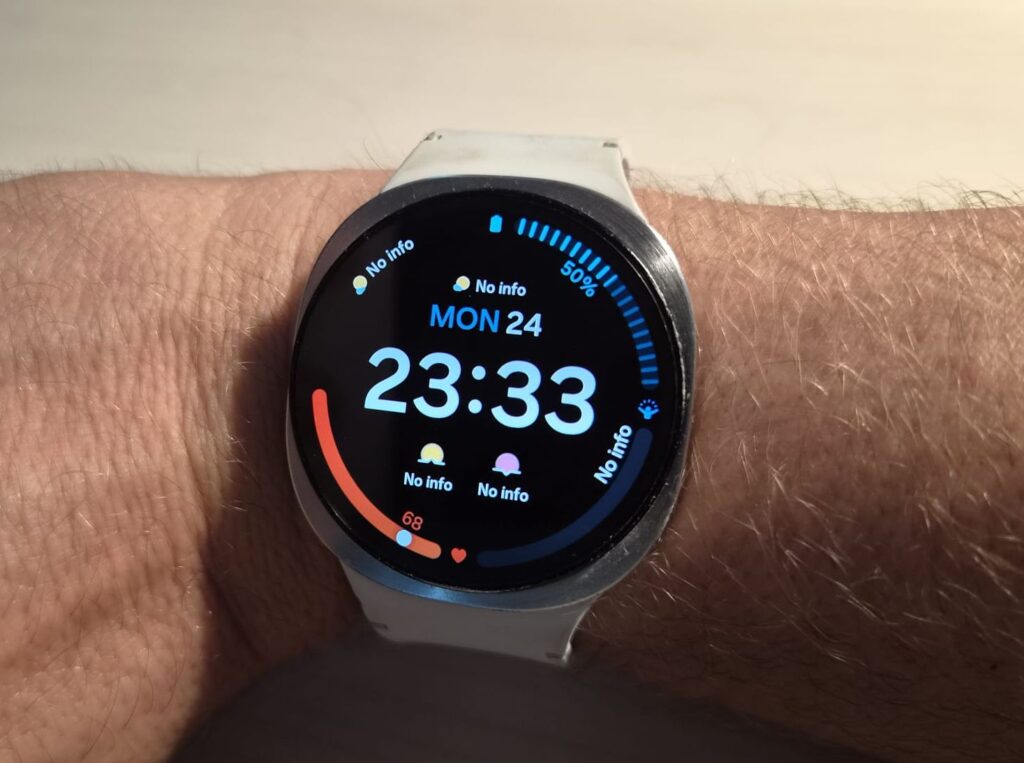
There is a moment at almost every major technology launch when the room is full of people looking at the same thing, but seeing something completely different. Executives see a product they have spent years developing, marketing also see the next big selling point and journalists see a story. Yet reviewers, if they are doing their job properly, should see something else as well: the things that might have been overlooked. Sometimes that difference is a bug, an awkward interface or something as simple as a smartwatch that does not quite make sense for the hand you use most. This isn’t a story about left handed smartwatch.
I am left handed, and that is where my story begins.
A small problem hiding in plain sight
When I wear a sports watch or smartwatch, I generally prefer to wear it on my right wrist because I am left handed. That sounds like an insignificant detail until you actually use a watch this way. With Samsung watches at the time, the physical buttons were positioned for the conventional configuration, which meant that when I wore the watch on my right wrist, the buttons ended up facing toward my elbow rather than sitting naturally toward my hand.
It was not a catastrophic problem, or make the watch unusable, but it is simply one of those small annoyances that you eventually stop thinking about because you assume that is just the way the product works. So I did what most people do, adapted myself to the product and wore the watch on my left wrist.
Then, few years ago, I walked into Samsung’s launch event for the Galaxy Watch and the company’s latest foldable phones, and something caught my eye. One of the Galaxy Watches on display was attached to a magnetic wireless charger upside down. Except it was not actually upside down, because the screen had rotated.
That immediately made me wonder whether Samsung had finally created a version of the watch designed properly for left handed users. I asked the public relations representative standing nearby whether Samsung was launching a left handed version of the Galaxy Watch and his answer was no.
Someone had simply placed the watch upside down on the magnetic charger, and because the watch could respond to its orientation while charging, the display had rotated accordingly. That was when I realized that Samsung already had part of the solution.
The technology was already there
The interesting part was not that a screen could rotate, but what that implied. If the watch already understood its physical orientation well enough to rotate the display in one context, then the basic idea of a left handed configuration did not appear to require an entirely new piece of hardware.
What seemed to be missing was the ability to turn that concept into a deliberate, persistent user setting. Let the user choose the wrist, choose where the buttons should be, rotate the interface accordingly and then swap the upper and lower sections of the band so the clasp and strap sit in the right orientation.
It was not a futuristic idea, just a user experience problem that seemed to have a relatively straightforward software solution. So I went looking for a Samsung R&D representative and explained what I had noticed.
My message was essentially this: you already have most of the technology needed to solve this problem, so why not give users the ability to lock that behavior into the configuration they actually want?
I made one more argument: if Samsung did this properly, it would have something that many Galaxy smartwatch users would appreciate but that was not being emphasized as a mainstream feature.
The representative listened, absorbed my feedback and the launch event continued. I that time I did not know whether anything would happen, but a few years later, I encountered the same Samsung representative again in another launch, so naturally, I asked him.
“Did anything ever happen with that left handed watch idea?”
He remembered it too and answered that he had passed the feedback along and that it was being handled. That moment was interesting to me because this is the part of technology journalism that readers rarely get to see.
A reviewer can write thousands of words about a product, but sometimes the most useful feedback is a conversation that never appears in the review at all. When I later saw Samsung’s documentation for Galaxy Watches running Wear OS, something stood out.
Samsung explicitly documents an Orientation setting that allows users to choose whether they wear the watch on the left or right wrist and independently choose which side the buttons occupy. Samsung also specifically says that the feature can be useful for left handed users and recommends swapping the upper and lower strap positions when changing button orientation. That is remarkably close to the solution I had described at that launch event.
But there is an important caveat, and it is one worth making clear. I cannot prove that my conversation caused Samsung to implement the feature. So this is not a story about one journalist single handedly changing Samsung’s global product roadmap, but something more interesting.
It is a story about what can happen when a reviewer notices a problem, understands the technology well enough to suggest a practical solution, and makes the effort to tell the people building the product.
Left handed is not exactly a tiny audience
There is another reason this seemingly small issue deserves more attention: left handed people are a minority, but they are not a microscopic one. A major 2020 meta analysis of handedness, drawing on more than two million people, estimated that approximately 10.6% of the population is left handed. Depending on how handedness is defined, the estimates ranged from 9.3% to 18.1%.
That means roughly one person in ten, and for a technology company operating at Samsung’s scale, one in ten is not a niche that can simply be dismissed. It represents millions of potential customers, and that is where product design becomes particularly interesting.
A feature does not have to be important to 90% of users to be valuable. If a relatively inexpensive software decision makes a product substantially better for 10% of the people using it, that can be an enormous improvement in the overall user experience. It can also be an important competitive advantage.
The watch on your wrist is a very different kind of interface
A smartwatch is not a phone, you do not hold it in your hand, but wear it. That distinction matters, since a phone can be rotated, repositioned and held however you want. A watch is physically attached to one side of your body for hours at a time, often during exercise, sleep, work and everything in between.
That makes physical orientation part of the interface. Research into smartwatch usability has already identified issues involving information display, controls, learnability, interaction and user preference. One qualitative smartwatch study combined surveys, interviews, diary studies and task performance experiments to identify usability problems and understand what users wanted from their devices.
Other smartwatch research has also examined interactions that depend on wrist orientation and movement, reinforcing a simple point: the physical relationship between a watch and the wrist it sits on is part of the user experience, not just a matter of hardware placement.
In other words, the problem I experienced was personal, but the underlying design question is much bigger.
How A Technology Reviewer Can Provide Real Value
It is easy to reduce the relationship between technology reviewers and manufacturers to a simple exchange: companies provide access to products, and reviewers provide coverage and attention. That is certainly part of the ecosystem, but it should not be the entire relationship. A serious technology reviewer is also an unusual kind of product tester because they bring their own life into the testing process.
There is a difference between complaining and contributing. It is easy to say, “Samsung should fix this.” It is much harder to say, “Here is the problem, here is why it affects real users, and here is how I think you could solve it“.
That kind of feedback is much more useful, since it gives engineers something to consider, product managers a concrete use case and the manufacturer an opportunity to hear from someone who is actually living with the product rather than simply reading a specification sheet.
That was exactly what I was trying to do at the Galaxy Watch launch event. I was not asking Samsung to invent an entirely new watch. I was looking at capabilities that already existed and asking whether they could be combined into a better experience. That distinction matters, since the feature is small, but the principle is not.
Today, Samsung’s official support documentation says that Galaxy Watches running Wear OS can be configured for either wrist and that users can independently select the button position. Samsung specifically calls out left handed users and explains that changing the orientation flips the screen so the buttons are easier to use.
Samsung also notes that users who change button orientation may want to swap the upper and lower strap positions, which is exactly the physical adjustment needed to make the band work naturally with the new configuration.
For most people, this will probably never be a headline feature, and that is perfectly fine. The best accessibility and personalization features often have something in common: the people who need them care enormously about them, while everyone else barely notices that they exist.
I do not want to take credit for something I cannot prove
There is a temptation in telling this story to say, I told Samsung to do this, and Samsung eventually did it.
That would make for a better headline, but would also be intellectually dishonest. My available evidence does not allow me to establish that my conversation was the reason Samsung introduced or expanded the feature. Samsung may already have been aware of the issue and working on a solution independently.
What I can say is that I identified the problem from the perspective of a left handed user, recognized that Samsung already had technical pieces of the solution, and took that observation directly to someone involved in development.
Years later, Samsung’s official documentation describes essentially the experience I was asking for.
Maybe my conversation helped. Maybe it reinforced an idea Samsung was already working on. Or maybe it had nothing to do with the final implementation at all. I simply do not know.
And that uncertainty is actually part of what makes the story worth telling, because reviewers should not be afraid to speak up. The larger lesson is not about me and not even really about Samsung. It is about the relationship between the people who build technology and those who spend their time using, testing and explaining it to everyone else.
A reviewer should absolutely be critical, point out weaknesses and challenge marketing claims. But there is another responsibility that is sometimes forgotten. When you see a problem and a plausible solution, say something. Do not assume that someone else has already noticed it or that engineers cannot be approached.
Good feedback has value even when you never get to see what happens to it after you send it into a company. Maybe nothing happens, but maybe it becomes a ticket, a discussion, or gets rejected.
Or maybe, years later, you put the watch on your wrist, open a setting, choose the wrist you actually use, move the buttons where they make sense, adjust the band, and realize that the product now fits you instead of asking you to fit it.
That is the part of technology reviewing I find most rewarding.
Not being the first to review a product, or the one getting the most views. But occasionally, a reviewer gets the chance to look at a piece of technology and say: this could be better.
And then having the courage to tell the people who built it, why.