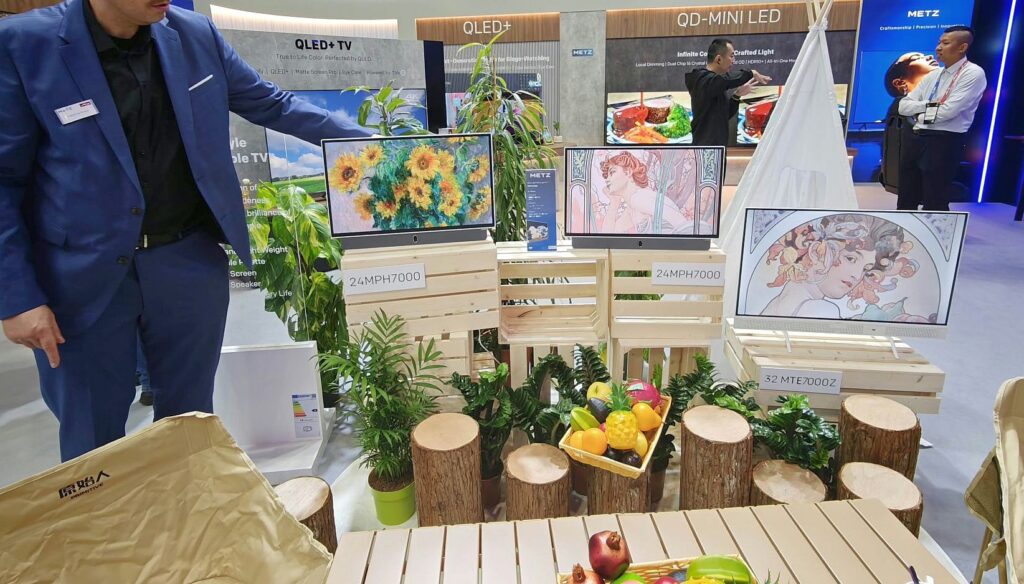
Metz TVs carry a story that is far more complicated than the name on the front of the screen suggests. For anyone who grew up in Germany, or anywhere in the German speaking European market, Metz was never simply another television manufacturer. It was one of those names that represented German engineering, reliability and a particular kind of domestic technology that seemed built to last for decades. I grew up with products from Metz myself, which is precisely why walking into the Metz booth at IFA 2026 in Berlin and speaking directly with a Metz representative felt like opening a chapter of consumer electronics history that many people outside Germany do not even realize has already been rewritten.

What makes the Metz story so fascinating is that the company did not simply disappear, nor remain what it once was either. It went through insolvency, was split apart, saw its television business acquired by Chinese electronics giant Skyworth, retained German engineering and manufacturing capabilities, developed new international brands, and now, more than a decade after the takeover, is once again producing televisions in Germany, this time from a new factory in Nuremberg. On September 10, 2026, Metz officially started television production at the new facility, marking the latest chapter in a story that began with Paul Metz in 1938. Metz itself describes the new Nuremberg facility as the new production home of its premium Metz Classic televisions, with the company insisting that the products remain developed and manufactured in Germany.
That is not a trivial detail.
It is the reason Metz is such an interesting case study for the future of television manufacturing.
The television industry has become brutally competitive, margins have been squeezed, display technology has become increasingly globalized, Chinese manufacturers have accumulated enormous economies of scale, and many historic European, Japanese and American brands have had to find ways of surviving without carrying the cost structure that once made their businesses possible. Omdia’s latest data shows just how intense the environment has become.
Metz is therefore not simply a story about one old German company.
It is a story about what happens when the economics of manufacturing change faster than the emotional value of a brand.
The Metz that older Germans remember
Metz was founded on November 28, 1938, by engineer Paul Metz as TAM, Transformatoren und Apparatefabrik Metz, beginning with a small team of just twelve people. Over the decades, the company developed into one of Germany’s best known consumer electronics manufacturers, eventually becoming particularly associated with televisions and photographic flash equipment. The Metz name therefore meant something beyond television. In Germany and other German speaking markets, it became associated with a broader idea of high quality domestic electronics, while its Mecablitz photographic flashes gave the company recognition well beyond the television business.
That history matters because Metz’s traditional customer is not necessarily looking for the same thing as the typical television buyer in North America.

The traditional Metz customer may have bought a Metz television twenty or thirty years ago, kept it for an unusually long time, and developed a very strong relationship with the brand. The television was treated less like a disposable piece of consumer electronics and more like a long term household appliance. That philosophy still influences Metz today, from its dealer based distribution strategy to its emphasis on repairability, long term software support, familiar interfaces and integrated television functions. Metz has repeatedly emphasized that its premium televisions are developed and manufactured in Germany, with its own software development and service capabilities remaining part of the proposition.
This is also why the company’s history cannot be understood simply by looking at who owns it.
Metz is now a wholly owned subsidiary of Skyworth, but that does not automatically mean that a Metz television is simply a Skyworth television with a different logo.
The distinction is critical.
The crisis that changed Metz forever
The old Metz business model eventually ran into the same problem that affected so many traditional European electronics manufacturers. Metz invested heavily in production and technology, including major investments in electronics and plastics manufacturing around 2010, but the television market was becoming increasingly dominated by global players with access to enormous purchasing power, display technology and economies of scale.
Metz itself has described how globalization made access to key technologies such as displays, processors and platforms increasingly difficult, while the resulting competition contributed to a dramatic fall in television prices. At the same time, the company’s photographic flash business was being transformed by the rapid rise of digital photography and smartphones. In 2014, Metz entered insolvency proceedings.
Then came 2015
The television business was separated from the rest of the company and acquired by Skyworth. On June 1, 2015, Metz Consumer Electronics was established as the successor to the insolvent television business and became a wholly owned Skyworth subsidiary. Skyworth acquired the Metz television operation while retaining production and development in Zirndorf, and it took over 152 of the remaining 219 employees in the television division, meaning roughly 70 percent of those jobs were preserved.
That was the moment when the Metz story could easily have become a familiar story of another European brand being absorbed into a Chinese manufacturing machine.
It did not. At least, not entirely.
What I learned at IFA 2026
When I met a Metz representative at IFA 2026, one of my first questions was precisely that. Was Metz still an actual company, or was it now simply a brand belonging to Skyworth?
His answer was clear.
He works directly for Metz.
That distinction became even more interesting when we discussed manufacturing. According to the Metz representative I interviewed, Skyworth supplies components, while Metz handles assembly, manufacturing activities, software engineering and the wider service operation around the televisions. In other words, the relationship is not simply a case of Skyworth producing a completely finished television in China and Metz attaching its logo to the front.
There is a Chinese industrial backbone underneath the product, but there is still a German company, engineering capability and assembly operation on top of it.
The timing could hardly be more symbolic.
Metz has just moved its production operation from Zirndorf to Nuremberg, and on September 10, 2026, the first Metz television officially rolled off the new production line. The company says the new facility includes a 96 meter production line as well as a dedicated manufacturing area for particularly large televisions, while development, quality assurance, administration and after sales service are being moved progressively into the new Nuremberg facility. Metz says the entire relocation is expected to be completed by the end of 2026, with the workforce retained.
This is where the phrase Made in Germany becomes much more than a marketing slogan.
For Metz, it is part of the survival strategy.
The company knows that it cannot compete with TCL, Hisense or Skyworth on manufacturing volume alone. It cannot purchase panels and components on the same scale as the largest Chinese manufacturers, and it cannot realistically build the same enormous international supply chain from scratch.
But it can sell something else.
It can sell the idea that a Metz television is still a German product, assembled and developed in Germany, supported by a German company, sold through specialized dealers and designed around the expectations of customers who may have owned a Metz television for ten, fifteen or even twenty years.
That is a very different competitive strategy.
The remote control that explains everything
Perhaps the most revealing moment of my conversation with the Metz representative had nothing to do with OLED, Mini LED or processors. It was the remote control.
While Samsung, LG and TCL have increasingly moved toward smaller, minimalist remotes, Metz still uses a large traditional remote control that looks almost like something from another generation of television. The representative joked that it has barely changed since 2012.
The reason is not technological laziness. It is customer psychology.
Metz customers are used to it. They know where the buttons are and do not want to spend money on a new television only to discover that they now have to learn a completely new way of operating it. The representative told me that when Metz has tried to change things, some customers effectively responded by saying, “No, no, no, go back.”

That may sound old fashioned to a technology journalist in North America, but it is actually a very sophisticated understanding of the value of continuity.
The same philosophy extends to the television operating system. Metz uses its own proprietary television platform rather than simply adopting Fire TV. The current Metz Classic platform is based on Linux and the company continues to develop its own interface and software environment. Metz has also introduced newer generations of its proprietary platform while maintaining the familiar philosophy of simple operation.
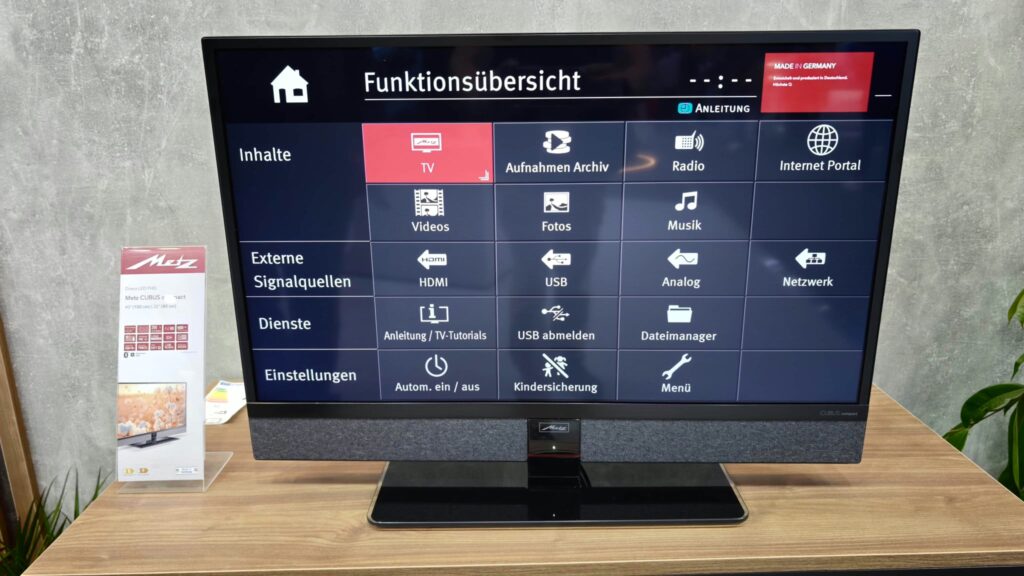
During my conversation, the representative explained that the company’s operating system has essentially maintained its familiar character since the middle of the last decade, while adding new functions and content over time. The point is that someone who owns a Metz television for ten or twelve years and buys another Metz should still feel that the new television makes sense almost immediately.
That is the opposite of the smartphone philosophy in which every generation is expected to feel different.
Metz is effectively selling technological continuity.
A television designed around television
This philosophy also explains why Metz’s televisions can appear unusual when compared with the direction of the broader smart TV market.
Metz is not trying to turn every television into a giant app store.
The company still places considerable emphasis on traditional broadcast television, including twin tuner functionality, recording, timeshift and integrated reception capabilities. Its premium televisions have included twin multi tuners and digital recorders, allowing viewers to record one or more programs while watching another, depending on the model and reception configuration. Metz continues to support USB recording and integrated recording functions as part of its television philosophy.
The representative also explained that Metz is not trying to compete with the enormous streaming ecosystems of companies such as Netflix and Amazon.
That is partly because the German and Austrian market has a very particular relationship with traditional television and local broadcasting, and partly because Metz does not have the global scale that would make it a priority platform for every major streaming service.
Instead, some services are available directly, while other streaming environments can be accessed through external devices such as Amazon Fire TV, Google TV or Apple TV. Metz has itself explained that services such as Netflix are generally accessed through an external streaming media player on its classic television platform.
The representative told me that the company supports services and applications including YouTube and selected German market services, as well as sports platforms such as DAZN and Dyn on relevant products, but that customers who want the broader global streaming ecosystem can simply connect an external device through HDMI.
The approach is almost stubbornly practical.
Metz wants to keep the television simple, even if that means allowing another device to handle the parts of the smart TV ecosystem that Metz does not want to build itself. That may be exactly what some of its customers want.
Metz and the Skyworth deal was never simply about outsourcing
The most important point about the 2015 acquisition is that Metz did not simply lose access to its identity.
The original Skyworth acquisition announcement was explicit about keeping the Zirndorf operation as a development and production location and using the existing Metz network as a European hub. One year later, Metz reported that around 160 employees were working at Zirndorf, where the company continued to produce and develop televisions, and it described the relationship with Skyworth as a source of economic stability and access to technologies that had become difficult for Metz to obtain independently.
That is an important distinction from a pure brand licensing model. Metz is not merely renting out its name. It is operating inside a larger Chinese industrial ecosystem.
The company itself describes its German operation as a European research and development center for its Skyworth parent company and as a base from which the European television business is managed across different brands and business models.
The employees who remained after the acquisition were therefore not simply watching their company disappear. According to the representative I interviewed, there had been understandable fears that Skyworth would arrive, fire everyone, take the name, move the software development elsewhere and simply use Metz as a label. Instead, the company found that Skyworth was interested in how Metz worked, how its engineers approached televisions and how the German company understood its customers.
That is probably one of the most important reasons Metz remains recognizable today. From the consumer’s perspective, Metz TV is a German product, a story supported also by marketing.

The Metz representative and I also discussed how far Skyworth’s manufacturing reach has expanded. He mentioned that Skyworth has manufactured televisions for other international brands and that its industrial footprint has extended into markets and relationships involving names such as Toshiba and Philips. The broader industry evidence certainly supports the idea that the same manufacturing ecosystems now sit behind multiple brands, although the precise relationship varies by product, market and time.
Skyworth was founded in Shenzhen in 1988 and has grown into a global electronics group with television and display businesses at its core. Its own corporate material describes a company that operates across smart televisions, smart appliances, display systems and other technology businesses, with an international manufacturing and distribution footprint.
The important thing is not that Skyworth makes every television with a famous logo, as it does not, but manufacturing scale has become a strategic asset in itself. A company such as Skyworth can spread component purchasing, software platforms, engineering resources, factory investment and supply chain management across enormous volumes and multiple brands. That creates an economic advantage that a relatively small European manufacturer simply cannot reproduce.
The 40 inch television says more than the 100 inch television
At the end of my conversation with Metz, I noticed the company’s 40 inch models. In a North American market increasingly obsessed with 75, 85, 98 and even 100 inch screens, a 40 inch television can look almost quaint.
But it makes perfect sense for Metz.
The company is still thinking about bedrooms, kitchens, smaller apartments and older customers who may not want a gigantic cinema screen dominating the room. The representative explained that Metz Classic is particularly strong with older generations, while younger consumers who buy televisions are generally more interested in Google TV, streaming applications and broader smart TV ecosystems.
Again, this is not necessarily a weakness, but a segmentation. A 40 inch television, a large physical remote and a simple operating system may look like evidence that a company is behind the times. At Metz, they are evidence that the company knows exactly who it is selling to.
Metz chose the most German version of the Chinese solution
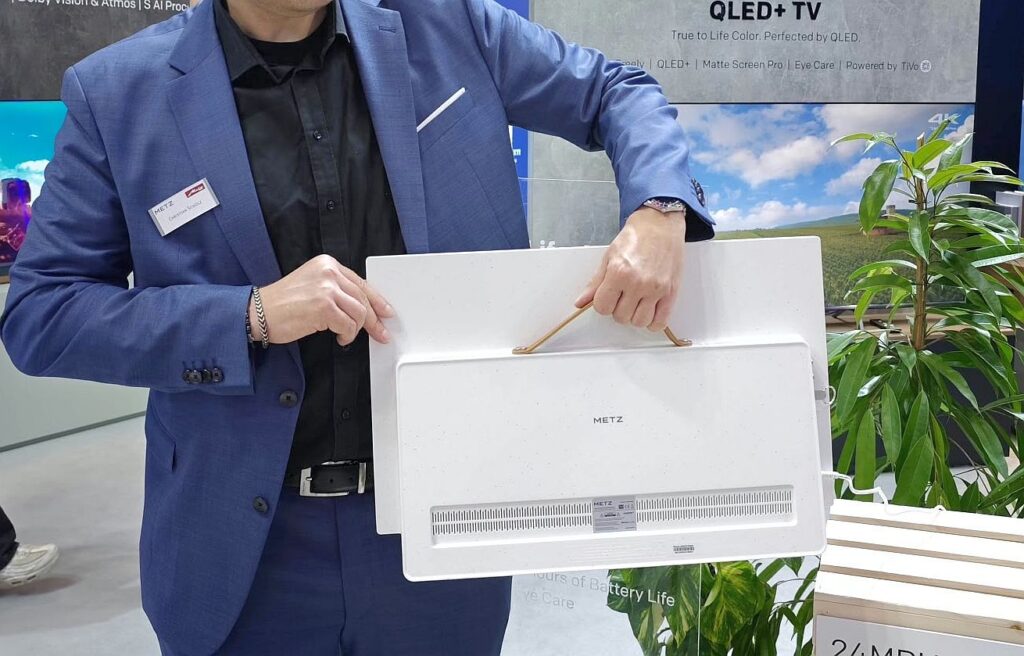
This is ultimately what makes Metz so unusual. The company accepted the Chinese industrial reality without completely abandoning the German identity. It could have moved everything to China, yet instead, Metz continued developing and producing its premium Metz Classic televisions in Germany, while building METZ blue as a more international and more price competitive brand.
The company therefore did not simply survive the Skyworth acquisition. It used the acquisition to create multiple versions of itself.
Loewe shows why the strategy matters
At IFA, I also discussed Loewe with the Metz representative, because Loewe is arguably the most obvious competitor to Metz in the German premium television space. The representative told me that Metz’s biggest competitor in its traditional market is Loewe, another historic German television name with a strong reputation among specialist dealers and older customers.
We discussed the Loewe Stellar, which is one of the company’s flagship products, and the increasingly complicated software choices behind modern Loewe televisions. Loewe has itself moved into a world where different operating systems and manufacturing relationships can coexist, reflecting the same broader transformation that is reshaping the entire category.
The comparison is useful because both brands understand that the value of a German television is no longer simply the cost of manufacturing it. It is the experience surrounding it: the remote, dealer, service and overall familiarity.
The future may belong to companies that know what to keep
This is why I think the Metz story is ultimately more important than the question of whether Metz is German or Chinese. The answer is both, and neither description is sufficient on its own. Metz is German in its history, engineering culture, customer relationships, product philosophy and local manufacturing.
Metz is Chinese in its ownership and in its access to the industrial scale, components and technologies of Skyworth. The television itself is therefore the physical expression of a hybrid business model. The panels and components can come through an enormous global supply chain, while the technology can benefit from Skyworth’s scale.
The software can still be developed by Metz and the television can still be assembled in Germany. As a result, the brand can still be marketed as Metz, the customer can still feel that it is buying a German television, and Skyworth can still benefit from the expertise and brand equity that Metz accumulated over generations.
That is not a contradiction, but the modern television industry.
Conclusion
Walking away from the Metz booth at IFA 2026, I was left with the feeling that the real story was not that a German television company had been bought by a Chinese giant. That happened more than a decade ago. The real story is that Metz found a way to remain recognizably Metz after the acquisition.
The television industry has therefore reached a strange new stage in its history. The logo on the front of the television is no longer enough to tell you who made it. The country where the company was founded is no longer enough to tell you where its technology comes from. Even the country where the television is assembled or company that owns the brand is no longer enough.
That sounds confusing, but there is an economic logic underneath it. Television manufacturing became too competitive, global and low margin for many historic companies to keep doing everything themselves.
The Japanese companies learned that lesson when Samsung and LG rose.
Now Samsung and LG are facing companies such as TCL and Hisense that have learned the same lesson at an even greater industrial scale. Samsung has managed to remain on top for twenty consecutive years, and LG remains a dominant force in OLED, so neither Korean giant should be written off. But the structure of the industry around them is changing rapidly, and the Sony TCL transaction, the Panasonic Skyworth partnership and the LG Hisense speculation all show how difficult it has become for a traditional television company to remain vertically integrated while competing globally.
This is why Metz matters.
Metz is a glimpse into the future through the lens of the past. It is a company that was born in the age when German manufacturing itself was the competitive advantage, survived the age of Japanese television dominance, survived the rise of Korean manufacturers, the collapse of the traditional European television business, and emerged on the other side of that transformation under the ownership of a Chinese electronics giant.
Yet in 2026, its televisions are once again rolling off a German production line. That is not a return to the past, but something much more interesting.
It is an entirely new model of what being a German television company can mean.