
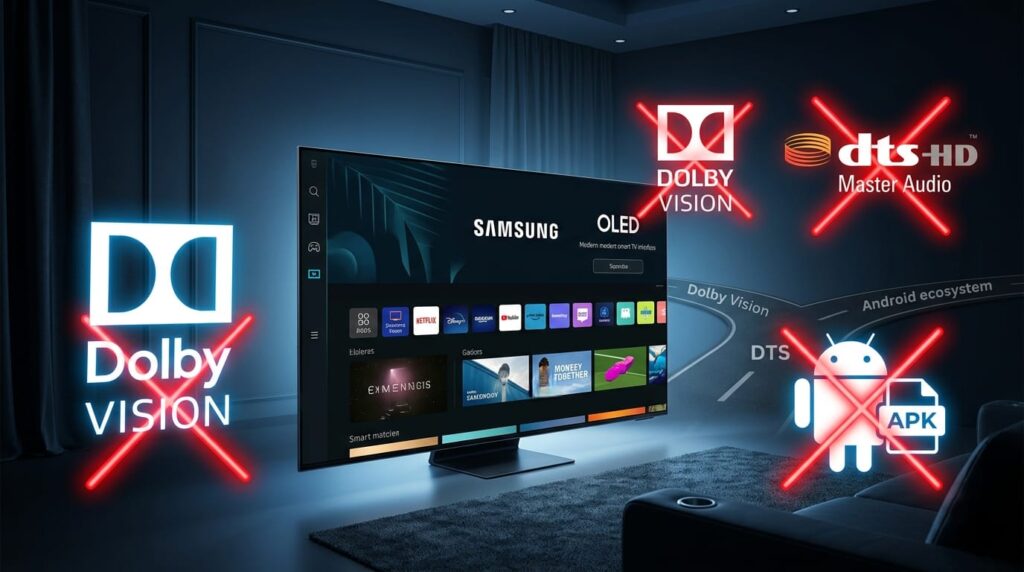
Samsung Strategy: Why Does the World’s Biggest TV Brand Keep Ignoring What Customers Want?
If you’ve reviewed TVs long enough, certain conversations start to feel like déjà vu. Every January, new TVs arrive, and every spring, review units begin landing in media rooms. In the summer, comparisons flood YouTube, Reddit, forums, and enthusiast communities, and every year, without fail, someone asks the same question about samsung strategy:
Why doesn’t Samsung support Dolby Vision?
It’s a fair question, not because Samsung makes bad TVs. Quite the opposite, for many years, Samsung produces some of the most impressive displays on the market. Its flagship Mini-LED and OLED models routinely compete with the best offerings from competitors. Yet despite all that engineering excellence, it continues making decisions that leave even loyal customers scratching their heads.
The strange part isn’t that people complain, but that Samsung hears the complaints and keeps doing it anyway. And once you start paying attention, you realize Dolby Vision is only the beginning.
The deeper story is about something much larger: a Samsung Strategy that has existed for years. It’s a philosophy that often prioritizes control, independence, and ecosystem ownership over following industry trends or even customer expectations.
The question isn’t whether Samsung knows what consumers want, but why Samsung sometimes chooses not to give it to them.

The Dolby Vision Question That Never Goes Away
Imagine spending $4,000 on a flagship television. You bring it home, connect it to your streaming devices, subscribe to premium streaming services, fire up a movie mastered in Dolby Vision, to discover your Samsung TV doesn’t support Dolby Vision at all.
And it’s not because it’s incapable, or because you saved on an entry-level model. It’s simply because Samsung strategy is not to include it. For years, reviewers have criticized Samsung’s refusal to adopt Dolby Vision while competitors such as LG, TCL, and others support both HDR10 and Dolby Vision simultaneously. Samsung’s answer has remained remarkably consistent.
The company backs HDR10+ instead, a competing HDR format that also uses dynamic metadata. Samsung helped create and promote HDR10+ as an alternative to Dolby’s licensing model. Rather than paying Dolby licensing fees and adopting a technology developed by another company, Samsung strategy was to invest heavily in promoting its own ecosystem.
From a business perspective, this makes sense, but consumer wise, it can feel frustrating. Because consumers rarely care about format wars, they care about compatibility! Nobody buys a premium television hoping it supports fewer formats than the competition.
And yet Samsung strategy has spent years betting that image quality, panel technology, brightness, and overall performance matter more than a Dolby Vision logo on a specification sheet. So far, that bet has largely worked, and Samsung remains one of the world’s largest TV manufacturers.
But the lingering question remains:
why fight a battle your customers clearly wish would end?
Then Came DTS
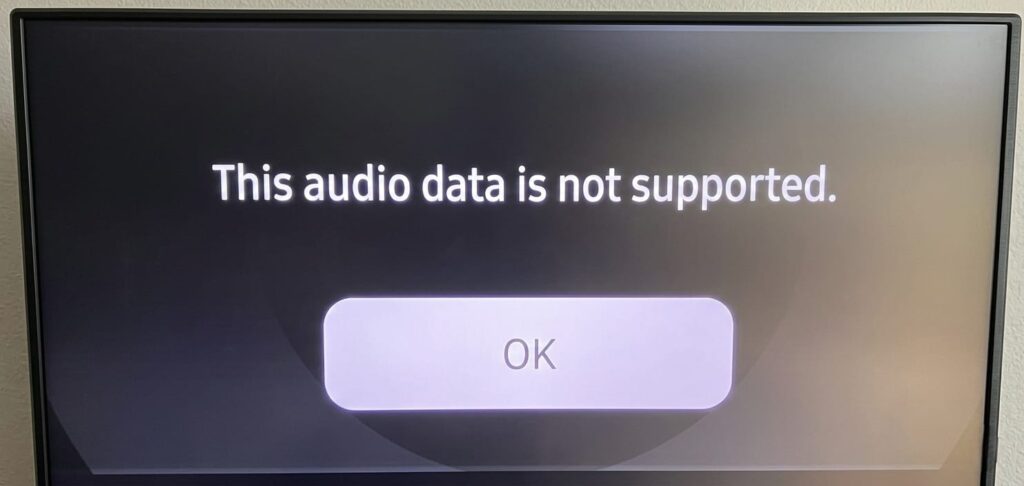
If Dolby Vision frustrates enthusiasts, the DTS situation often confuses them, since many home theater fans discover this issue only after buying a Samsung television. Everything seems fine until they try playing a movie file with a DTS soundtrack, and suddenly there is no sound, or no playback at all!
The reason is simple: Samsung removed DTS support from its TVs years ago, and this limitation continues today. Samsung’s own support documentation states that DTS support is unavailable on newer TV models, while current TV specifications continue listing DTS audio as unsupported. This includes formats that home theater enthusiasts have relied on for years, including DTS-HD Master Audio and other DTS variants.
Again, Samsung’s reasoning isn’t irrational. Dolby formats dominate streaming services as Netflix, Disney+, Max, Apple TV+, and most mainstream streaming platforms rely heavily on Dolby technologies. If Samsung analyzes viewing habits across millions of customers, the company may conclude that only a relatively small percentage of users ever encounter DTS content.
But for those users, the experience can be infuriating, especially when they’ve purchased Samsung’s most expensive televisions. There’s something uniquely frustrating about discovering that a premium product is deliberately less compatible than competing products.
It’s not a hardware limitation, but a strategic decision on it’s customers back. And that’s what makes it so fascinating.
The Remote Control That Started an Argument
Then there’s Tizen. Years ago, Samsung’s smart TV platform felt genuinely innovative, with a fast interface was fast, competitive app ecosystem, and a cleaner experience felt than many rivals.
But the smart TV world changed, Google transformed Android TV into Google TV, content recommendations improved and App availability exploded. Voice integration became more sophisticated developers increasingly focused on Google’s ecosystem, and the TV interfaces of WebOS and TIzen began looking more like Google TV.
Yet while competitors adopted greater openness to Google TV, Samsung doubled down on control. A perfect example is app installation. With Google TV, users have far greater flexibility and broader options. Advanced users can also sideload applications via APK download.
But Samsung’s Tizen platform remains far more restricted, with Samsung controlling the experience, storefront, and distribution pipeline.
AI Digital
For some users, that’s beneficial, but enthusiasts can feel it’s limititation. The most common complaint I hear isn’t about image quality. It’s about usability. The five clicks required to switch between HDMI inputs is far more that the WebOS or Google TV interfaces.
Then there’s also the sense that recommendations and promotions sometimes receive more attention than basic navigation. You can build one of the best televisions on Earth, but if a user needs multiple button presses just to switch HDMI sources, they’re going to notice it every single day.
The Watch Story Reveals Everything
For years, Samsung also pushed Tizen in smartwatches, but then something remarkable happened. Samsung changed its mind, since with the Galaxy Watch4 generation, Samsung abandoned Tizen and moved to Wear OS, Google’s smartwatch platform. New Galaxy Watches use Wear OS Powered by Samsung and distribute apps through Google Play.
That decision transformed the smartwatch experience, since app support improved and developer interest increased. This allowed consumers to gain access to a larger ecosystem. In many ways, it was exactly the kind of move TV enthusiasts had been asking Samsung to make elsewhere.
This raises an obvious question:
If Samsung was willing to embrace Google’s ecosystem in wearables, why maintain such a tightly controlled strategy on televisions?
The answer likely comes down to power: Samsung sells enormous numbers of TVs, far more than smartwatches. The TV business gives Samsung enough leverage to shape standards instead of merely adopting them. That leverage is transformed to promote HDR10+, maintain Tizen and decide which codecs matter.
The watch business offered less room for independence, but the television business still does.
The Hidden Logic Behind the Samsung Strategy
After years of reviewing Samsung products, I’ve come to believe many enthusiasts misunderstand what’s happening. They assume that Samsung is ignoring customers, but I don’t think that’s entirely true.
I think Samsung is prioritizing a different customer than the one posting on Reddit. The enthusiast community is vocal, passionate and knowledgeable, but it’s also relatively small.
Samsung’s real audience is the family walking into a warehouse club, seeing a stunning display wall, and choosing the TV with the brightest image. That customer may never know what DTS is, won’t notice Dolby Vision is missing, and doesn’t care about sideloading an app.
Samsung understands that audience extremely well, and that’s where the it’s Strategy starts making sense. The company isn’t optimizing for enthusiasts, but for scale, ecosystem ownership, licensing independence and long-term platform control.
A Brilliant Company With One Persistent Weakness
The irony is that Samsung’s strengths make these decisions feel even more frustrating, because if Samsung built mediocre televisions, nobody would care. But it builds extraordinary televisions, the brightest, most innovative and desirable displays in the world.
Which is exactly why these omissions stand out. Every year, reviewers praise the hardware and question the software decisions. Every year, consumers ask for Dolby Vision and home theater enthusiasts ask for DTS. In parallel, users ask for greater OS flexibility, but Samsung stays the course.
It can be confidence, stubbornness, or the inevitable consequence of being a market leader. Whatever the reason, one thing has become clear: the most fascinating thing about Samsung isn’t the technology it creates, but the technology it deliberately chooses not to adopt.
And that may be the clearest window into the Samsung Strategy of all.