
Foldable phone longevity is probably the last thing on your mind when you first fall in love with a folding smartphone. When you pick up a Galaxy Z Flip for the first time, you are probably thinking about how remarkably compact it becomes when it closes, how satisfying it feels to snap it shut after using it, and how strange, in the best possible way, it is to carry a full size smartphone that suddenly takes up half the space in your pocket. I know that feeling very well because I have been using Samsung’s Flip phones continuously since the Galaxy Z Flip 4, moving through the Flip 5, Flip 6 and Flip 7, and despite everything I am about to tell you, I remain a huge fan of the concept.
In fact, the Flip changed something about my everyday life that had nothing to do with cameras, processors or artificial intelligence. Before I started using a foldable, I carried my smartphone in a side holster attached to my belt, something I had become so accustomed to that I barely thought about it anymore. Then I started carrying a Flip, and suddenly did not need the holster. The phone folded in half, slipped naturally into my pocket, and that simple change completely altered the way I carried a smartphone.
That is why this is not an article written by someone who dislikes foldables, or someone who thinks the entire category is an expensive gimmick. Quite the opposite, I genuinely love these devices, and after moving through several generations I would still choose the Flip form factor over a conventional phone for many aspects of daily life. What has changed is my understanding of what happens after the novelty wears off, the phone has been opened and closed thousands of times, the original screen protector starts showing its age, the battery has gone through hundreds of charging cycles, and the inner display begins to reveal the fact that it is fundamentally different from the piece of glass on a traditional smartphone.
That is the part of the foldable experience I think consumers need to hear more about.
The Galaxy Z Flip 5 is my case study, not the whole story
The Galaxy Z Flip 5 is particularly useful for this discussion because it is the device that has given me enough distance from the launch experience to see what long term ownership actually looks like.
When I first received the Flip 5, I reviewed it as a new smartphone, and at that point there was very little to complain about. The hinge was new, inner display looked perfect, factory applied protective film was pristine, battery behaved like a new battery and the entire experience felt exactly like what Samsung wanted it to feel like, futuristic, compact, stylish and surprisingly practical.
Two years later, the same phone tells a very different story. That does not mean the Flip 5 suddenly became a bad phone, and it certainly does not mean that every Flip 5 will develop the same problems. What it means is that I now have something a launch review cannot provide, which is perspective. I have lived with the device long enough to see how the components that make the phone special also create a different kind of ownership experience.
Samsung says the Flex Hinge in the Galaxy Z Flip 5 was designed to withstand more than 200,000 folding and unfolding cycles on average, which translates to more than five years if the phone is opened and closed around 100 times a day. That is an important durability benchmark, but not the same thing as a promise that every individual hinge will feel identical for five years, because real world use includes drops, pressure, dust, temperature changes and all the other things that laboratory testing cannot perfectly reproduce.
That distinction is important because I do not want to turn my own experience into a blanket statement that Samsung’s hinge is destined to fail. It is not.
The more interesting point is that the hinge exists at all. Folding is the feature, but it is also the compromise, and this is the paradox at the heart of every foldable phone. It’s the thing that makes it so appealing but also introduces additional complexity.

A conventional (candybar) smartphone like to Galaxy S26 Ultra is essentially a rigid object. You can put a protective glass over the display, a big battery underneath it, seal the body and forget about the fact that the phone is a mechanical object because it really is not. Yet a Flip phone is different, since its has a hinge that moves every time you use it, flexible display that bends every time you close the phone, and protective layers that have to accommodate that movement without compromising the experience.
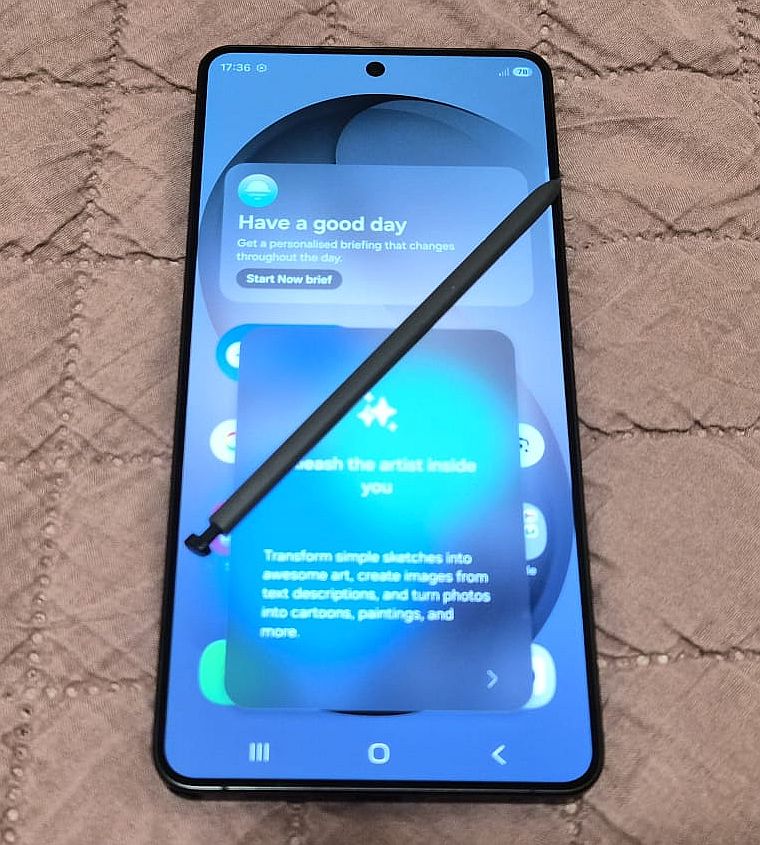
Samsung has done an impressive job refining this architecture over multiple generations, and its testing shows just how seriously it takes durability. But as an owner, you eventually become aware of the mechanism in a way you simply do not with a conventional phone.

With the Flip 5, for example, Samsung itself explains that the new Flex Hinge can make the phone feel less rigid when opened or partially folded than previous Z series models, and that slight movement or clicking can be part of the design rather than an indication of a defect. That is a useful reminder that not every unusual sensation means something is broken.

At the same time, after years of using Flip devices, I have become much more conscious of how much work that hinge is doing every single day, and that is something I would want anyone considering a foldable to understand before buying one.
The inner screen is where the difference becomes impossible to ignore
The biggest adjustment for someone coming from a conventional smartphone is actually the inner display, and not the hinge itself. The screen on a Flip is not something you can treat exactly like the glass display on a Galaxy S Ultra or an iPhone. Samsung installs a specially designed protective film on the main folding display, and Samsung’s own support documentation explains that the protector is specifically designed to withstand repeated folding and unfolding while protecting against scratches and debris. The company also has a dedicated replacement service for that protector, including a one time replacement within the first year for eligible devices in the United States.
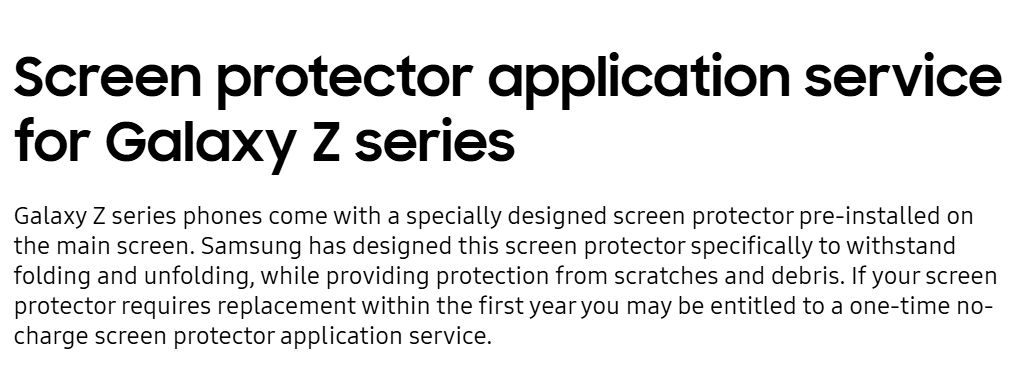
That tells you something important, because the protective layer is part of the experience and not an optional accessory in the same sense as a conventional tempered glass protector. On my Flip 5, that became very apparent after roughly a year of use, when the original protective layer began to deteriorate. Once that happens, replacing it is not quite the same experience as buying a glass protector for a conventional smartphone and applying it yourself at home. The material is different, the installation is more demanding, and when the replacement is not applied perfectly you can end up looking at bubbles or imperfections every time you open the phone. Once you have seen a factory applied protector looking perfect, it is difficult not to notice the difference.
Other owners have reported similar experiences, although the timing varies enormously. In recent discussions, some Flip users describe protectors that lasted years, while others say they began bubbling or lifting after roughly a year or so. My current Flip 7 protector began bubbling across the middle of the display after about a year, which let me to peal it off, while other owners reported significantly better experiences.
That inconsistency is actually one of the most important things to understand about foldable ownership. There is no single timeline, only a range of experiences, and then there is what happened to my Flip 5 screen.
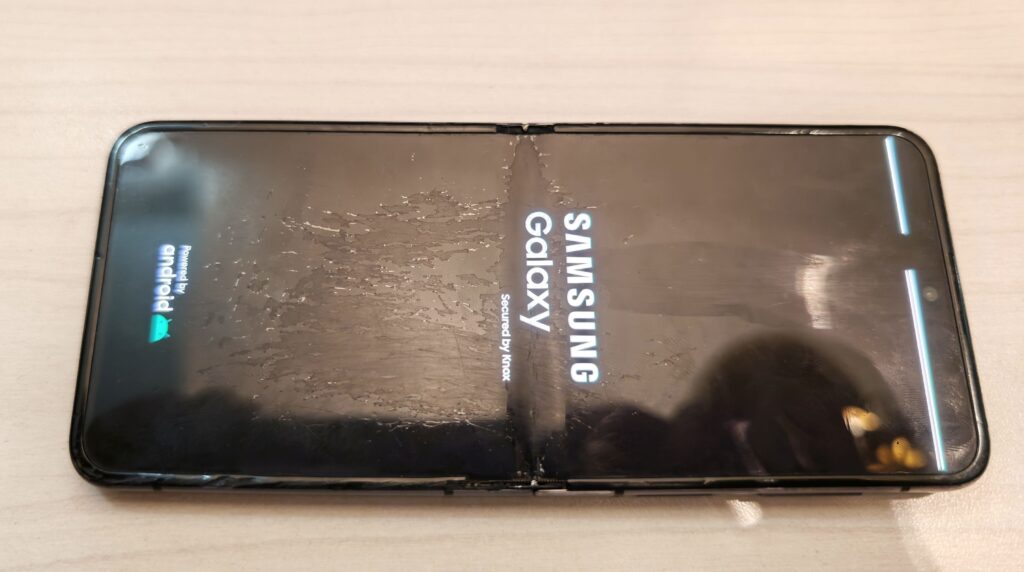
This is where I want the photograph that accompany this article to do some of the talking, because the condition of my screen is much easier to understand when you can actually see it.
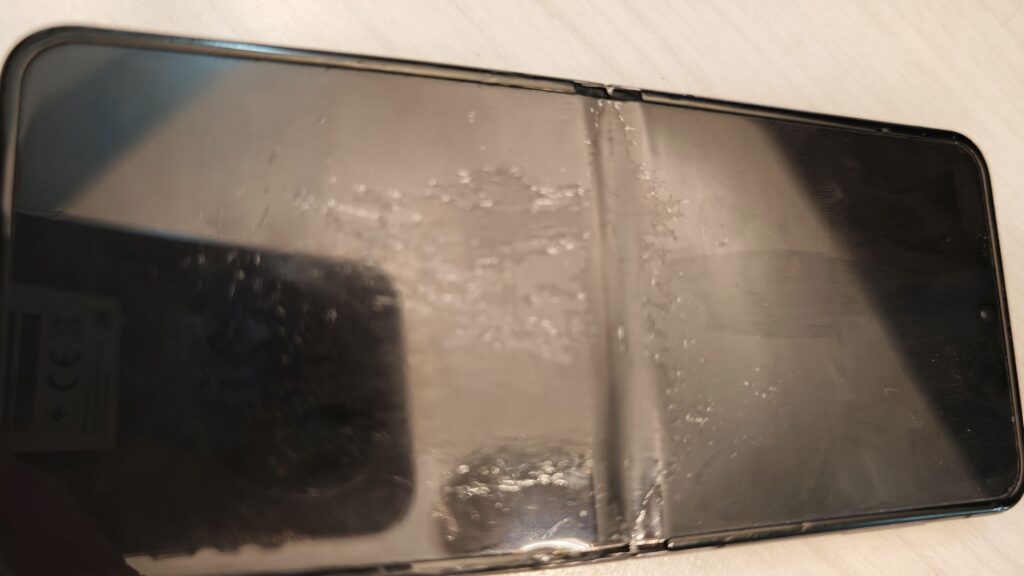
After prolonged use, including a period in which the inner display was being used without the protective film that originally came with the phone, my Flip 5 developed a visible horizontal white band running across the display. The line is now clearly visible, stretching across the width of the screen, and it has become one of those imperfections that you cannot unsee once you know it is there.
It is important to be precise about what I am saying here. I am not claiming that every Flip 5 develops a white line after two years, or that Samsung designed the screen to fail at a particular point. I am saying that this is what happened to my device after extended use, and that is precisely why I think long term ownership reports are valuable. A two week review cannot tell you this, nor attending a launch event. You only learn it by living with the phone over years.
A flexible internal display remains a different physical object from a rigid glass panel of a candybar smartphone, but that does not automatically make it fragile, since most of the time it remains folded. Yet if you spend enough time reading long term experiences from Flip owners, you quickly discover that there is no universal answer to the question, How long will my foldable last?
Some people have extraordinary experiences, while others experienced shorter successful usage. That contrast is fascinating because it demonstrates exactly why I do not think it is responsible to describe foldables as either durable or fragile. Both things can be true but but it mainly depends on the user.
Battery life is the other part of the two year equation
Battery degradation is obviously not unique to foldables, because every rechargeable smartphone battery loses capacity over time, but the experience becomes particularly noticeable when a phone that was already designed around compactness begins losing some of its original capacity.
When my Flip 5 was new, I could use it throughout the day without constantly thinking about where my next charger was coming from. After roughly two years, my experience is very different, and depending on what I am doing, I can find myself needing to recharge after only a few hours of active use, sometimes around three or four hours.
Again, that is my experience, and not a universal benchmark for every two year old Flip 5. In a 2026 discussion about long term Flip 7 use, prospective owners were specifically asking about battery degradation, hinge wear and screen protector longevity, which shows that these remain central concerns for people considering keeping a foldable for several years.
The important thing is that battery aging becomes more significant when you combine it with the other maintenance considerations of a foldable.
Repairing a foldable is not quite like repairing a regular phone
This is one area where I think buyers should be realistic from the beginning. If the battery in a conventional smartphone eventually needs replacement, you already want a qualified technician to handle it. With a foldable, I would be even more conservative, because the device contains a hinge, flexible display components and a more complicated internal architecture, which means an inexperienced repair can create problems that would never exist on a simpler phone.
Samsung’s own repair pricing illustrates that the display assembly is a significant component of the overall repair equation. In Samsung US current published pricing, for example, the main display replacement for the Galaxy Z Flip 5 and 6 are listed at 429 USD, or 250 USD within the first two years of purchase. Prices obviously vary by market, but the broader point is clear, repairing the main folding display is not comparable to replacing an inexpensive screen protector.
For that reason, if a foldable needs internal repair, I would strongly prefer Samsung or a repair facility that genuinely specializes in Galaxy Z devices rather than treating the phone like an ordinary slab smartphone.
The more complicated the architecture becomes, the more important the person working on it becomes.
This is where the age of the buyer matters
This is the part of the conversation I think deserves more attention as Samsung brings foldables to a broader audience. The latest Galaxy Z generation is no longer being presented simply as a niche experiment for technology enthusiasts. Samsung says the 2026 lineup is designed to expand foldables to a wider audience, with the Fold8 Ultra focused on productivity, the Fold 8 on immersive content and the Flip8 on self expression and quick interaction. Samsung’s U.S. marketing for the Flip8 specifically emphasizes personality, pocketability, social media creation, selfies and everyday expression, and that is a significant evolution in the category.

The new Fold 8 is now increasingly presented as a lifestyle device, something compact, expressive and highly personal. While that makes perfect sense from a marketing perspective, it also means that younger consumers who are attracted to the design, social media features and sheer novelty of a folding phone may be less likely to think about what the device will look like three or four years down the road.
If you are the kind of person who upgrades every two years, perhaps that does not matter much, but if you are buying the phone with the expectation of keeping it for five years, it matters enormously.
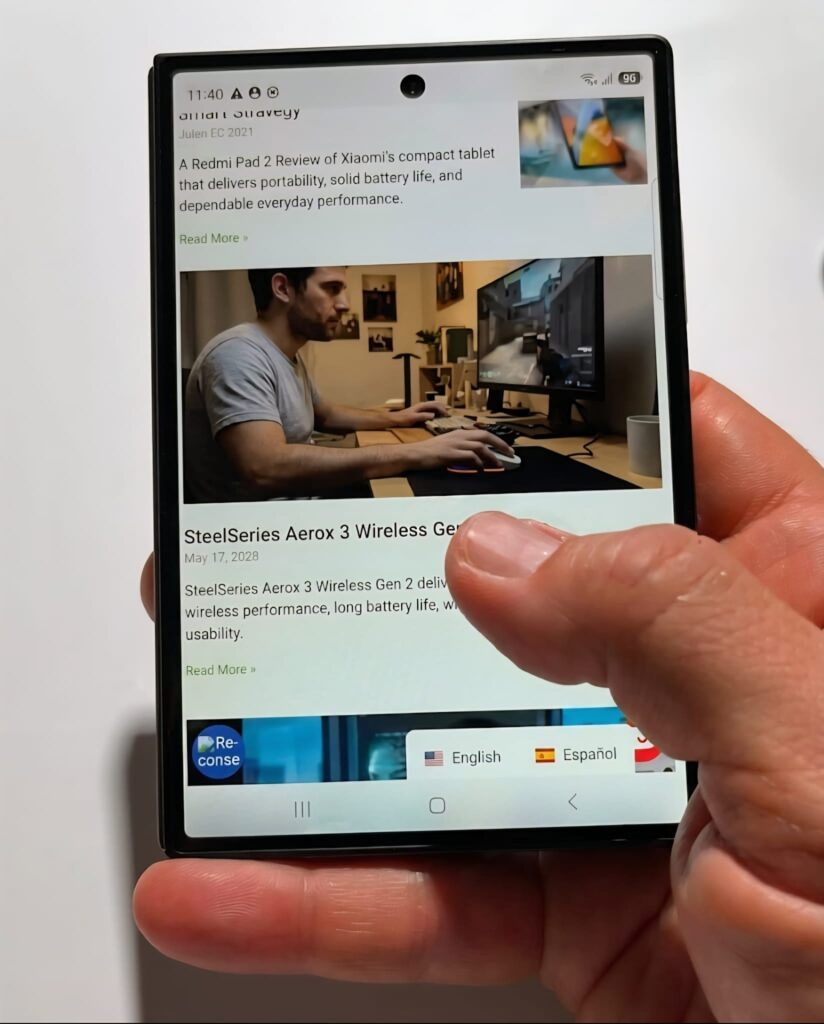
A New Targeted Audience for the Foldabels
The new Galaxy Z Fold 8 is marketed as an optimal pocketable foldable, with a focus on social media ready photography, hands free selfies and customization. Those are all genuinely appealing features, especially for a younger audience that treats the phone as much as a form of personal expression as it does a piece of technology.
But the same audience deserves to know that the phone still folds, and that one sentence explains almost everything. Since it folds, it is also so much fun, but such ownership also requires a little more awareness.
If you replace your phone every two or three years, the equation changes. In that case, the foldable can be exactly what it promises to be, a compact, stylish and genuinely different smartphone that gives you a large display when you need it and a tiny footprint when you do not.
The problem is that not everyone replaces an expensive phone that freaquent. There are plenty of young adults who keep their devices for four, five or even six years, and for those buyers I think the conversation has to be different.
The question is not simply, “Can a foldable last?”but rather “What kind of maintenance and risk am I comfortable accepting in order to enjoy the advantages of a foldable?”
After four generations, I still choose the Flip
Perhaps the most important thing I can say about all of this is that none of these concerns have made me stop loving foldables. I have gone from the Flip 4 to the Flip 5, then the Flip 6 and the Flip 7, and if anything, moving through those generations has made me appreciate the form factor more because I now understand what it adds to my everyday life.
I still love being able to put a full size smartphone into my pocket in a much smaller folded form, closing it when I am finished, and not requiring the belt holster I once considered an essential part of carrying a phone. Because there is something wonderfully satisfying about a device that feels like a normal smartphone when you need it and transforms into something dramatically smaller when you do not.
The fact that I am willing to talk openly about the weaknesses does not make me less enthusiastic about foldables. If anything, it makes my enthusiasm more credible.
This article isn’t telling people to stay away from the technology, but to understand it.
The real foldable phone longevity test starts after the honeymoon
That is ultimately what my Galaxy Z Flip 5 experience has taught me. The first few months convince you about the idea of a foldable, after a year you find that it fits your lifestyle, but the second and third years start telling you what the technology is really like to live with.
When battery degradation becomes more noticeable, the protective layer may need attention, the hinge has accumulated thousands of cycles, and the inner display may begin showing signs of the years it has spent bending every day.
My Flip 5 now has a visible white line across the inner display, and that is something I want readers to see in the accompanying photo rather than simply take my word for. It is not a reason to declare foldables a failure, yet simply to understand the tradeoff.
My verdict after years of living with Samsung foldables
If you ask me whether I regret buying the Galaxy Z Flip 5, the answer is no, and I still recommend a Flip to someone who values portability, design and the unique experience of a folding phone.
But if you ask me whether I would tell a buyer that a foldable is exactly the same ownership proposition as a conventional smartphone, the answer is absolutely not. The folding mechanism is a remarkable piece of engineering, but it is still a mechanism.
The inner display is beautifully engineered, but it is still a flexible display with a protective layer that requires more care than ordinary glass. The battery will age, just as every smartphone battery does, and when the phone eventually needs serious repair, the complexity of the device means that the choice of repair facility matters more than it would with a basic slab phone.
None of this cancels out the advantages of a folding, pocket size special feeling, and after using Samsung foldables from the Flip 4 through the Flip 7, I still believe there is something genuinely better about the form factor for the right person.
But consumers should not be sold only the dream. As Samsung expands foldables to a much wider audience and increasingly presents the Flip as a device built around self expression, portability, social media and lifestyle, younger buyers deserve to understand both sides of the equation.
If you plan to upgrade every two or three years, the long term drawbacks may never become a serious issue for you, but if you are the person who wants to buy a phone today and still be using it several years from now, you should know what you are signing up for.
Because the most important foldable review is the one that shows you what happens after the excitement has faded, the phone has been folded thousands of times, the battery has aged and the screen protector has been pealed off. Not the one that tells you how exciting the phone is on launch day.
That is where the real story of foldable phone longevity begins.