
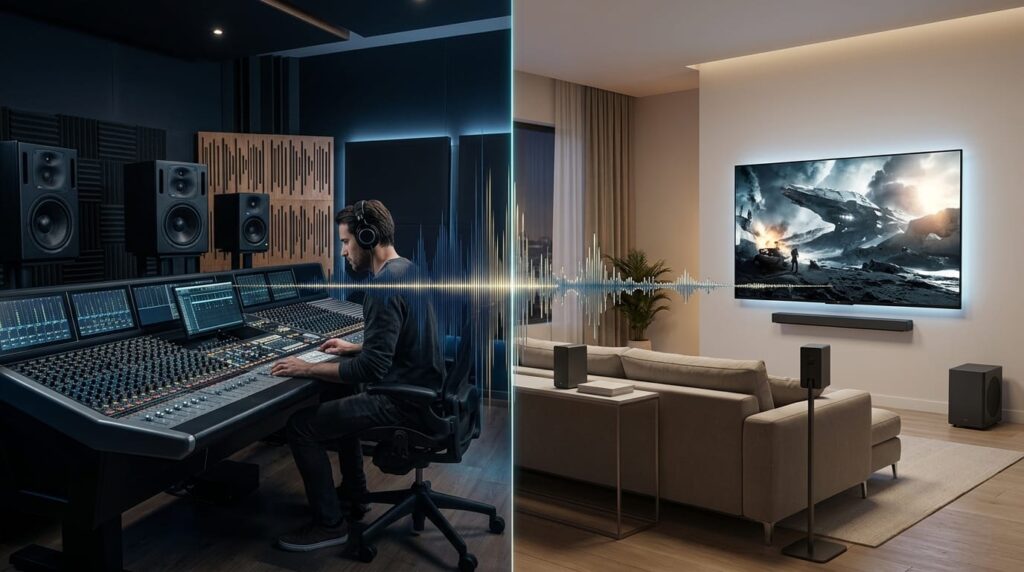
Creator Intent Audio has become one of the most powerful phrases in home theater marketing, but does it always reflect real performance?
This article is part of an ongoing series sectioned Beyond The Gear, exploring the deeper world of high-end audio and home theater. While some articles focus on maximizing performance in dedicated cinema rooms, others examine broader topics such as music reproduction, source quality, human hearing perception, acoustic psychology, and the often-overlooked differences in how people actually experience sound. Among the additional articles in this series, readers can also find:
- The Most Expensive Home Theater Mistakes to Avoid
- Audiophile Psychology: What We Really Buy in Audio
- Soundbar vs Surround Sound: Which Is Best for You?
- Why We Turn Music Up – Even When It’s Already Loud?
- Music Isn’t Just Sound. It Affects Brain and Body. Learn How!
- Do Audiophiles Really Hear Better, or Just Think They Do?
- Audiophile vs. Music Lover: Who Actually Enjoys Music More?
- Toxic Headphones? Separating Fact from Fear
- From Needle to Cloud: How the Way We Listen to Music Changed and What We Lost Along the Way
The following article discusses how Creator Intent Audio has become one of the most powerful phrases in home theater marketing, and questions whether it always reflect real performance design decisions directly impact real-world home theater performance.
There is a phrase that has quietly become one of the most influential concepts in modern home theater marketing: Creator Intent Audio. It appears in product launches, advertising campaigns, manufacturer presentations, audio demonstrations, and promotional materials across the industry. Whether discussing Dolby Atmos systems, premium soundbars, wireless surround speakers, or flagship home theater ecosystems, manufacturers increasingly claim that their products reproduce sound exactly as filmmakers, audio engineers, musicians, and content creators intended.
For consumers, the promise is compelling. After all, who would not want to hear a movie exactly the way its creators envisioned it? The problem is that the phrase often goes unchallenged. And once you start examining it closely, an important question emerges:
How often is Creator Intent Audio an objective reality, and how often is it simply an effective marketing narrative?
What Is Creator Intent Audio?
In theory, the concept is straightforward. When a film is mixed in a professional studio, audio engineers carefully position sounds throughout a three-dimensional space. Dialogue is balanced against effects, bass is calibrated, surround channels are precisely placed, and Atmos objects are mapped within a defined acoustic environment. The goal is to create a specific experience.
When manufacturers talk about Creator Intent Audio, they are essentially claiming that their systems reproduce that experience as accurately as possible in a consumer’s home. At face value, this sounds entirely reasonable.
The challenge is that there is rarely a universal definition of what “creator intent” actually means once content leaves the studio and enters thousands of different living rooms, listening environments, and playback systems.
A movie mixed on professional monitoring systems inside a carefully treated studio may ultimately be played through a compact wireless soundbar, a television speaker system, a premium wireless Atmos package, a traditional receiver-based theater, or a pair of headphones.
Which one truly represents the creator’s intent? The answer is often less clear than marketing suggests.
Why Creator Intent Audio Became So Powerful
The reason Creator Intent Audio has become such a powerful phrase is simple: it is emotionally persuasive. Consumers naturally want authenticity. People want to believe they are seeing films the way directors intended and hearing soundtracks the way audio engineers created them. The phrase also carries a subtle authority. It shifts the discussion away from measurable performance and toward artistic legitimacy.
Instead of asking:
- How much dynamic range does this system reproduce?
- How deep does the bass extend?
- How accurately are Atmos effects positioned?
- How much compression is being applied?
Consumers are encouraged to ask:
“Is this what the creator intended?”
The distinction matters, because one question is technical and the other is philosophical, and philosophical claims are often much harder to verify.
The Wireless Atmos Revolution
Part of the growing popularity of Creator Intent Audio coincides with the rapid rise of wireless home theater systems. Modern wireless surround systems have become remarkably sophisticated. Today’s premium offerings can include:
- Dolby Atmos processing
- Wireless rear speakers
- Dedicated subwoofers
- Room correction systems
- Spatial audio algorithms
- Automatic calibration technologies
SO, compared to systems from just a decade ago, the improvement is extraordinary. For many consumers, these products deliver a genuinely immersive experience while eliminating much of the complexity associated with traditional home theater installations, and that convenience is valuable.
Few people want to run speaker wire through walls, install ceiling speakers, configure advanced AV receivers, or spend hours calibrating channel levels. Wireless systems solve real-world problems, but convenience and accuracy are not necessarily the same thing.
When Creator Intent Audio Meets Physics
The debate surrounding Creator Intent Audio becomes even more complicated when examining the physical realities of most wireless home theater systems. While modern wireless Atmos solutions can deliver impressive immersion, many rely on relatively compact satellite or bookshelf-sized speakers rather than the large full-range loudspeakers commonly found in dedicated reference theaters and professional mixing environments.
As a result, much of the frequency spectrum must be delegated to a separate subwoofer, which in consumer-oriented wireless ecosystems is often designed for practicality and living-room integration rather than maximum output capability. This differs substantially from high-performance home theater installations that may employ one or multiple 15-inch, 18-inch, or even larger subwoofers capable of reproducing deep low-frequency effects with far greater headroom, extension, and physical impact. In addition, wireless audio transmission introduces its own limitations.
The Physical Limits of Wireless Home Theater Systems
Although modern wireless protocols have improved dramatically, many systems still rely on varying degrees of signal processing, bandwidth management, compression, or reduced-resolution transmission compared with the lossless multichannel audio pathways available through premium AV receiver-based systems.
The result is not necessarily poor sound quality, because many wireless systems sound excellent. To my understanding this is a question of scale, dynamic capability, and full-spectrum reproduction. For that reason, claims of exact Creator Intent Audio reproduction should be viewed carefully, as the physical capabilities of many compact wireless systems may not always match the acoustic potential available in larger dedicated theater environments.
In many professional dubbing stages and commercial cinemas, creators are monitoring their work through large full-range speaker systems with substantial amplification reserves and bass capabilities that simply do not exist in most consumer wireless ecosystems.
Nevertheless, modern engineering has become incredibly effective at minimizing these limitations, however, minimizing a limitation is not the same as eliminating it. That distinction is important because many marketing narratives implicitly suggest that convenience and performance have become interchangeable. In reality, there are still trade-offs.
Immersive Versus Cinematic
One of the most important distinctions in modern home theater is the difference between immersive sound and cinematic sound. While these concepts overlap, they are not identical. An immersive system creates a convincing sense of space: sounds appear around the listener, Atmos effects add height, and surround channels enhance environmental realism.
A cinematic system goes further. It creates scale, reproduces the physical impact of explosions, the effortless dynamics of orchestral scores, and the sensation that the room itself has disappeared. This is where many enthusiasts argue that Creator Intent Audio becomes difficult to define.
A system may sound impressive, spacious, and highly enjoyable while still falling short of the full scale originally captured in a studio mix. The difference can be subtle, but once experienced, it becomes difficult to ignore.
The Home Theater Experience Most Consumers Never Hear
Part of the challenge is that relatively few consumers have experienced a fully optimized home theater system. Many people have never heard:
- Dedicated floor-standing speakers
- Multiple independent amplifiers
- Properly integrated subwoofers
- Discrete overhead Atmos channels
- Professionally calibrated speaker layouts
As a result, comparisons often occur within a limited frame of reference. A premium wireless Atmos system may sound dramatically better than a television’s built-in speakers. It may even outperform many entry-level surround systems, but that does not necessarily mean it represents the highest level of performance available. Without experiencing both, consumers may have little basis for evaluating the differences.
This is not a criticism of wireless audio, but simply a recognition that expectations are often shaped by exposure.
Is Creator Intent Audio Becoming a Marketing Shield?
This is perhaps the most controversial aspect of the discussion. Because once Creator Intent Audio becomes the central marketing message, it can sometimes function as a shield against technical criticism. If bass output feels restrained, it may be described as studio accuracy, and if dynamics seem softened, it may be framed as faithful reproduction. Also, if Atmos effects appear less dramatic than expected, the explanation may be that the mix was intentionally subtle.
Sometimes those explanations are entirely valid. Professional audio mixes are not always designed to maximize spectacle, however, there is also a risk that subjective artistic language can blur discussions about objective performance limitations.
That possibility deserves attention, particularly as manufacturers increasingly prioritize simplicity, aesthetics, and convenience.
The Shrinking World of Traditional Home Theater
Meanwhile, traditional receiver-based home theater continues to become more specialized, since fewer consumers build dedicated media rooms, install wired surround systems, or even invest in complex multi-speaker configurations. The market increasingly favors simplicity, and there is nothing inherently wrong with that trend.
In many cases, modern wireless systems offer a better balance between performance and practicality, but as traditional home theater becomes less common, fewer consumers have opportunities to experience reference-level audio performance firsthand. And when fewer people hear what is possible, marketing narratives naturally become more influential.
The Question Worth Asking
The goal of this discussion is not to criticize wireless Atmos systems or dismiss modern audio innovation. Many of today’s premium wireless solutions are genuinely impressive achievements. They deliver excellent sound quality, strong immersion, elegant design, and significantly improved usability. so for many households, they are the right choice.
The real issue is whether Creator Intent Audio is sometimes presented as a definitive outcome rather than an aspiration. Because reproducing a studio mix perfectly inside a home remains extraordinarily difficult. Room acoustics, speaker placement, listening habits and even equipment capabilities vary. And all of these factors influence the final result.
The phrase itself is not necessarily misleading, but it may be far more complicated than advertising materials often imply.
Creator Intent Audio and the Future of Home Theater
As home entertainment technology continues to evolve, consumers should welcome innovation while remaining curious about the claims surrounding it. The next time a manufacturer promises Creator Intent Audio, it may be worth asking a simple question:
What specific aspects of that intent are being preserved?
Dynamic range? Bass impact, apatial accuracy, tonal balance, or simply a general impression of immersion?
Because hearing what a creator intended is a powerful idea, but understanding how that intention is actually reproduced may be the more important conversation. And in an industry increasingly focused on convenience, that conversation may be more relevant than ever.