
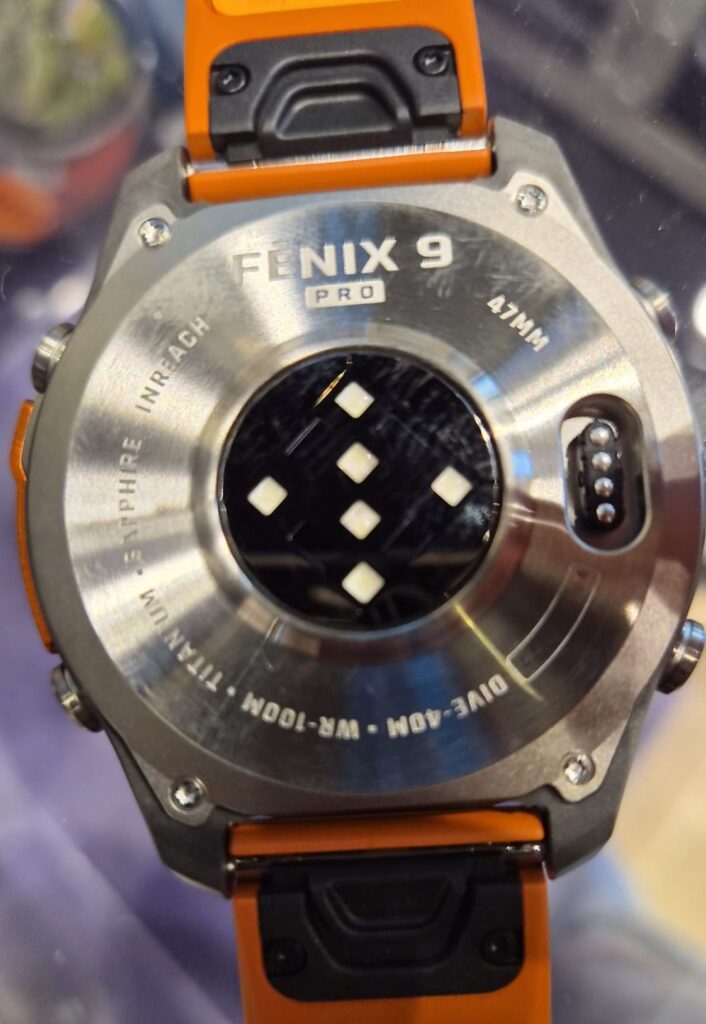
The new fēnix 9 lineup has barely had time to reach the headlines, yet there is already another question that deserves attention, and it has very little to do with GPS accuracy, AMOLED brightness or how many days the watch can run between charges. It has to do with Garmin battery replacement: what happens several years after spending four figures on one of Garmin’s most expensive sports watches, when the battery that made all of those impressive features possible inevitably begins to lose capacity.
Garmin officially introduced the fēnix 9 and fēnix 9 Pro on August 25, with US pricing starting at $999.99 for the fēnix 9 and $1,099.99 for the fēnix 9 Pro. Depending on the configuration, size, connectivity and band, the price climbs considerably higher, with a 51 mm fēnix 9 Pro with inReach reaching $1,399.99 in the United States. Garmin itself describes the new watches as premium multisport GPS smartwatches designed for athletes and adventurers, and the specifications certainly justify positioning them at the high end of the market.
That price makes the question of long term ownership considerably more important than it would be with a $200 fitness tracker. If a watch costing $1,000 or more eventually develops a worn battery after several years of daily use, most owners would probably expect battery replacement to be a fairly ordinary maintenance procedure, particularly when the rest of the watch is still working perfectly.
The reality surrounding Garmin battery replacement is considerably more complicated.
Garmin Battery Replacement Is Not as Simple as It Should Be
Garmin’s own US support documentation says that its watches use rechargeable lithium ion batteries that are not user replaceable, which is not the same thing as saying Garmin will never service a battery, but it does establish an important distinction between a conventional replaceable battery and the sealed battery system used in these watches. Garmin’s general support documentation similarly explains that many of its fitness devices have batteries that are not user replaceable.
Garmin’s service policy is also more nuanced than simply saying every failed battery results in a new watch. The company’s official exchange documentation says that, depending on the product and problem, Garmin may repair or replace a specific component, while in other cases the original product may need to be exchanged for an identical or equivalent product. In other words, there is no blanket public promise that a customer with an aging battery will receive a straightforward battery replacement inside the watch they already own.
That distinction matters because there are numerous owners who say their experience was not a battery replacement at all, but a replacement watch, sometimes for a substantial fee.
There is also an important complication that makes this story more interesting rather than less interesting. Some Garmin support pages for older models and certain regions have explicitly described a battery replacement through Garmin’s RMA process. Garmin’s Spanish support page for the fēnix Chronos, for example, says that while the battery is not user replaceable, a new battery can be replaced through Garmin’s RMA process.
That means the responsible conclusion is not that Garmin has universally banned battery replacement, because the evidence does not support such a sweeping statement. The stronger question is why customers in different markets and with different models can encounter such dramatically different outcomes when they ask the same basic question, namely whether they can keep their expensive watch and simply replace its aging battery.
The Problem Becomes More Obvious When the Watch Costs $1,400
The timing of this discussion is difficult to ignore because Garmin has just launched a generation of watches that pushes the premium pricing argument even further.
The US launch price for the fēnix 9 starts at $999.99, while the fēnix 9 Pro starts at $1,099.99, and some of the most expensive Pro configurations reach $1,399.99. The new generation brings a titanium case on the Pro, AMOLED displays, advanced navigation, training features, inReach connectivity on selected models and battery life measured in weeks rather than days.
Those are impressive specifications, but they also change the conversation around battery life.
When you spend $1,399.99 on a sports watch, the battery is not an accessory that can simply be ignored when it begins to degrade. It is one of the fundamental components that determines whether the watch remains useful. The screen can still look perfect, the buttons can still work, the GPS can still be accurate, the case can still be in excellent condition and the sensors can still function exactly as they did when the watch was new, yet a deteriorated battery can eventually turn the entire product into a problem.
That is where the issue becomes particularly frustrating for owners who bought Garmin because they expected a sports watch designed to last.
Owners Have Been Asking Garmin About This for Years
This is not a complaint that appeared with the fēnix 9 launch. Garmin owners have been discussing battery replacement for years, and some of the most revealing conversations can be found on Garmin’s own forums.
One particularly relevant discussion on the official Garmin forum was started by a fēnix 7 Pro owner who wanted to keep the watch for many years and asked whether the battery could eventually be replaced rather than throwing away the entire device. The concern was straightforward, the owner understood that lithium ion batteries wear out and wanted to know what would happen when that eventually occurred. The discussion produced replies from owners who had replaced batteries themselves, while another participant described the official battery replacement situation as essentially nonexistent for Garmin watches. Read here the Garmin forum discussion about the Fenix battery replacement program.
Another Garmin forum discussion is even more revealing because owners were actively trying to find replacement batteries for older fēnix watches, comparing third party batteries, part numbers and the risks involved in opening the watch. One user described spending about €120 on parts and several weekends trying to replace batteries in older Garmin watches, only to eventually pay Garmin around €200 for a replacement service on another device. Read the forum discussion here.
The frustration is easy to understand. If the battery itself can be purchased for a relatively small amount, but replacing it safely requires taking apart a waterproof sports watch, finding the correct battery, dealing with adhesives and seals, and accepting the possibility of damaging the device, the official service route becomes extremely important.
The United States Has the Same Basic Problem
For American buyers, Garmin’s own support documentation does not offer the kind of simple battery service promise that many consumers might expect from an expensive electronic product.
Garmin’s US support page states that the rechargeable lithium ion battery in its watches is not user replaceable. The company directs customers toward troubleshooting and support when battery performance becomes abnormal, rather than presenting battery replacement as a normal consumer maintenance procedure.
That does not mean every American customer will necessarily receive the same response from Garmin support, and there are reports of Garmin offering replacement watches or special service arrangements depending on the circumstances. What it does mean is that there is no simple public message saying that an owner of a premium fēnix can bring the watch in after several years, pay a standard battery replacement fee and receive the same watch back with a new battery.
That is a meaningful difference when compared with the expectations many people have for a product that can cost more than a laptop.
One American owner who discussed the issue in 2025 described trying to revive an older fēnix 5X after its battery had deteriorated, eventually attempting a battery replacement after watching a repair video. The owner reported that the process was possible, but the discussion also highlighted the concern about waterproofing and the fact that official support may instead offer a discount or replacement route. Read the forum discussion here.
There is another important American perspective in the broader discussion, because not every Garmin owner is unhappy with the company’s support. A 2026 post from a long time user describes Garmin offering an out of warranty replacement for an Epix 2 after an initial $190 charge, eventually resolving the problem at no cost.
That is worth mentioning because it shows why this issue cannot fairly be reduced to saying that Garmin always treats customers badly. Some owners have had excellent experiences with Garmin support, while others have received expensive replacement offers or no service at all, depending on the device, the market, the age of the watch and the specific failure.
The inconsistency is part of the story.
Europe Shows Just How Complicated the Situation Can Become
The most striking examples I found came from Europe, where the conversation about repairability is becoming increasingly important because of new European battery regulations.
One Portuguese owner of a fēnix 6X Sapphire documented an especially frustrating experience with Garmin Iberia. After a previous battery failure had resulted in a replacement watch, the same owner contacted Garmin again in July 2025 after another battery failure. Garmin initially quoted €201.67 for a replacement. The situation then changed, and according to the customer’s account, Garmin later said that the replacement was no longer possible and offered a discount toward a new fēnix 8 instead. Read the forum discussion here.
That is exactly the kind of case that makes the economics of ownership uncomfortable. The customer had an otherwise functional watch with a battery problem, yet the proposed solution moved from replacing the device for €201.67 to buying a newer generation with a discount.
Another European owner reported a similar situation with a Garmin 965, saying that after roughly three years the battery had degraded to the point where the watch lasted only around 25 minutes, while Garmin was asking €180 for the service. The owner considered the cost excessive relative to a watch that had originally cost around €600 and began considering competing brands instead. Read the forum discussion here.
Then there is an even newer case from August 2026, this time involving Garmin Czech. A user reported that a Garmin watch had worked for approximately two and a half years before the battery failed, after which Garmin reportedly replied that it no longer serviced the equipment and could not offer a newer replacement with a favorable surcharge. The owner described the situation as effectively turning a several hundred euro watch into electronic waste after only a few years. Read the forum discussion here.
The important detail here is that these are individual customer reports, not evidence of a universal Garmin policy across Europe, but when several independent cases produce similar complaints, they become relevant to the broader discussion.
Singapore Customers Were Asking the Same Question
The issue is not limited to Europe. In Singapore, a Garmin customer wrote about visiting a Garmin flagship store in 2023 and specifically asking what would happen when the battery in a fēnix or Forerunner eventually deteriorated. According to the customer, the sales representative said the watches were not battery replaceable because opening them could compromise the water seal, and that the practical solution would eventually be buying another watch.
The customer described being shocked by the answer, particularly because the price of models such as the fēnix 7 and Forerunner 965 made the idea of treating them as disposable products difficult to accept.
The discussion became particularly interesting because other users pointed out that Garmin’s approach can involve replacing the entire watch rather than physically replacing the battery, while others said that support quality appeared to vary considerably between Garmin regions. Read the forum discussion here.
That regional variation is important, because it means the same Garmin watch can effectively have a different repair story depending on where the owner lives.
Australia Has the Same Question, With Third Party Repair Filling the Gap
Australian owners have also been asking about battery replacement for years. One owner looking for a battery replacement for a fēnix 6X Sapphire in Sydney said the understanding at the time was that Garmin did not support battery replacement directly, while users pointed toward third party repair and DIY options instead.
More recently, an Australian based repairer began openly advertising Garmin battery replacement and button repair services for older watches, including fēnix models. The existence of independent repairers is significant because it shows that the technical problem is not necessarily impossible to solve, even when official support does not offer the same type of service.
The downside is obvious, however. Once a waterproof sports watch is opened by a third party, the owner has to think about seals, water resistance, battery quality and the skill of the person performing the repair, which is a very different proposition from sending a $1,000 watch to the manufacturer for a standard battery replacement.
India Shows Why the Second Hand Market Matters
The issue becomes even more relevant when you stop looking only at original owners and start thinking about the second hand market.
An Indian buyer considering a three year old Garmin Forerunner 955 Solar asked whether a used device made sense when the new watch cost substantially more locally. One of the responses pointed out that Garmin does not offer the kind of battery replacement service that would allow the buyer to treat the battery as a separately maintainable component, making the age of the used watch an important factor in determining whether the deal was worthwhile.
This is where the issue becomes much bigger than a repair question.
A used Garmin that is three or four years old may look like a great deal when compared with the price of a new model, but the buyer is also buying into the remaining life of the battery. Two watches that look identical from the outside can therefore have very different values if one has a relatively fresh battery and the other is approaching the point where battery performance becomes unacceptable.
Without a clear and predictable battery service option, that uncertainty becomes part of the price.
Some Owners Are Simply Replacing the Batteries Themselves
The online Garmin community has not been completely passive about the problem. There are numerous examples of owners opening older fēnix watches and replacing the battery themselves, sometimes successfully. One fēnix 6 Pro owner reported buying a replacement battery for around $20 and restoring the watch after the original battery had completely failed.
Another owner described replacing the battery in a fēnix 5X and continuing to use the watch, while other owners have reported less successful attempts that resulted in damage to the device.
The existence of these repairs is useful evidence, but it should not be interpreted as a recommendation that everyone should open a Garmin watch at home. A sports watch is designed to survive sweat, rain, swimming and, in some cases, serious water exposure, so replacing a battery is not simply a matter of opening a plastic case and dropping in a new cell.
The fact that some owners can do it successfully does, however, raise a legitimate question about why the official repair path is not clearer and more consistent.
There Are Even YouTube Videos Showing That It Can Be Done
The repair community has documented the process visually as well. This detailed video walks through the removal of the bezel, display, vibrator module, mainboard and battery before reinstalling the components and testing the watch. It has accumulated more than 60,000 views, which gives some indication of how much interest there is in keeping older Garmin watches alive rather than simply replacing them.
Another video documents the replacement of an aging fēnix 5X battery and explains why the owner chose to repair a watch that was already several years old instead of throwing it away.
I did not find a strong, clearly identifiable YouTube video from a customer specifically documenting a Garmin support complaint in the same way as the Reddit cases above, so I would not manufacture that connection. The repair videos are nevertheless useful to readers because they demonstrate that the battery is physically replaceable, even if official service options can be more complicated.
The EU Battery Rules Make This Even More Interesting
There is another reason this issue deserves attention right now. The European Union’s new battery regulation contains provisions stating that portable batteries incorporated into appliances should be removable and replaceable by the end user by 2027, subject to the regulation’s conditions and exceptions. The stated goal is to support a more circular economy, reduce waste and give consumers a better ability to keep products in service.
This does not mean that every Garmin watch currently sold in Europe is automatically illegal because its battery is not user replaceable, and it would be irresponsible to make that claim without examining the precise scope, implementation dates and exemptions that apply to a specific product.
What it does mean is that the direction of European regulation is moving toward longer product life and greater battery replaceability, while Garmin owners are already asking why an expensive sports watch cannot simply have its battery replaced. The timing could hardly be more interesting.
A Battery Can Outlive the Product, or the Product Can Outlive Its Battery
Garmin has always had a strong argument when it comes to battery life. A fēnix can run for weeks where many mainstream smartwatches need charging every day or two, and that makes Garmin particularly attractive to runners, hikers, cyclists and people who spend extended periods away from a charger.
The irony is that long battery life can create an entirely different expectation. When a customer buys a Garmin because it is supposed to be a durable sports instrument, that customer may reasonably expect the watch to remain useful for many years. A battery that lasts two weeks or a month between charges is impressive when new, but it is still a lithium ion battery, and lithium ion batteries age.
Eventually, the question is not whether the battery lasted 14 days, 20 days or 30 days when the watch was new. The question becomes whether the owner can economically replace that battery when its capacity has fallen far enough that the original product is no longer practical. That is why the battery replacement policy should be considered part of the product, not an afterthought.
What This Does to the Second Hand Garmin Market
This may ultimately be the most important consequence. The second hand market depends on buyers being able to estimate the remaining useful life of a product. That is relatively easy with a mechanical watch, where a service can often keep the movement operating for decades. It is more complicated with a smartphone, but at least battery replacement has become a familiar part of ownership.
With a Garmin sports watch, the calculation can be much less predictable. A three year old fēnix may still have years of useful life left in its processor, display, GPS hardware, sensors and case, but if the battery has already lost a significant portion of its original capacity, the buyer may be looking at a much shorter practical lifespan.
The result is a strange situation in which an older Garmin can be perfectly functional but still become difficult to sell at a reasonable price because the buyer knows that a battery problem could turn into a several hundred dollar or several hundred euro service decision. That puts downward pressure on the value of used Garmin watches, particularly older premium models.
The irony is that this can also encourage people to replace perfectly functional hardware with newer hardware, simply because keeping the old watch alive is too uncertain or expensive.
Garmin Does Not Have a Simple Global Answer
After looking across the available documentation and owner reports, I would not describe Garmin’s policy as a simple worldwide ban on battery replacement.
That claim would be too broad. Garmin’s US documentation clearly says that batteries in its watches are not user replaceable, while its general service policy allows for either component repair or device exchange depending on the product and problem. Some regional Garmin support pages have explicitly described battery replacement through an RMA process, while owners in other markets report being offered replacement watches, discounts or no service at all.
That inconsistency is actually more troubling than a simple yes or no policy because consumers should not have to search through years of forum posts to understand what will happen when the battery in a $1,000 sports watch reaches the end of its useful life.
A premium product should come with a premium ownership experience, and that should include a clear answer to a very basic maintenance question.
The fēnix 9 Makes the Question Harder to Ignore
Garmin is asking customers to spend up to $1,399.99 in the United States for the most expensive fēnix 9 configurations, while promising advanced navigation, training features, premium materials, satellite connectivity and long battery life. None of those features change the basic chemistry of the battery inside the watch.
Five years from now, the software may still work, the titanium case may still look excellent and the GPS may still be perfectly capable, but the battery will inevitably have experienced thousands of hours of use and charging cycles.
If Garmin offers a straightforward and reasonably priced battery service for that watch, the concern becomes much smaller. If the practical answer for a large number of customers is to surrender the old watch and pay hundreds of dollars for another device, the economics look very different.
At that point, the real price of a $1,399.99 Garmin is not simply $1,399.99. It is the purchase price plus the uncertainty surrounding what happens when the component most likely to age first finally reaches the end of its useful life.
Garmin Owners Are Not Asking for Something Unreasonable
The strongest criticism I found from Garmin owners was not that the company should make batteries removable by the user in every watch, nor that a waterproof sports watch should be designed like a smartphone with an easily accessible battery compartment.
The request is much simpler. Owners want Garmin to provide a reliable, transparent and reasonably priced way to keep an otherwise functional watch alive when the battery wears out. That could mean replacing the battery inside the original watch, providing a manufacturer serviced replacement with a clearly published price, or offering a certified refurbishment program with enough information about the replacement device and its battery condition to make the decision worthwhile.
What frustrates people is uncertainty. One owner may receive a replacement watch for a reasonable fee, another may be offered a discount on a new model, another may be told the product is no longer supported, while another may discover that a regional Garmin service center still offers an RMA battery replacement.
For a company selling premium sports watches, that should not be a mystery.
The Real Test of a Premium Garmin May Come Years After You Buy It
The launch of the fēnix 9 is naturally about everything the new watch can do today, but perhaps the more interesting question is what Garmin will allow owners to do with it several years from now.
The company has built a reputation around endurance, reliability and products designed for people who spend time in demanding environments. That makes the concept of an expensive watch becoming economically disposable because of a worn battery particularly uncomfortable.
There is no evidence that every Garmin watch may become electronic waste after three or five years, and there are plenty of owners who continue using their watches successfully for much longer. Some users have even managed to replace batteries themselves and keep old fēnix models running for years.
The problem is that consumers should not have to be lucky, technically skilled or willing to risk damaging a waterproof watch just to extend the life of a product they already paid a premium price for.
Garmin has just launched a watch that can cost as much as $1,399.99 in the United States. The next question should therefore be much simpler than any of the technical specifications Garmin announced yesterday.
When the battery finally wears out, what exactly does Garmin expect the owner to do?
That answer may ultimately tell us more about the true value of the fēnix 9 than another week of battery life ever could.